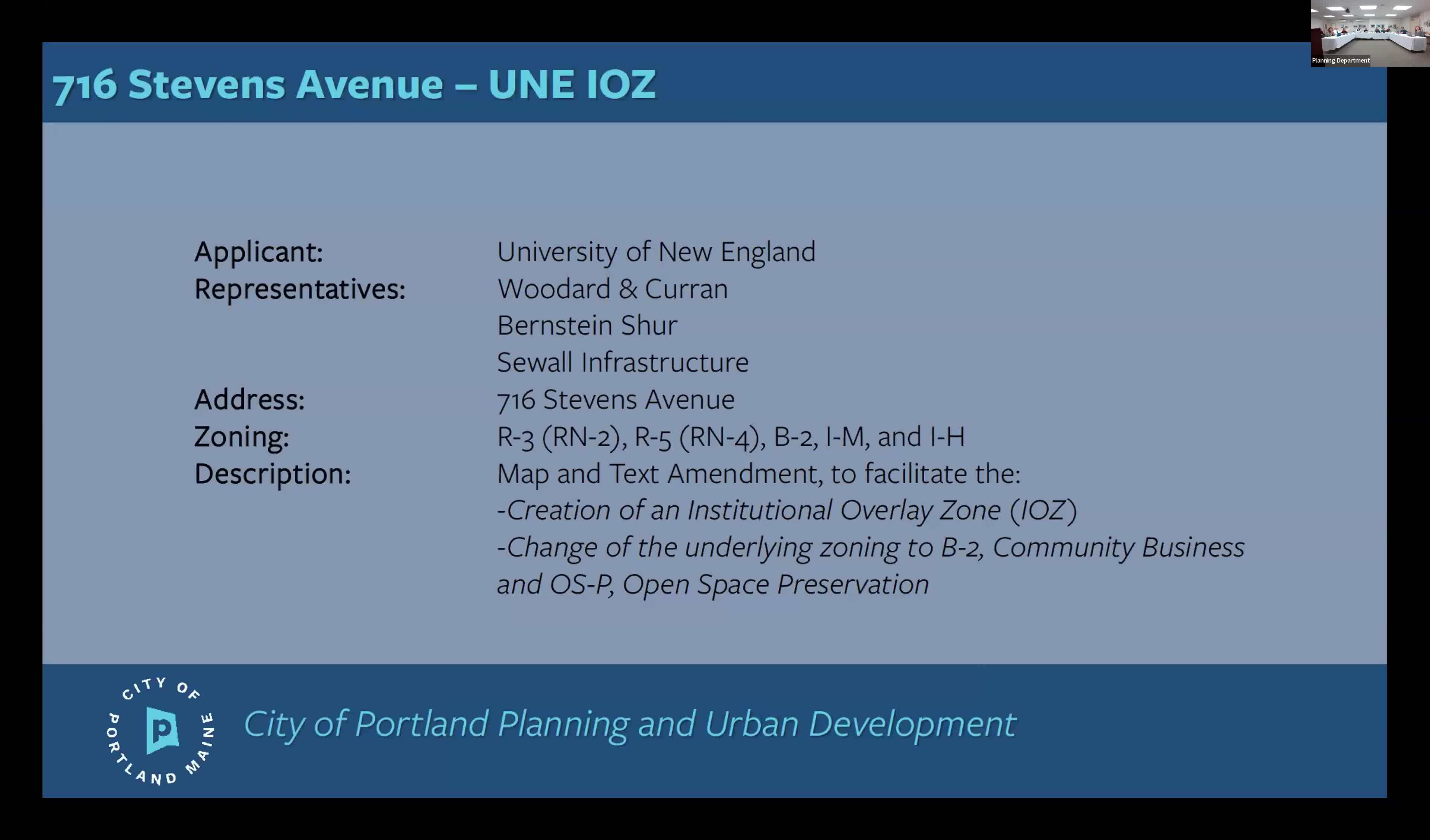
Planning Board recommends approval of Institutional Overlay Zone for University of New England, including open‑space protections and height map
Loading...
Summary
The Planning Board unanimously recommended that City Council adopt an Institutional Overlay Zone for the University of New England’s Portland campus, including an Institutional Development Plan, regulatory framework and an open‑space/maximum‑height map with explicit open‑space protections.
The Portland Planning Board on Feb. 25 recommended City Council adopt an Institutional Overlay Zone (IOZ) for the University of New England (UNE) Portland campus, including the institutional development plan (IDP), a regulatory framework and a revised open‑space and maximum‑height map.
Planning staff summary and board review Natasha (planning staff) summarized the record: the applicant seeks a map and text amendment to create an IOZ that rezones portions of the UNE campus to B2 (Community Business) and OSP (Open Space Preservation) and establishes an IDP and regulatory framework to guide anticipated campus growth. The board reviewed two prior workshops (Nov. 12, 2024 and Jan. 28, 2025) and staff’s redlined Chapter 14 text changes for the regulatory framework.
Key elements and changes - Open space designation and maximum‑height map: the IDP and regulatory framework were revised after the January workshop. The latest map designates roughly 10 acres of the campus as OSP to preserve natural resources and buffers. Staff and the applicant adjusted a previously triangular transition area to a 50‑foot height buffer and added a 25‑foot offset in places to strengthen the transition to adjacent neighborhoods.
- 85‑foot maximum areas: the proposed IOZ identifies two campus areas where an 85‑foot maximum height could apply in future development scenarios. One area is a rectangular parcel envisioned for student housing (the applicant referenced a 7‑story, roughly 350‑bed building as a financing scenario). Another 85‑foot area near Bishop Street is intended to offer flexibility for future athletic or academic facilities and potential structured parking.
- Community engagement and appendices: UNE supplied two neighborhood meetings (June 13, 2024 pre‑submittal and Oct. 30, 2024 post‑submittal). The applicant also added UNE’s lighting and signage standards as appendices to the IDP, which staff said would streamline review of future campus projects.
Applicant presentation Caitlin Soar (Gordon & Kern) and Alan Thibault (UNE vice president of operations) said revisions responded to board input and community concerns. Caitlin emphasized the IDP’s role as a proactive planning document and noted that the regulatory framework contains community engagement commitments and development standards that will govern future site plan reviews.
Board action and vote The planning board voted unanimously to recommend City Council: (1) adopt the B2 and OSP zoning map amendment for the UNE Portland campus; (2) find the IDP consistent with the IDP standards (Land Use Code §8.3.4); (3) adopt the IOZ boundary for UNE; and (4) find the proposed regulatory framework consistent with the regulatory standards (Land Use Code §8.3.5). Each motion passed by roll call.
Why it matters: The IOZ creates a long‑term regulatory structure for UNE’s Portland campus, balancing potential campus growth with protections for natural resources, transitions to neighborhoods and commitments to community engagement. The recommended 85‑foot areas are limited to specific parts of campus but provide the university flexibility for larger future facilities.
Next steps: The Planning Board’s recommendation goes to City Council for first read and public hearings (tentatively scheduled for spring). Council will hold its own public comment opportunities before any adoption.