Get Full Government Meeting Transcripts, Videos, & Alerts Forever!
Get email alerts on the Housing And Homelessness topic
No spam. Unsubscribe anytime.
Committee reviews governor’s middle‑housing and infill bill proposing statewide legalization and incentives for affordable and accessible units
Summary
House Bill 2138 (dash 1) would expand middle‑housing allowances, reduce process barriers, and create a density bonus to incentivize affordable and Type A accessible units. The committee heard detailed agency and stakeholder testimony March 3.
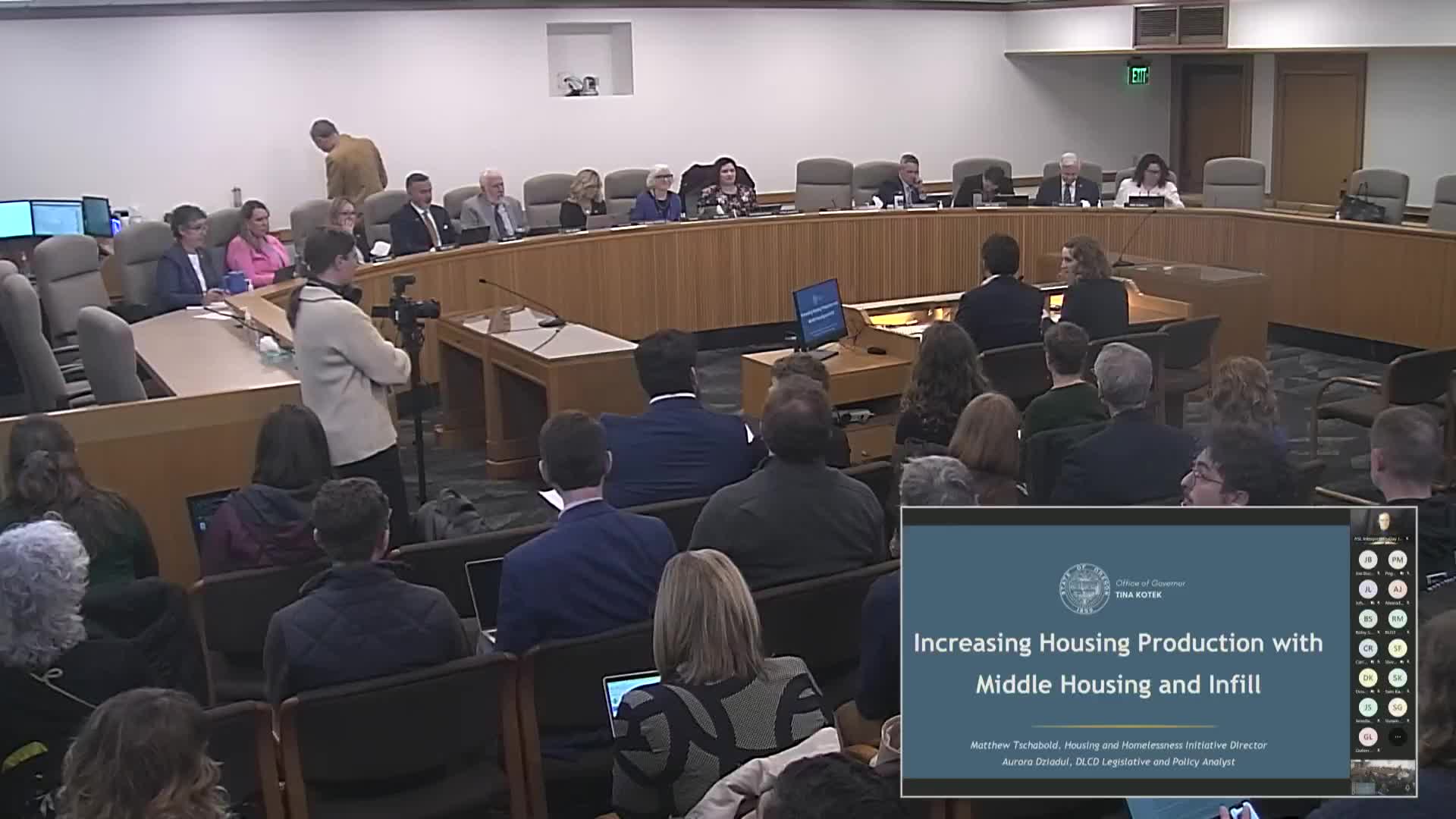
The House Committee on Housing and Homelessness held a public hearing March 3 on House Bill 2138, the governor’s middle‑housing and infill policy bill (dash‑1 amendment). Agency staff and dozens of stakeholders testified about proposals to legalize additional middle housing across urban areas, streamline land‑division processes, limit certain off‑site exactions for small infill projects, and offer a statewide density bonus to incentivize affordable or Type A accessible units.
Matthew Schawbold, director of the Governor’s Housing and Homelessness Initiative, and Aurora Jettl of the Department of Land Conservation and Development (DLCD) presented the bill’s goals and technical elements. Jettl summarized the statewide housing shortfall: a current deficit of about 100,000 units and an estimated need of roughly 400,000 additional units over the next 20 years, with 89% of the current deficit concentrated among households at or below 80% area median income.
Schawbold said the bill’s core goals are to legalize middle housing in more urban areas, eliminate development barriers that apply to middle housing but not to single‑family housing, and create incentives so builders provide affordable or accessible units. Among changes are directives to legalize middle housing on urban unincorporated lands subject to urban services capacity, require cities to allow middle housing on lots with existing single‑family homes or ADUs, and invalidate private restrictions that bar middle housing. The bill also proposes optional consolidation of subdivision and middle‑housing land‑division processes and would remove some notice and appeals requirements for middle‑housing land divisions.
On incentives, the dash‑1 amendment rewrites the affordable and accessible housing bonus: developers who provide at least one Type A accessible unit or one unit sold at an affordable price point to income‑qualified buyers would receive additional density (one or two extra units), a mechanism intended to push both market and mission developers toward accessible or affordable production.
Supporters from the building and development community, including the Oregon Home Builders Association, Hides Homes, FISH Construction and others, urged passage as a means to accelerate production and reduce regulatory delay. Mike Riddle, president of the Oregon Home Builders Association, said, “This is a step in the right direction” to reduce approvals delays and outdated policies that slow housing delivery.
Cities and local governments — represented by the League of Oregon Cities, the City of Hillsboro, Lake Oswego’s mayor, and others — testified with caution or neutrality. Their concerns centered on sections that would limit certain exactions (for example, traffic impact exactions for single infill projects) and a requirement to translate land‑use allowances into clear, objective urban service standards (water, sewer, stormwater, transportation). Cities requested clarifying language to preserve the ability to require proportionate public improvements for safety and resilience and warned that repeated statutory changes force additional local code updates and staff workload.
Other witnesses, including Central Oregon Land Watch, local chambers of commerce and disability advocates, supported the bill or its amended incentives. The Oregon Council on Developmental Disabilities highlighted incentives for accessibility and noted the bill does not itself change building code accessibility standards but aims to increase Type A units through bonus density.
Committee members asked a series of technical questions about demolition review language, the cap before a traffic study is allowed, and how clear and objective standards for urban services would be defined. Schawbold said several provisions were being reworked for the next amendment, including a full rewrite of the bonus, removal of an overly broad down‑zoning prohibition, and removal of the cottage‑cluster courtyard requirement as drafted. The committee did not vote; public testimony was extensive and the record was left open for further written comments.