Get Full Government Meeting Transcripts, Videos, & Alerts Forever!
Get email alerts on the Corporate Activity Tax topic
No spam. Unsubscribe anytime.
Senate committee hears competing views on raising Oregon's corporate activity tax thresholds
Summary
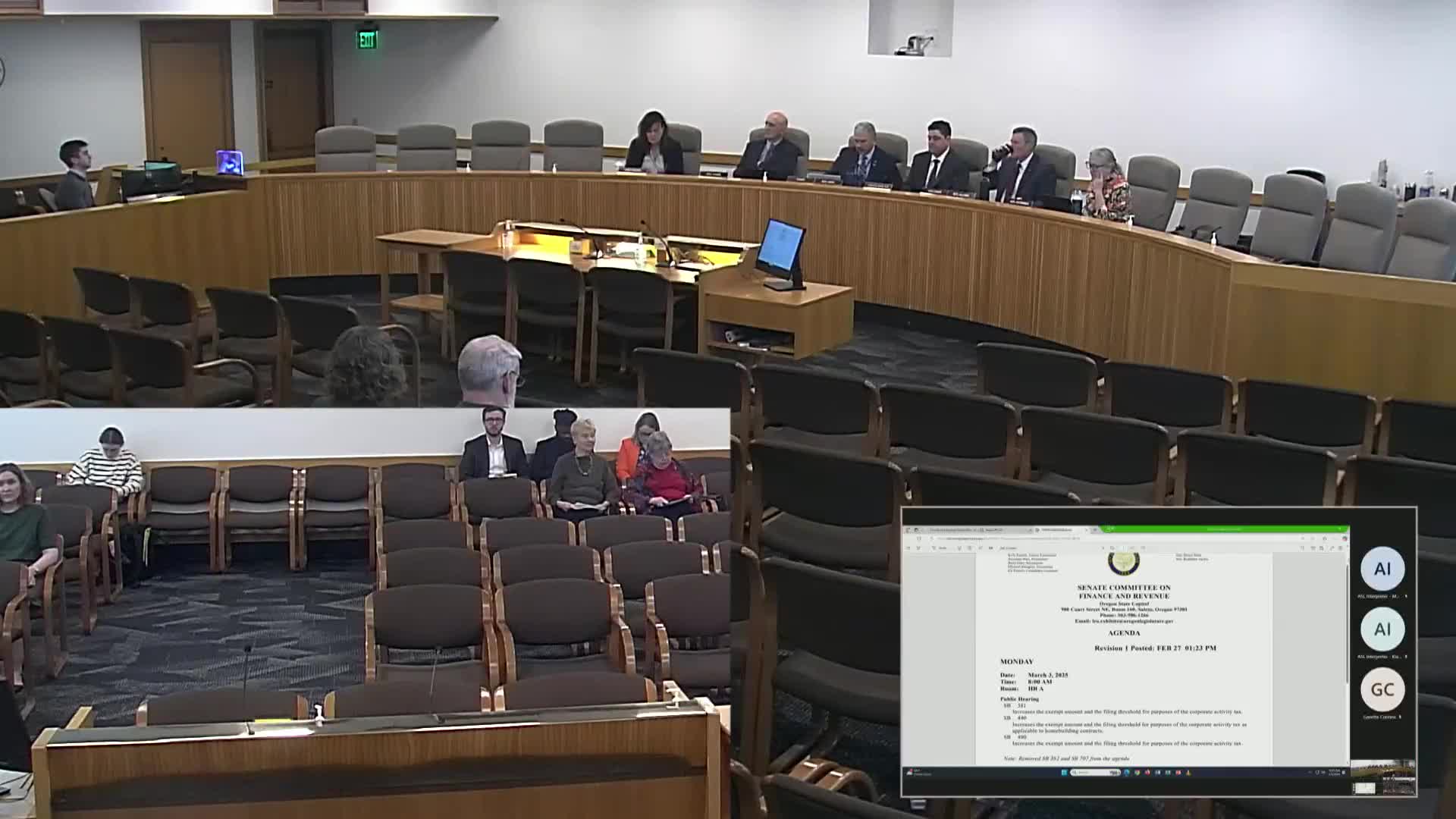
The Senate Committee on Finance and Revenue opened public hearings March 3 on bills that would raise Oregon's corporate activity tax (CAT) exemption thresholds, drawing support from business groups and opposition from education and labor representatives worried about lost Student Success Act revenue.
The Senate Committee on Finance and Revenue opened public hearings March 3 on bills to raise exemption thresholds for Oregon's corporate activity tax. Chair Meek said the committee would take testimony on Senate Bill 381 and Senate Bill 490 simultaneously because they are "exactly the same bill," then later opened a hearing on Senate Bill 440.
Sen. Suzanne Weber, sponsor of SB 381 and SB 490, told the committee the change would raise the CAT exemption from $1,000,000 in commercial activity to $5,000,000 and described the adjustment as "a very, very modest adjustment" aimed at helping high-volume, low-margin local businesses recover from recent years of inflation and pandemic disruptions. "This will be a lifeline to many Oregonian businesses who are still trying to pull themselves out of the pain of the beginning of this decade," Weber said.
Supporters said the change would deliver immediate relief to many small firms while leaving most CAT revenue intact. Anthony Smith, Oregon state director for the National Federation of Independent Business, said raising the threshold to $5,000,000 would exempt roughly "70% ish of current CAT filers" while representing only about 6.5% of total CAT revenue. He said the original $1,000,000 threshold has produced "pyramiding effects" that have hurt small operators.
Megan Perona, co-owner of ARE Manufacturing in Newberg, described her companyas a 40-employee family-owned CNC contract machine shop that last year paid about $13,000 in CAT. "If we were able to keep that $13,000 in our company ... we would be able to put that money directly back into our community," Perona said.
Derek Singston, policy director and counsel for Oregon Business & Industry, cited Legislative Revenue Office data and said the proposed change would exempt more than 14,000 of Oregon's smallest businesses while preserving "over 93% of the $1,200,000,000 generated for schools during the 2022 tax year." Jody Weiser of Tax Fairness Oregon supported the idea of relief but urged lawmakers to identify pay-fors, suggesting adjustments to the CAT rate or the deduction structure.
Education and labor representatives urged caution or opposed the bills unless changes were revenue neutral. Louis Stitzer (testifying for the Oregon Education Association) said SB 381, SB 490 and SB 440 would represent "massive structure changes" to the CAT and argued that stakeholders from education, business and other sectors should negotiate offsets. Stacy Mickelson of the Oregon School Boards Association said Student Success Act dollars fund behavioral health staff, school meals and services for students with significant needs and warned that any change without an offset would reduce funding available to schools.
Lamar Wise, political director of Oregon AFSCME, said raising the exemption would "significantly reduce the amount of revenue available for education" and could force the state to backfill with cuts or shifts affecting public services and employees. Marcia Kelly of the Oregon Women's Rights Coalition urged that any carve-outs for home builders be crafted so they do not subsidize higher-cost houses and again pressed for revenue neutrality.
Sen. David Brock Smith, sponsor of SB 440 with Sen. Anderson, described SB 440 as raising the filing and taxability threshold for amounts received from home-building contracts to $10,000,000 for licensed construction contractors. He framed the proposal as a way to reduce tax-related costs tied to large subdivisions or developments to encourage more housing construction. Committee members asked whether the bill requires the housing built under the exemption to be affordable; Brock Smith said SB 440 does not include affordability requirements.
Committee members asked staff to provide additional historical and fiscal context. Sen. Taylor requested an informational review of the state's business tax history and how business contributions to the General Fund have changed over several decades. Chair Meek closed the public hearing on SB 381, SB 490 and SB 440 and said the committee will continue CAT-related work in a follow-up meeting scheduled for March 5 at 8 a.m.
Votes: The committee took no formal votes during the March 3 hearing. No amendments or actions were adopted.