Get Full Government Meeting Transcripts, Videos, & Alerts Forever!
Get email alerts on the Cryptocurrency Reserve topic
No spam. Unsubscribe anytime.
Committee hears sponsor testimony on Ohio Strategic Cryptocurrency Reserve Act; sponsors stress safeguards and custodial rules
Summary
House Bill 18 would allow the state treasurer to invest in high-value digital asset exchange-traded products under specified safeguards. Sponsors told the Technology and Innovation Committee the measure grants but does not mandate investment and would require qualified custodians, market-cap thresholds and other security measures.
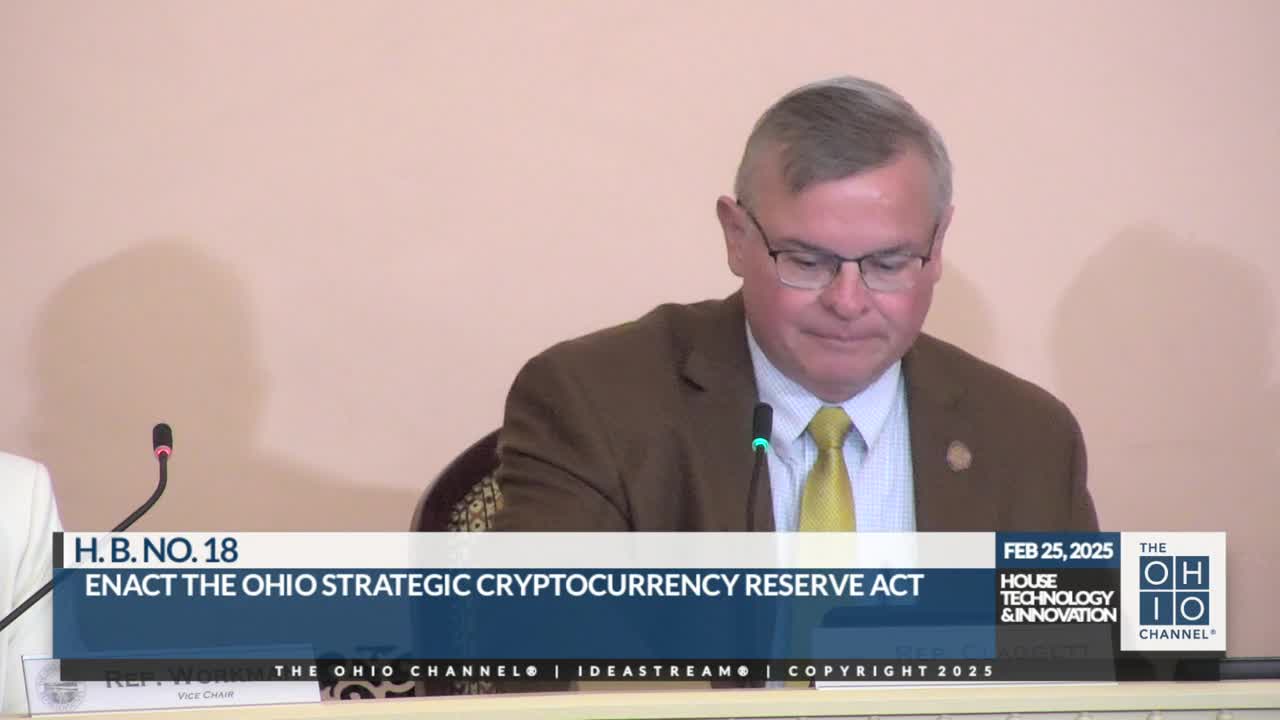
The House Technology and Innovation Committee on Wednesday heard sponsor testimony on House Bill 18, the "Ohio Strategic Cryptocurrency Reserve Act," a proposal to authorize the state treasurer to invest state funds in high-value digital-asset exchange-traded products under specific safeguards.
"This legislation is straightforward. It grants but does not mandate the treasurer of the state to invest in high value digital assets in the general or reserve fund," Representative Demetrio told the committee during sponsor testimony, laying out the bill’s objectives and safeguards.
The bill’s author said HB18 would require institutional custody and top-tier security measures rather than allowing management through consumer trading apps or smartphones. The text sets a market-capitalization threshold of $750,000,000,000 for eligible exchange-traded products; the sponsor said that under the bill as drafted Bitcoin would currently be the only cryptocurrency meeting that benchmark.
Sponsors described additional safeguards in the draft: use of qualified custodians such as banks or institutional custodial services, restrictions designed to avoid "meme coins," and a governance or advisory structure to help guide the treasurer’s decisions. Representative Demetrio said the bill would not force pensions to invest but would clarify that state retirement systems are permitted to invest in exchange-traded products tied to digital assets.
Committee members questioned the measure’s financial and security risks and the potential impact on pensions. Ranking Member Mohammed asked about financial risk and security protocols; Demetrio pointed to reduced volatility in exchange-traded products compared with earlier cryptocurrency trading and reiterated the plan for institutional custody. Representative Cockley asked whether private keys would be held digitally and, if so, whether that created a backdoor risk; Demetrio described cold-storage custody options and said the treasurer’s office is working with the bill’s drafters on technical custody language.
Representative White asked whether pension funds would receive investment returns if they participated; Demetrio said pension returns would remain for pension members and reiterated that the bill clarifies, rather than mandates, pension investment authority. Members also raised concerns about federal policy changes and potential effects on state-held assets; Representative Ferguson urged provisions or structures that preserve state control.
Sponsors said they are in ongoing discussions with the treasurer’s office and expect to file technical amendments or a substitute bill after that consultation. No formal committee vote was recorded; the hearing was a first-step policy discussion intended to refine language and custody provisions.
Representative Demetrio and several members described the issue as one that will require additional technical input from custodians, the treasurer’s office and outside experts as the bill is developed.