Get Full Government Meeting Transcripts, Videos, & Alerts Forever!
Get email alerts on the Digital Id topic
No spam. Unsubscribe anytime.
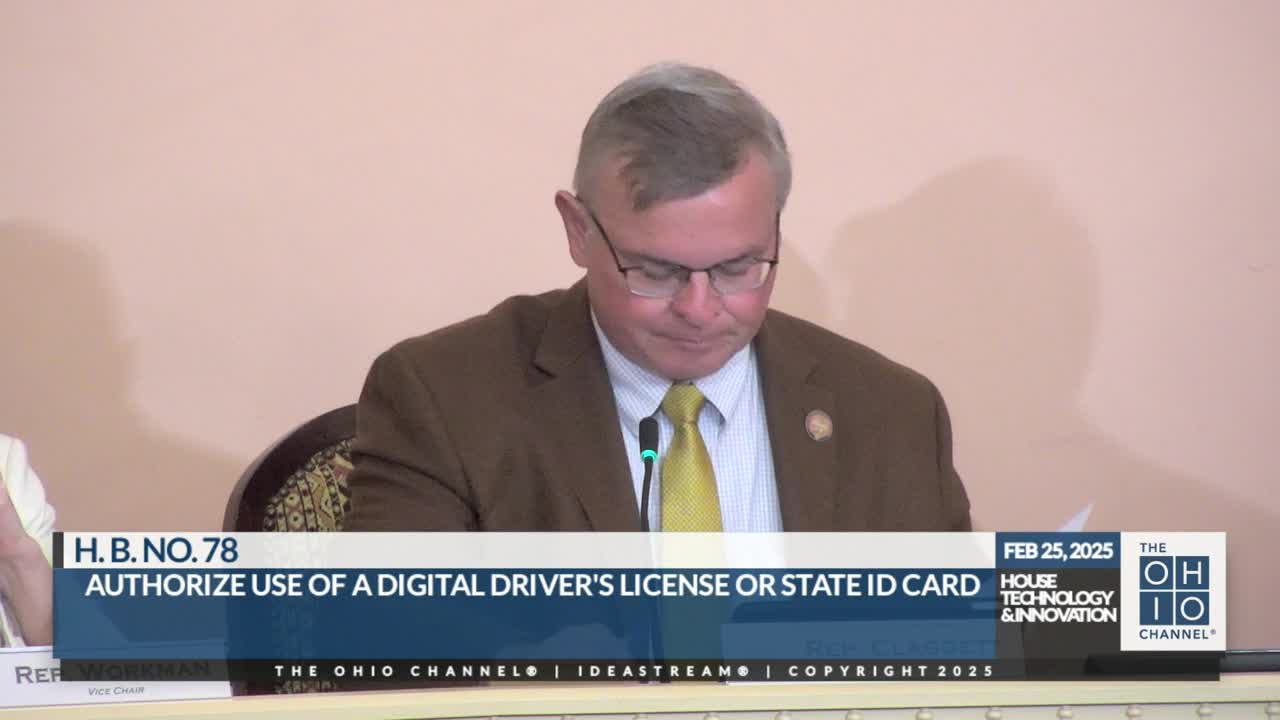
Committee adopts amendment clarifying digital driver’s licenses not valid for voting in first hearing on House Bill 78
Summary
The House Technology and Innovation Committee on Wednesday held a first hearing on House Bill 78, a measure to authorize a statewide digital driver’s license and state identification program and require the registrar of motor vehicles to implement security and identity-verification procedures.
The House Technology and Innovation Committee on Wednesday held a first hearing on House Bill 78, a measure to authorize a statewide digital driver’s license and state identification program and require the registrar of motor vehicles to implement security and identity-verification procedures. The committee adopted an amendment clarifying that a digital driver’s license or state ID cannot be used for voting.
The amendment (AM1360123) was offered by Vice Chair Workman and, without objection, was incorporated into HB78. "This amendment is from the sponsor of the legislation. It makes several small changes to the text of the bill in order to specify that a digital driver's license or state ID cannot be used for voting purposes," Vice Chair Workman told the committee before members accepted the change.
The bill’s sponsors, Representative Joe Miller and Representative Hall, told the panel HB78 would expand existing digital-ID functionality beyond the Apple Wallet pilot announced by the governor. "This bill would require the registrar of motor vehicles to establish a program that provides for the use of a digital ID by Ohio residents," Miller said, adding the bill would require encryption of information transmitted to mobile devices and permit the registrar to receive an image (a selfie) to verify the license holder’s identity.
Under the bill, a person would be required to retain a valid physical ID while obtaining a digital ID, and the registrar must maintain procedures to identify expired, suspended or revoked credentials. Sponsors also said the bill would allow the registrar to support all smartphone types rather than the Apple-only pilot currently in use.
Committee members focused on security and practical use cases. Representative White asked whether requiring a physical ID and a digital ID would raise costs or require people to carry both at the same time. Representative Joe Miller said the intent is to validate the physical card during enrollment and then allow users to rely on the phone, similar to moving a credit card into a digital wallet.
Representative Ortman asked about whether the digital ID could carry health information or be used by hospitals; sponsors said the bill as drafted did not include provisions specifically authorizing health-data transmission and that they are willing to work with members and to refine language in rules to match legislative intent.
Sponsors and members also discussed device support for non-Apple phones. Representative Hall noted Google Wallet is available on some Android devices and said the bill’s language is intended to enable broad device support.
No formal committee vote on final passage of the bill occurred; the committee held a first hearing and accepted the amendment. The committee chair closed the hearing after questions and public testimony.
The hearing record shows sponsors and members emphasized security, device compatibility and preserving existing voting-ID rules as the measure moves to further review and possible amendment in rules.