Get Full Government Meeting Transcripts, Videos, & Alerts Forever!
Get email alerts on the Consumer Protection topic
No spam. Unsubscribe anytime.
Consumer advocates urge bans on high‑pressure marketing, raise concerns about consolidated billing and submeters
Summary
The Ohio Consumers' Counsel and other witnesses supported HB15's consumer protections but urged additional limits on door-to-door and high-pressure marketing, questioned utility-supplied consolidated billing for suppliers and sought protections for residents served by submeters.
Consumer advocates told the House Energy Committee that provisions in House Bill 15 protecting consumers are welcome but need strengthening, especially on marketing practices, consolidated billing and the treatment of submetered customers.
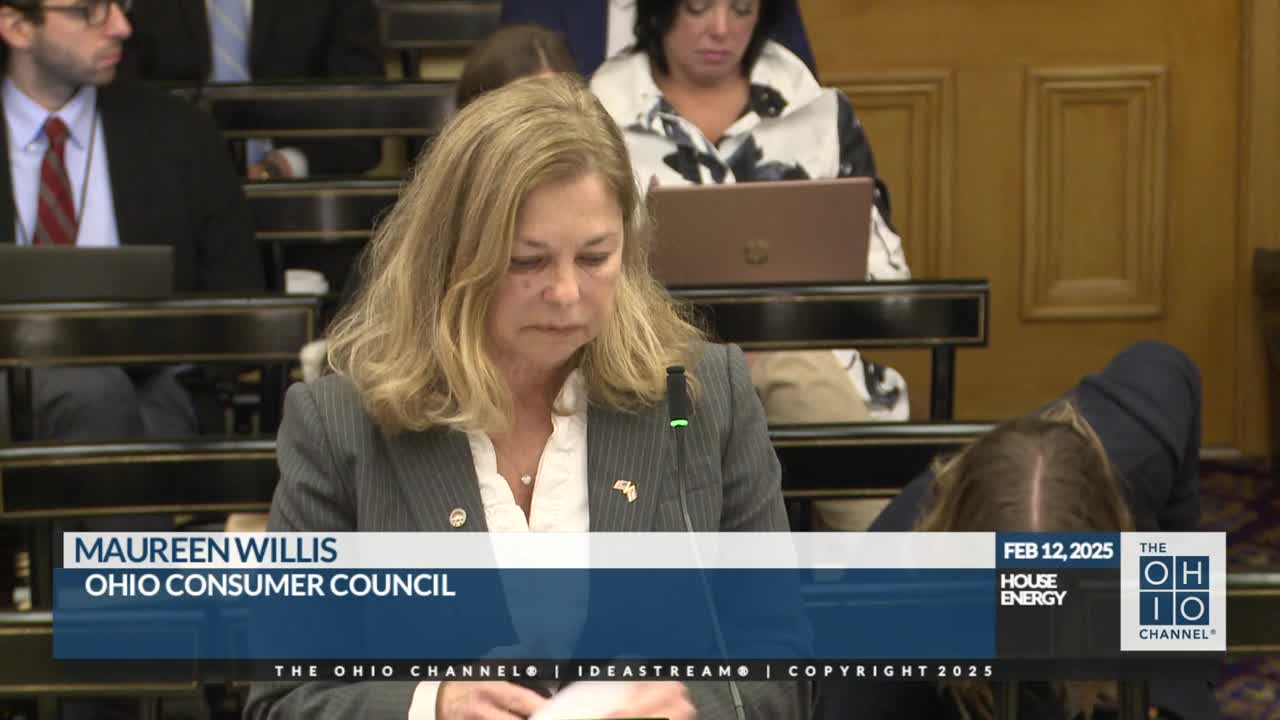
Maureen Willis, director of the Ohio Consumers' Counsel, said the office represents the state’s residential utility customers and supports HB15’s market emphasis, but urged a ban on door‑to‑door energy sales. “Consumers don't want to be hounded when they're at home,” Willis said, and she described numerous complaints and manipulative marketing practices she has seen in commission filings.
Willis criticized a proposed consumer choice billing system as duplicative if customers indirectly subsidize its development: “Marketers should pay for the development of that system. There's no reason why consumers should be paying for it.” She also warned that the bill’s consolidated-billing provisions could place nonregulated third parties in control of billing for monopoly distribution and transmission services.
Several lawmakers and witnesses raised submetering concerns: Willis said utility regulators have treated submeters as nonpublic utilities, leaving customers with fewer protections on disconnection, rate limits and program access. She noted anecdotal reports of low‑income tenants evicted over submeter charges.
Retail suppliers and generators said they support stronger bonding and transparency for suppliers to reduce bad actors, and several suppliers argued that direct supplier billing can enable innovative products and services for customers. Arnie Quinn of Vistra said choice billing can allow suppliers to offer tailored programs such as off‑peak pricing or targeted bill-relief pilots that are harder to run when the utility is the only biller.
Witnesses urged clearer notice requirements, opt‑in language and limits on what data can be shared, so customers know when a contract ends and can make informed choices without being exposed to high‑pressure sales or data‑privacy risks.