Get Full Government Meeting Transcripts, Videos, & Alerts Forever!
Get email alerts on the Hb15 topic
No spam. Unsubscribe anytime.
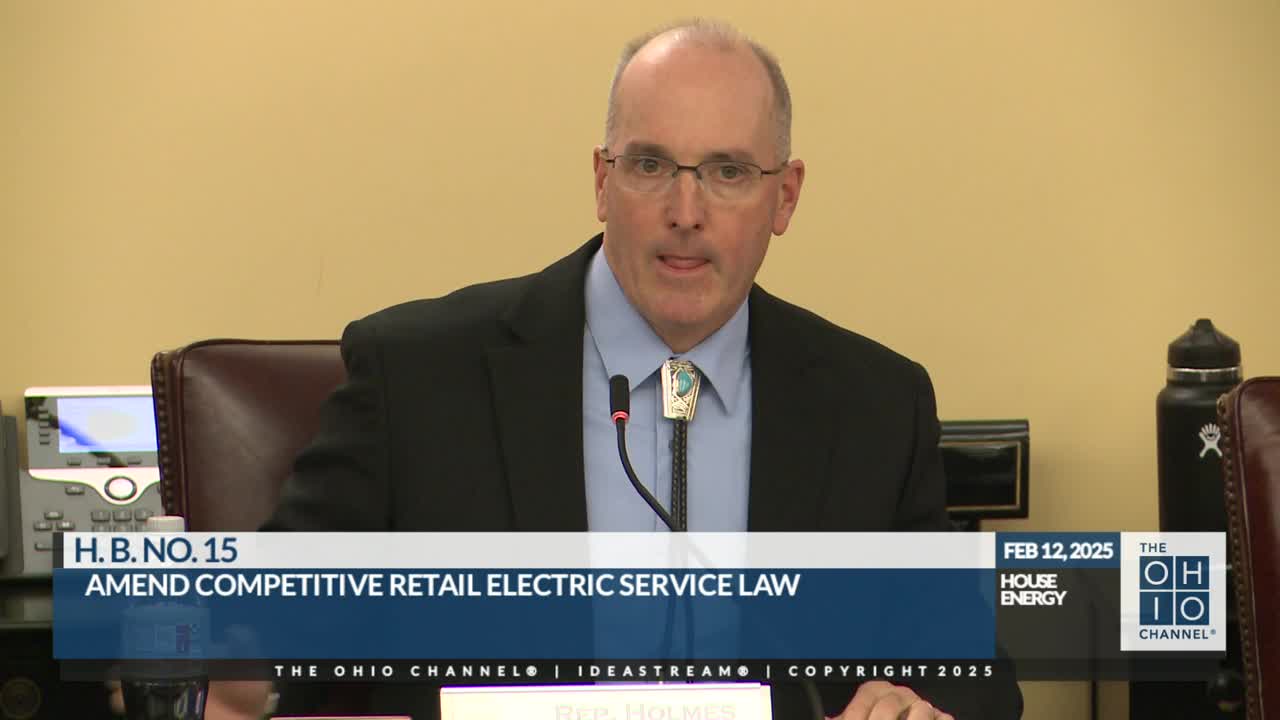
Ohio House Energy Committee hears wide-ranging testimony on House Bill 15 to restore competitive power markets
Summary
The Ohio House Energy Committee heard proponent testimony on House Bill 15, a bill that would end electric security plans, bar utilities from owning generation and repeal several legacy-generation subsidies.
The Ohio House Energy Committee heard proponent testimony on House Bill 15, a bill that would end electric security plans, bar utilities from owning generation and repeal several legacy subsidies for generation.
Supporters from consumer, industry and energy groups told the committee the bill would restore wholesale market forces and lower costs for customers. Maureen Willis, director of the Ohio Consumers' Counsel, said the measure “continues to rely on the market forces and not regulation for supplying electricity to consumers.” Willis added, “HB15 ends the coal plant subsidies that are vestiges of HB6.”
Proponents said the bill would return default service procurement to competitive bidding and preserve a standard service offer as a safety net for nonshopping customers. Melvin Nickerson, director of government affairs for NRG, said, “competitive markets are working abundantly, robustly for Ohio,” and called the bill “a pro consumer bill that aims to keep number 1, electricity costs low and 2, it drives customer benefits through competition.”
Industry witnesses said eliminating state-specific taxes and subsidies would incentivize investment. Arnie Quinn, senior vice president for regulatory policy at Vistra, told the committee that shifting the burden of new generation investment to shareholders rather than ratepayers is a key advantage of the bill: “shareholders are going to bear the burden of new generation investment, not ratepayers.” Kim Boyko of the Ohio Manufacturers Association cited data she said shows large cumulative savings from competition and urged immediate repeal of OVEC subsidies.
But witnesses also urged amendments and clarifications. Consumer advocates asked for stronger protections around supplier marketing and consolidated or “choice” billing. Several trade groups and energy lawyers asked the committee to ensure that ending electric security plans would not unintentionally terminate reliability or economic-development programs that many large industrial users rely on.
The hearing brought multiple requests for more transparency and technical fixes: better heat maps of transmission capacity, clearer interconnection and siting rules for co-located or behind-the-meter generation and a consistent date or mechanism for elimination of legacy subsidies. Committee members and testifiers repeatedly cited PJM, the Public Utilities Commission of Ohio and FERC in discussions of market functioning and oversight.
The hearing recorded only proponent testimony and no formal committee votes. Proponents asked the committee to advance HB 15 subject to technical amendments to preserve critical reliability programs and to add consumer protections in supplier and consolidated-billing rules.