Get Full Government Meeting Transcripts, Videos, & Alerts Forever!
Get email alerts on the Vision Zero topic
No spam. Unsubscribe anytime.
Portland committee hears GPCOG Vision Zero plan, councilors weigh formal adoption
Summary
Greater Portland Council of Governments presented its Vision 0 action plan to the Portland Sustainability and Transportation Committee; committee members asked for local analysis and signaled support for a council resolution to adopt the plan, with staff to return with a draft.
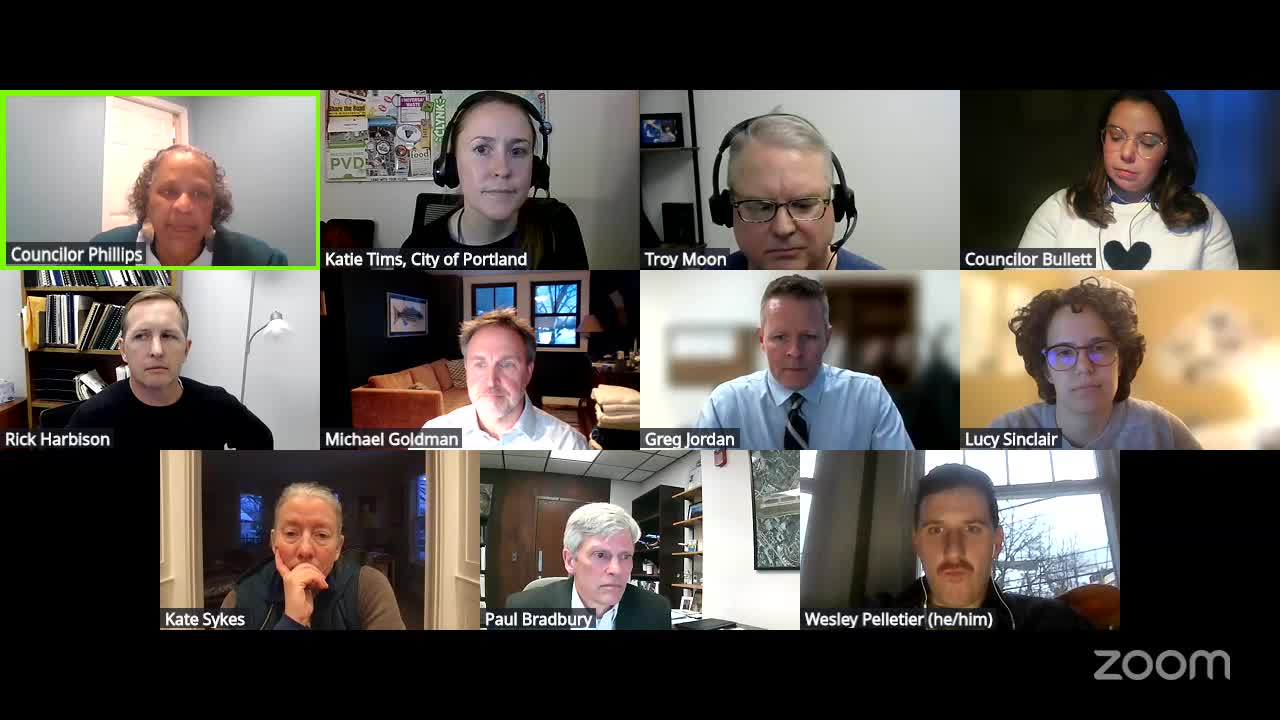
Greater Portland Council of Governments (GPCOG) on Wednesday presented its Vision 0 action plan to the Portland City Council’s Sustainability and Transportation Committee, outlining a regional strategy to eliminate traffic fatalities and serious injuries by 2045 and recommending a menu of evidence-based roadway, speed and programmatic measures.
The plan’s authors said the initiative focuses on redesigning streets and lowering speeds to prevent deaths and severe injuries — not only on changing individual behavior. “Vision 0 is a strategy to eliminate all traffic fatalities and severe injuries while increasing safe, healthy, equitable mobility for all,” said Lucy Sinclair, data analyst at GPCOG. Rick Harvison, planner at GPCOG, described data tools used to identify “critical safety corridors and intersections” where countermeasures will yield the most benefit.
Committee members and city staff pressed for Portland-specific follow-up. Assistant City Manager Greg Jordan said staff would return to the committee next month with a draft resolution and a preliminary implementation roadmap, including options for a more aggressive time frame if the council prefers one.
GPCOG staff described an 18-month planning effort that included five objectives aligned with USDOT’s Safe System approach: safer roads, safer speeds, safer people, safer vehicles and post‑crash care. The region’s plan identifies 94 critical corridor segments and 18 intersections in the Portland area, and recommends treatments ranging from enhanced crosswalk visibility and pedestrian refuge islands to roundabouts, which GPCOG’s materials cite as producing as much as a 78% reduction in fatal and severe crashes at certain intersections.
Presenters told the committee the regional Vision 0 plan costs about $135,000 to prepare, covers roughly 30 member communities under GPCOG’s action plan, and that adopting the regional plan locally would not, by itself, obligate new city funding; rather, staff time and project costs would follow as specific projects are proposed. GPCOG also highlighted federal funding programs tied to a Vision 0 or Safe System approach, including the Safe Streets and Roads for All (SS4A) grant program created through the Bipartisan Infrastructure Law.
Councilors asked for more Portland-focused analysis and regular reporting. Councilor Kate Sykes requested that crash data and follow-up appear in future committee updates so members know whether collisions resulted in fatalities or survivable injuries. Councilor Anna Bullitt said she favored adopting the GPCOG plan to avoid duplicative work, while reserving the option to add Portland-specific elements if the council wants them.
GPCOG staff said local adoption could be done by formal council resolution and is flexible: the city could accept GPCOG’s regional plan as a foundation, add local actions, or pursue a faster target year than 2045. Staff noted that some federal funding opportunities may require an adopted Vision 0 action plan to qualify.
The committee did not take a formal vote on a resolution at the meeting but directed staff to return next month with a draft resolution and implementation options for council consideration.
Portland averages about 2.6 traffic fatalities and roughly 26 serious injuries per year based on the 11-year period GPCOG reviewed; presenters said the region records about 5,580 crash-involved people per year across the reporting period. GPCOG staff encouraged targeted interventions on the highest‑injury corridors rather than across-the-board changes where crash risk is low.
Committee Chair Regina Phillips thanked GPCOG for the presentation and invited the agency back to the next meeting to support drafting the proposed resolution and to answer further questions about funding alignment and metrics.