Get Full Government Meeting Transcripts, Videos, & Alerts Forever!
Get email alerts on the Township Funding topic
No spam. Unsubscribe anytime.
Township officials urge Legislature to preserve marijuana host-community fees, seek larger cemetery grant funding in HB 96
Summary
Directors from the Ohio Township Association and the Mahoning County Township Association told the House Agriculture Committee HB 96 should preserve the host community cannabis fund and boost cemetery grant revenue; witnesses also asked the Legislature to increase burial-permit fees and retain local zoning authority over adult-use operators.
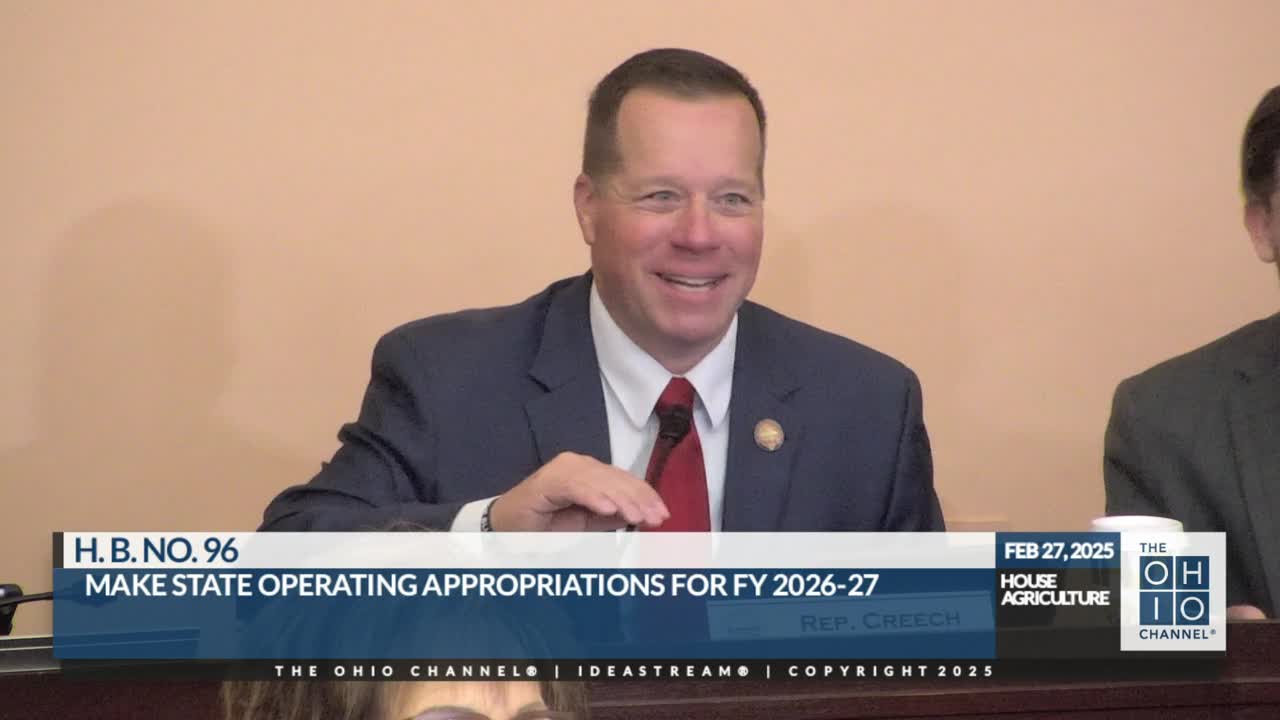
Chairman Creech and members of the Ohio House Committee on Agriculture heard testimony from township leaders on how provisions in House Bill 96 would affect local services, cemeteries and recently legalized adult-use cannabis arrangements.
Kyle Brooks, director of governmental affairs for the Ohio Township Association, told the committee HB 96 “essentially maintains funding for townships in Ohio,” but asked lawmakers to do more to close a persistent funding gap for cemetery care. Brooks said townships are responsible for maintaining roughly 2,400 cemeteries and that the Ohio Revised Code requires townships to provide protection and preservation for cemeteries under their jurisdiction. He said the state’s cemetery grant program, administered by the Ohio Department of Commerce, saw demand outstrip available funds: “For fiscal year 2024, over 316,000 was requested statewide, while only 104,000 was available,” Brooks said, and asked the committee to increase the burial-permit fee so more revenue flows to the cemetery grant fund.
Brooks said HB 96 as introduced raises the burial-permit fee from $3 to $4.50 to support Department of Commerce duties tied to cemetery registration under “chapter 47 67,” and that the OTA supports that increase but requests a $6 fee with $1.50 dedicated to the cemetery grant program.
Robert John Santos, president of the Mahoning County Township Association and vice chair of Austintown Township, urged the committee to preserve the host-community portion of the adult-use cannabis tax. Santos invoked Issue 2’s ballot language about the 10% excise tax and its allocations and said repeated changes would disregard voters’ intent: “Any changes to this effectively regards the measure and the will of the people,” he said. Santos told lawmakers many townships permitted dispensaries because the expected revenue share would finance roads, safety services and other local projects without levies.
Witnesses pressed that the proposed removal of the host-community fund in RC 3780.23 and any limits on local control would leave townships without both revenue and the zoning authority they relied on when consenting to dispensaries. Brooks said roughly 134 licensed dispensaries existed in the state’s Division of Cannabis Control roll, with 45 located in townships; Santos estimated individual successful dispensaries can yield hundreds of thousands of dollars annually to host jurisdictions depending on sales.
Committee members asked follow-up questions about the cemetery program and how often fees had been increased; witnesses said they did not have a precise history on the record but offered to provide the information to the chair’s office. In response to questions about local impacts, both witnesses said lost host-community revenue would force townships either to reallocate money from other priorities — for example, delaying road paving — or ask residents for levies.
No committee votes were taken during the testimony. The committee appointed Representative Cockley as committee secretary by unanimous consent and approved the minutes of the February 26 meeting without objection earlier in the session.