Get Full Government Meeting Transcripts, Videos, & Alerts Forever!
Get email alerts on the Net Metering topic
No spam. Unsubscribe anytime.
Lawmakers weigh raising net‑metering cap to 100 kW in HB 811
Summary
House Bill 811 would raise Montana’s net‑metering generation cap from 50 kilowatts to 100 kilowatts. Supporters said the change would help schools, libraries, municipal buildings and small businesses offset large utility bills and boost local resilience; utilities warned of cost shifts to nonparticipating ratepayers.
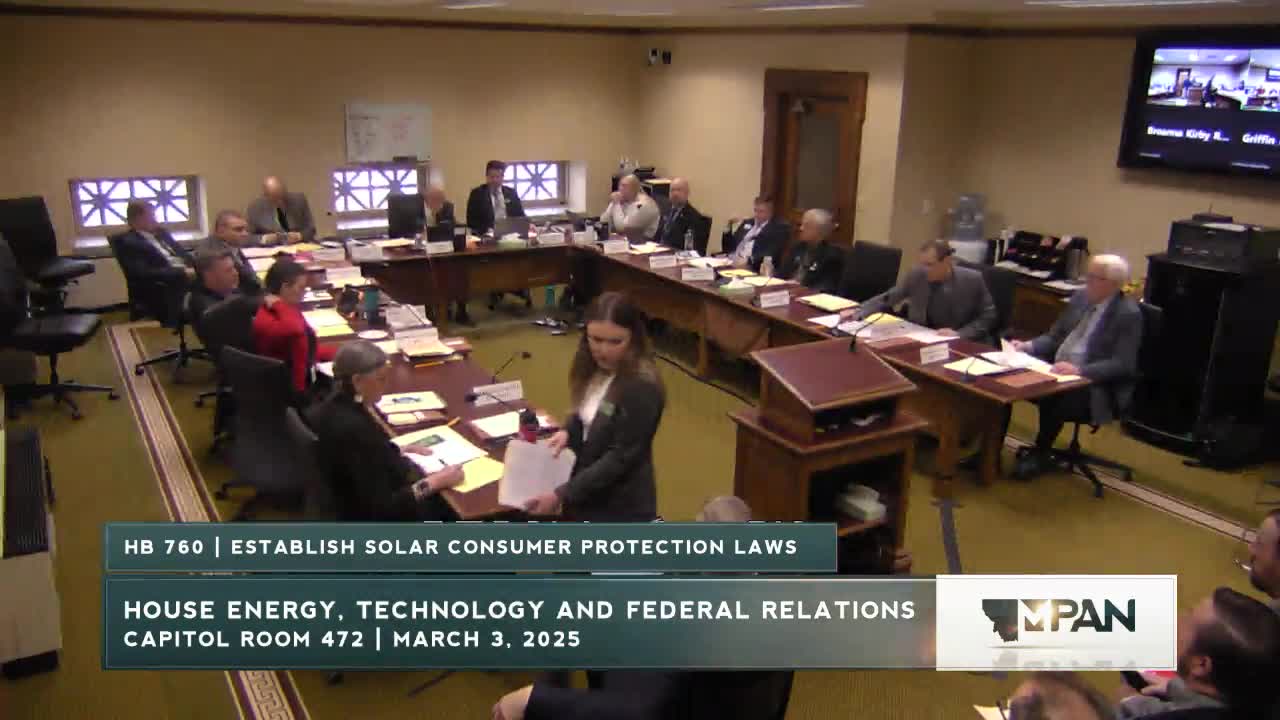
The House Energy, Technology and Government Affairs Committee held a hearing on House Bill 811, which would raise the net‑metering generation capacity cap from 50 kilowatts to 100 kilowatts for customer‑sited solar, wind or hydropower systems.
Sponsor Representative Jamie Isely of House District 58 said the bill is a “common sense” update to a cap set in 1999 and would allow larger community and institutional projects — schools, libraries, municipal buildings, churches and small businesses — to offset a greater share of their electric bills. Isely said an expanded cap could save taxpayers and create learning and job opportunities.
Supporters included the Montana Renewable Energy Association, Solar Montana, the Montana Environmental Information Center, the City of Bozeman and school representatives. McKenna Sellers of the Montana Renewable Energy Association said the two‑decade‑old 50 kW limit “no longer meets the energy needs of Montana’s small businesses, schools, and libraries” and described interconnection and safety review processes utilities already impose. Danny Hess, representing the City of Bozeman, said increasing the cap could raise the Bozeman Public Library’s offset from about 17% to roughly 33% and save about $20,000 a year; similar estimates were offered for municipal water plants.
Opponents, led by Alan Olson of Northwestern Energy, warned that net‑metered customers currently receive bill credits that effectively include components of delivery, transmission and distribution charges, creating what Olson described as a cost shift to other ratepayers. Olson said Montana’s net‑metering program already accounts for more than 60 megawatts of nameplate capacity and estimated the current cost shift at about $5,200,000 a year.
Committee members questioned both the magnitude of any cost shift and whether existing Public Service Commission proceedings or evidence warranted rate changes. Proponents said the most recent PSC analysis did not find sufficient evidence to change net‑metering rates and emphasized project‑level benefits and grid resiliency from distributed generation.
The sponsor closed by asking for a do‑pass, saying the bill “adds length to one of those prongs” of a multi‑pronged energy strategy. No committee vote was recorded at the hearing.