Get Full Government Meeting Transcripts, Videos, & Alerts Forever!
Get email alerts on the Land Use Family Transfer topic
No spam. Unsubscribe anytime.
Senate committee hears competing views on tightening family-transfer subdivision exemptions in SB 477
Summary
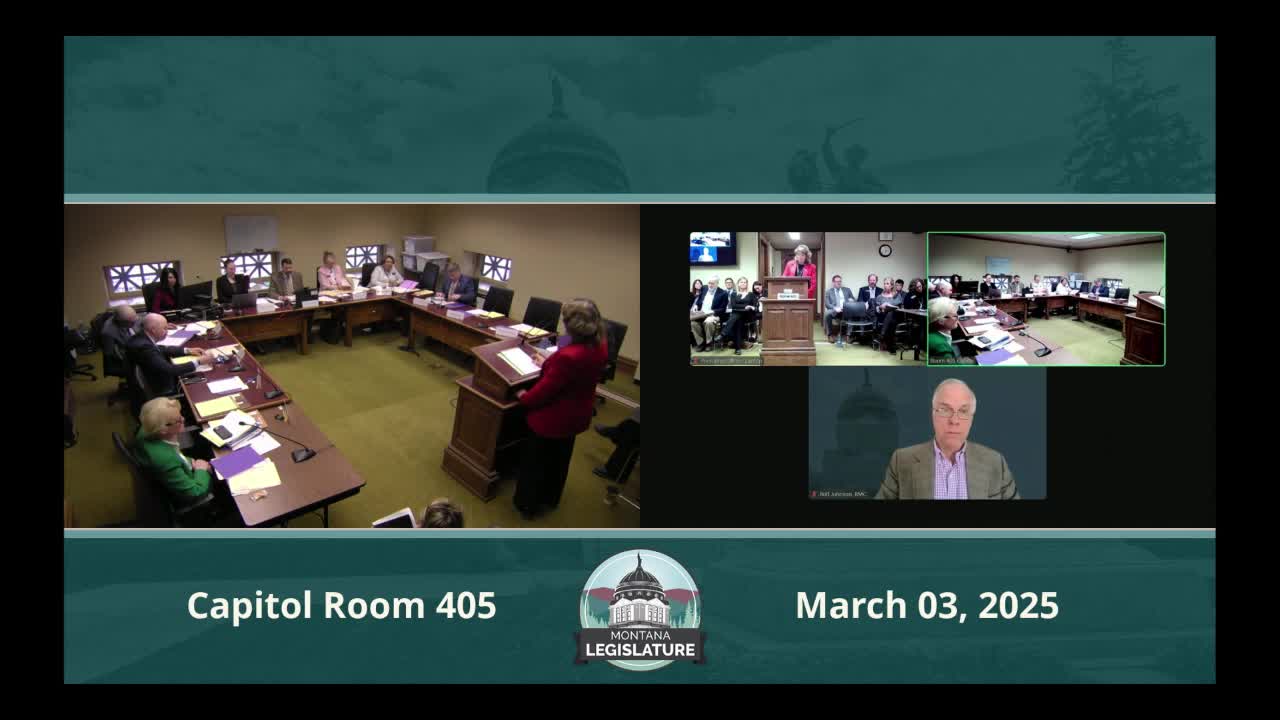
Senator Teresa Manzella, sponsor of Senate Bill 477, told the Senate Local Government Committee the bill would revise state law on divisions of land exempt from subdivision review, commonly known as family transfers.
Senator Teresa Manzella, sponsor of Senate Bill 477, told the Senate Local Government Committee the bill would revise state law on divisions of land exempt from subdivision review, commonly known as family transfers.
"We do know that the family transfer is sometimes used to subvert and evade subdivision review," Manzella said, adding the measure aims to balance property owners’ ability to transfer land within families with neighbors’ rights to notice and input.
Proponents including Alan Macki of the SAFIRE Coalition and Kathy Matranga urged the committee to adopt the bill’s public-notice and affidavit provisions. Macki described county-level patterns he called widespread: "It would appear that over 50% of the lots created in Ravalli County are through family transfer," and said a uniform affidavit would help identify transfers intended to evade subdivision review. Kathy Matranga said she and neighbors face repeated, unannounced divisions of farmland in areas with limited water supply: "I have a well that yields a meager 1.1 and a half gallons per minute," she said, and warned that additional wells could further deplete fractured-aquifer areas.
Laura Collins of the Montana Environmental Information Center supported the bill, saying family transfers "have been taken advantage of for decades" and arguing that a standardized notice, hearing and affidavit are common-sense measures used in other states to deter evasion. Collins said existing data are limited; she cited a 2017 survey that received county responses showing wide variation in counts of parcels created by family transfer and that some counties reported dozens of family-transfer lots created in a recent year.
Opponents, including Karen Alley of the Montana Association of Counties (MAKO), the Montana Building Industry (Adrienne Cotton), the Montana Bankers Association (Sam Sill), the Montana Land Title Association (Stewart Doggett) and the Montana Association of Registered Land Surveyors (Brian Thompson), argued the bill would convert an exemption into a near-subdivision process, produce costly notice obligations and create legal and lending uncertainty.
MAKO’s Alley pointed to a 20-business-day statutory deadline added in 2023 for deciding exemption applications and said a public-hearing requirement could push decisions beyond that timeline. Thompson and others said the bill’s proposed requirement to notify "each water user in the same sub-basin" could mean notifying large numbers of people and cross county lines; Thompson said in some areas that could be "thousands of people." Bankers warned the bill’s provision allowing retroactive subdivision review after lots are conveyed could render family-transfer lots unusable as loan collateral.
Committee members asked for clarifications. Senator Fern asked whether counties receive complaints on the issue; MAKO said planners and county counsel see occasional evasion questions and that local judgment criteria (common design, road networks, utility patterns) are used in evasion analyses. Committee members also asked whether extending the holding period beyond the current 2-year default might be a less disruptive alternative; proponents said that could be considered.
Executive action in committee did not advance the bill. Vice Chair Beard moved a do-pass motion that failed on a voice and proxy vote. A subsequent motion to table SB 477 carried and the bill was placed on the table.
Votes at a glance (SB 477)
- Motion: Do pass SB 477 (mover: Vice Chair Beard). Result: Failed (voice/proxy votes listed; several senators recorded as "no" by proxy). - Motion: Table SB 477 (mover: Vice Chair Beard). Result: Passed (SB 477 placed on the table).
Why it matters
Supporters say the bill would give neighbors notice and a standardized affidavit to deter transfers that effectively create subdivisions without review, and would surface concerns about water availability and infrastructure earlier. Opponents say the changes could delay legitimate family transfers, impose substantial notice costs (committee discussion cited about $9 for registered/certified mail per notice) and risk destabilizing property transactions and lending if retroactive subdivision requirements apply.
What remains unresolved
Committee discussion identified several open questions: how many family transfers occur statewide (witnesses said county tracking is incomplete and the most recent broader survey was in 2017), how to define the sub-basin notification area, how many recipients would be affected and whether a uniform attorney-general affidavit could address some concerns without adding a public-hearing requirement. The sponsor said she is open to narrowing the bill to an affidavit created by the attorney general as a compromise.
Sources and testimony
Testimony and exchanges summarized above came from the hearing record before the Senate Local Government Committee, including sworn statements by Senator Teresa Manzella (bill sponsor), Alan Macki (SAFIRE Coalition), Kathy Matranga (community proponent), Laura Collins (Montana Environmental Information Center), Karen Alley (MAKO), Adrienne Cotton (Montana Building Industry), Sam Sill (Montana Bankers Association), Stewart Doggett (Montana Land Title Association), and Brian Thompson (Montana Association of Registered Land Surveyors). The committee took executive action and tabled SB 477.
Ending
The committee left SB 477 on the table after extended testimony from landowners, environmental advocates and industry groups. Sponsors and opponents indicated interest in further drafting to address timing, notice scope and affidavit language.