Get Full Government Meeting Transcripts, Videos, & Alerts Forever!
Get email alerts on the Missing Persons Presumption Of Death topic
No spam. Unsubscribe anytime.
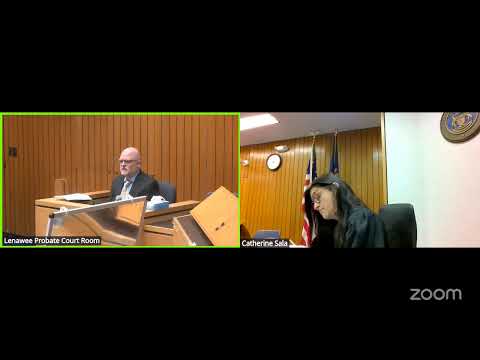
Judge hears evidence in petitions to declare three Lenawee County children legally dead
Summary
At a bench hearing in Lenawee County Probate & Juvenile Court, law enforcement testimony described the 2010 disappearance of three children and investigative steps taken since. The petitioner argued Michigan’s presumption-of-death statute controls; police described forensic leads, an Amber Alert and the later arrest of the children’s father.
LANSING, Mich. — The Lenawee County Probate & Juvenile Court on Thursday heard testimony in three consolidated petitions asking the court to declare three children — Andrew, Alexander and Tanner Skelton — legally dead and to fix the date of death at about Nov. 26, 2010.
Petition counsel opened by saying the petitions were governed by Michigan Compiled Laws MCL 700.1208(2), which creates a presumption of death when an individual has been absent and unheard from for five continuous years unless evidence establishes an earlier date. "We believe that MCL 700.1208, paragraph 2, is what controls in this matter," counsel told the judge.
The court heard lengthy testimony from Larry Weeks, then the Morenci (Mich.) police chief, who described the department’s response after the three children were not returned to their mother on Nov. 26, 2010. Weeks testified that officers found the Skelton home in disarray on arrival, including broken glass, cut electrical cords, a noose hung from an upper balcony and what investigators concluded was a suicide note.
Weeks said officers recovered items the children likely used — toothbrushes and winter coats — that John Skelton had allegedly left with relatives the morning of Nov. 26. He testified that a relative brought a laptop to police that day and that a cursory review showed email activity linking an account for a named "Joanne Taylor" to an internet protocol address commonly used at John Skelton’s Congress Street residence.
Weeks described subsequent forensic work tying the account to the Skelton residence and said investigators discovered other online activity on Skelton devices, including a surreptitious CafeMom account and searches for methods of self-harm and poisoning. He testified that cell‑tower records showed Skelton’s phone left the home area early Nov. 26, was in Ohio in the predawn hours and was back near the home before 7 a.m.
Weeks told the court he and local investigators activated an Amber Alert on Nov. 26 and that the case soon drew assistance from the FBI, the Michigan State Police and the National Center for Missing and Exploited Children. He described large coordinated searches with volunteer teams and fire departments across parts of Lenawee County and neighboring counties; he said federal evidence‑recovery teams later searched a location based on information from a tip and from Skelton’s changing statements but found nothing identifying the children.
Weeks recounted interviews in which John Skelton at various times told investigators different stories about the children’s whereabouts — including that they had been "wrapped in blankets and placed" in an old schoolhouse and a later claim that the children had been delivered to an alleged underground organization. Weeks testified that Skelton later acknowledged fabricating a "Joanne Taylor" persona used in messages to Tanya Skelton and that investigators found no corroborating evidence for the organization Skelton later described.
Weeks said law enforcement arrested John Skelton on Nov. 30, 2010; he was extradited to Lenawee County and later charged with three counts of unlawful kidnapping, one count per child. Weeks testified he eventually transferred the investigative materials to the Michigan State Police as the lead agency and that, to his knowledge, national age‑progressed images and alerts have been circulated in subsequent years.
Asked whether he believed the children were alive, Weeks testified: "I am confident they're deceased." He also testified he believed the children died on or about Nov. 26, 2010 — the date the petitions ask the court to recognize for legal purposes — but he framed that as his investigative opinion rather than a court finding.
The hearing continued with additional witnesses and documentary evidence scheduled; no final ruling on the petitions was made during the testimony presented Thursday.
Why it matters: If the court finds the statutory presumption applies and the record supports an earlier date of death, the legal status of the children’s estates, benefits and certain records could change. The petitions ask the court to apply Michigan’s presumption-of-death rule and set the date of death at about Nov. 26, 2010, rather than the statutory five‑year endpoint that would otherwise apply.
What the record shows and does not: Testimony described search warrants, forensic computer analysis linking an email account to an IP address used at Skelton’s home, cell‑tower movements and volunteer search operations. Witnesses testified that exhaustive searches and forensic work have not produced physical remains or evidence positively identifying the children since 2010. Several investigative leads described in testimony were pursued by local, state and federal agencies without locating the children.
Next steps: The bench trial will continue with additional witnesses and evidence. The court did not issue a ruling on the petitions during the testimony reported here.