Get Full Government Meeting Transcripts, Videos, & Alerts Forever!
Get email alerts on the Missing Children Skelton Case topic
No spam. Unsubscribe anytime.
State investigators tell Lenawee County court no proof Skelton children are alive; timeline exhibit admitted
Summary
Michigan State Police investigators testified in Lenawee County Probate & Juvenile Court that extensive searches and database checks produced no proof-of-life for three boys missing since November 2010. The court received a timeline as Petitioner—s Exhibit 1.
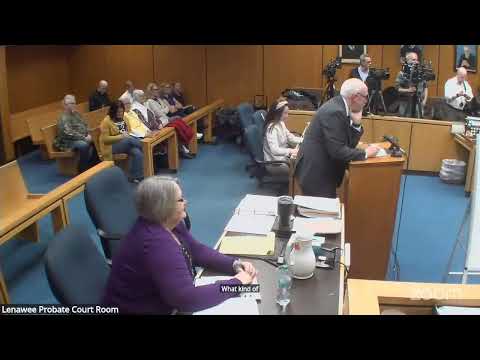
Lenawee County Probate & Juvenile Court — Michigan State Police Lieutenant Jeremy Brewer and criminal intelligence analyst Kelly Hodges testified at a court hearing that investigators have found no evidence that the three Skelton children are alive and that a timeline compiled from case files was received into evidence as Petitioner—s Exhibit 1.
The testimony summarized more than a decade of investigation into the Nov. 24—6/Nov. 26, 2010 disappearance of three boys from the Skelton household. Lieutenant Jeremy Brewer, lead investigator assigned to the case, described assembling thousands of pages of files and hundreds to thousands of tips, creating a consolidated timeline, and conducting repeated interviews with John Skelton after the Michigan State Police became the lead agency. "No doubt whatsoever," Brewer testified when asked whether he believes the children were killed on or about Nov. 26, 2010.
Brewer told the court he reviewed online activity tied to a Skelton laptop and cell-phone location pings that he said showed movement away from the residence in the early morning hours of Nov. 26, 2010 and then a period when the phone was off for roughly an hour to an hour and a half. He described testing a baseball found near the Lazy River Campground in 2015 for DNA that did not match the boys and said dive-team searches and other resource-intensive follow-ups on tips in Ohio and elsewhere produced no evidence locating the children.
Brewer described multiple investigative steps taken after he inherited the case, including numerous interviews with family members in Jacksonville, Fla.; outreach to an individual named Moses Gingrich after John Skelton told investigators in custody that a group had given him a photograph of that person; and coordination with local, county and federal partners. He said that a set of bones found in Montana in 2018 initially drew interest but were later identified as prehistoric by anthropological experts and thus not connected to the missing children.
Kelly Hodges, a Michigan State Police criminal intelligence analyst assigned to cold cases, testified she performed "proof of life" checks across about 20 databases, including federal and commercial sources and the NamUs database used for missing persons and unidentified remains. "My searches indicated nothing, just the original case report," Hodges testified, and she said her most recent searches included federal records and were completed in August 2024.
Hodges testified the department has used age-progressed photos, facial-recognition checks and national media outreach to solicit tips; those efforts produced occasional leads but none that investigators could verify as the missing boys. Brewer told the court investigators had pursued leads that ranged from mundane to improbable (including calls from psychics and mediums) and that they exhausted tips that had investigatory merit, deploying aviation, dive teams and canine resources as warranted.
The hearing record shows the court received four pages compiled as the timeline and the parties agreed to admit them together as Petitioner—s Exhibit 1. No formal decision on guilt or disposition was announced at the hearing; the testimony was admitted as part of the court proceeding and both witnesses were excused after cross- and redirect examination.
The testimony focused on investigative steps, technical results (cell-phone pings, DNA testing) and the conclusions of state investigators; it did not include a jury verdict or criminal-sentencing action within the hearing record.
Court action: the judge received the timeline materials as Petitioner—s Exhibit 1.