Get Full Government Meeting Transcripts, Videos, & Alerts Forever!
Get email alerts on the Dc Statehood topic
No spam. Unsubscribe anytime.
Committee hears testimony on HJ 18 urging recognition of D.C. statehood
Summary
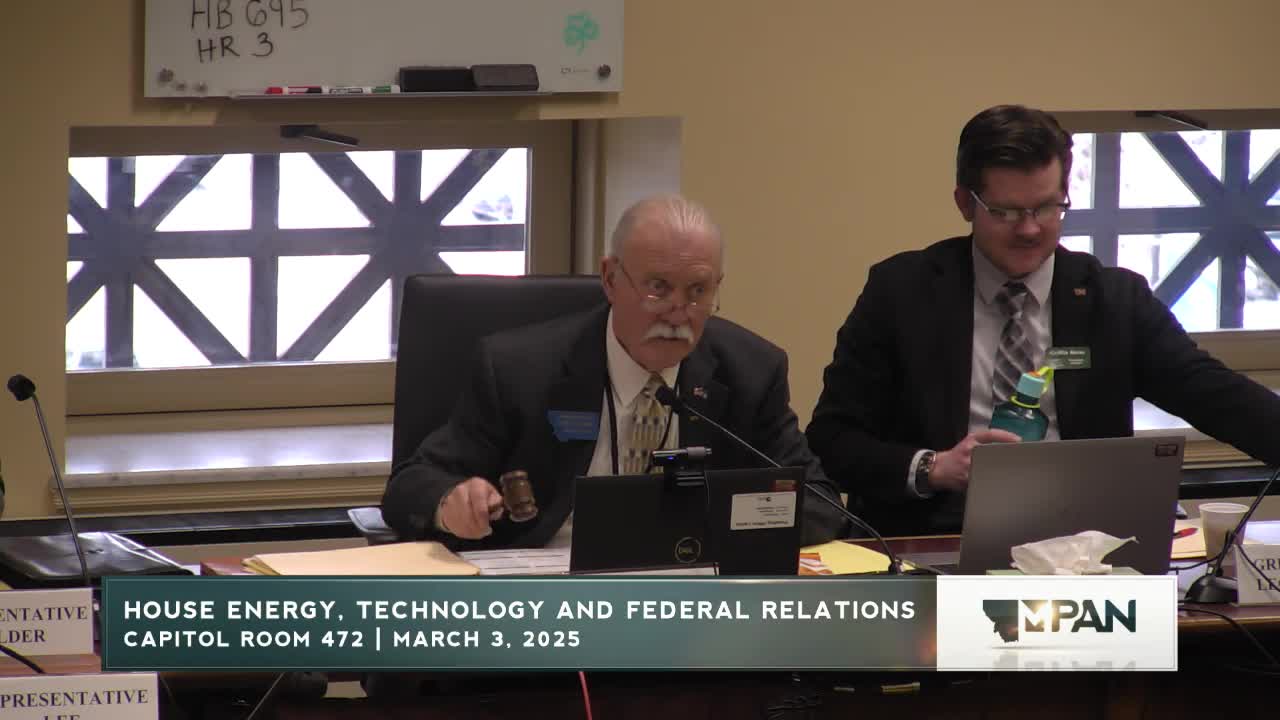
House Energy, Technology and Government Affairs held a hearing on House Joint Resolution 18, a resolution urging recognition and support for statehood for the District of Columbia.
House Energy, Technology and Government Affairs held a hearing on House Joint Resolution 18, a resolution urging recognition and support for statehood for the District of Columbia.
HJ 18’s sponsor, Representative Bob Carter of House District 96, opened the hearing and limited public testimony to three minutes because of floor time constraints. The resolution asks Montana’s legislature to register support for full congressional representation for the roughly 700,000 residents of the District of Columbia.
Proponents who testified online said statehood would restore full voting rights. Ankit Jain, appearing online and identifying himself as a U.S. senator for the District of Columbia (non‑voting/shadow status), said, “I urge you to support and vote in favor of this legislation, HJ 18,” and described statehood as a matter of “democratic justice and democratic rights.” Paul Strauss, who described himself as a senior shadow U.S. senator for D.C., said, “Taxation without representation was tyranny at the founding of our republic, but it remains the situation in D.C. now,” and urged lawmakers to consider D.C. residents’ lack of voting representation despite paying federal taxes.
Other witnesses emphasized local impacts. Reverend Wendy Hamilton, who said she works in D.C. public schools, described D.C. as a full civic community with a population larger than some states and asked Montana lawmakers to “think of us, your fellow Americans” when considering the resolution.
Committee members asked factual and procedural questions. Representative Mitchell asked whether the resolution’s approach would be limited to creating a state rather than restoring the federal district around the Capitol and White House; a witness explained that most DC statehood plans would shrink the federal district down to the “Federal Monumental Core” while admitting the remainder as a state. A committee member also asked whether statehood would require a U.S. constitutional amendment; the sponsor answered that a short answer was “no,” but said some electoral‑college implementation changes could raise constitutional questions if members of Congress sought to alter the number of electoral votes.
No formal committee action was recorded at the hearing. The sponsor closed by urging committee support for the resolution.
The hearing concluded with the chair noting the end of testimony and moving to the next agenda item.