Get Full Government Meeting Transcripts, Videos, & Alerts Forever!
Get email alerts on the Oil And Gas Taxation topic
No spam. Unsubscribe anytime.
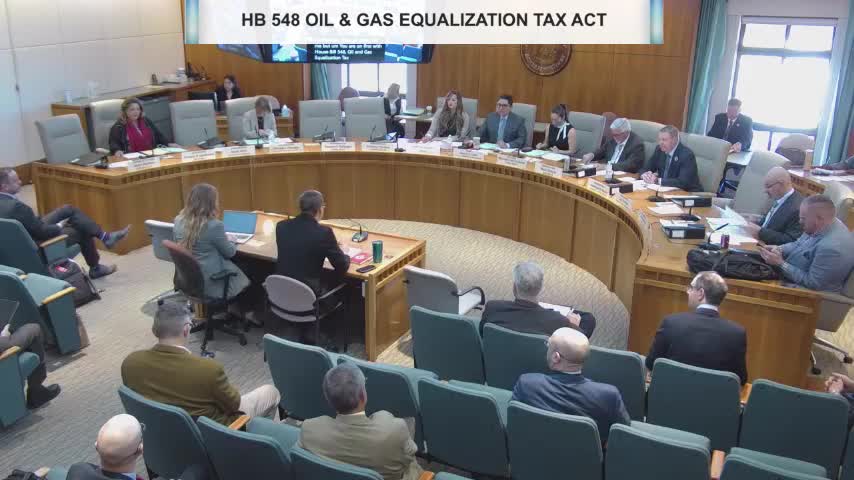
Committee debates HB 548 to equalize oil and gas severance taxes; bill temporarily tabled
Summary
Representative Small, sponsor of House Bill 548, told the House tax committee on Monday that New Mexico is producing record levels of oil and natural gas and urged the panel to "equalize" the severance treatment of the two commodities by raising the effective oil tax to 4 percent.
Representative Small, sponsor of House Bill 548, told the House tax committee on Monday that New Mexico is producing record levels of oil and natural gas and urged the panel to "equalize" the severance treatment of the two commodities by raising the effective oil tax to 4 percent.
The measure drew lengthy public testimony, with business and local‑economic groups warning the change would harm small producers and local economies, and environmental and civic groups urging support. After more than two hours of debate and questions about fiscal modeling, industry competitiveness and alternative approaches, a committee motion to temporarily table HB 548 was made and seconded and carried with no recorded opposition.
Supporters' case
Representative Small, presenting the bill, said New Mexico has benefited from recent production gains and argued the proposal fixes a longstanding discrepancy between how crude oil and natural gas are taxed. "We're extraordinarily fortunate, to be producing record levels of oil and natural gas right now," he said, and cited a current rig count of 105 and Energy Information Administration data showing December production above 65,000,000 barrels. He told the committee the difference dates to federal incentives for gas in the 1980s and a state rate set in the 1990s, and that equalizing the rates would restore horizontal equity.
Camilla Feidlman, an online supporter, said the state is entitled to set the rates for publicly owned resources and urged lawmakers to "please support the legislation." Alyssa Kenny Geier of Sierra Club and Healthy Climate New Mexico also registered support during the public comment period.
Opposition and concerns
Numerous business and local representatives urged rejection or more study. Carla Sontag, identifying herself as president for New Mexico businesses and consumers, warned the bill would "ripple through the entire market" and said the oil and gas industry is central to the state fiscal picture. Paul Gessen of the Rio Grande Foundation said the state already holds substantial sovereign wealth and that a tax increase is unnecessary. Terry Cole, president and CEO of the Greater Albuquerque Chamber of Commerce, asked why the measure was needed while the state is in a revenue surplus.
Smaller operators and service companies stressed narrow margins and local impacts. Nick McClellan of Manzano (Roswell) said small companies face higher breakeven costs and could be disproportionately harmed. Testimony from local economic development and industry associations — including the New Mexico Chamber of Commerce, New Mexico Idea (statewide economic development professionals) and the Permian Basin Petroleum Association — expressed concerns about competitiveness, job losses and compliance costs.
Key technical and fiscal points
Witnesses and staff discussed alternative ways to achieve parity: raising the oil rate (the bill's approach), lowering the natural gas rate (which staff said would reduce state revenue), or a hybrid of both. Legislative fiscal staff and the sponsor cited roughly a $400 million annual revenue effect if oil were fully equalized to 4 percent; staff also said reducing the gas rate to achieve parity would cost about $100 million annually. Committee staff cited a federal mineral leasing payment to the state of $2,847,000,000 in FY2024 when members asked about broader revenue sources.
Officials described differences in breakeven estimates: the Legislative Finance Committee's testimony noted breakeven ranges for new wells in the high‑thirties to mid‑forties per barrel (dollars), while some legislators and industry witnesses argued breakeven for many operators is nearer $60–$65 per barrel. Committee members repeatedly raised the possible downstream effects on local ad valorem revenues, schools and small businesses if production slowed.
Members also questioned the bill's nontechnical provisions. Representative Montoya and others criticized a proposed reporting change (quarterly to monthly) as potentially costly for small operators; one company estimated a roughly 40 percent compliance cost increase in that scenario.
Outcome and next steps
After extended questioning and public comment, a motion "to temporarily table HB 548" was made by Mister Terry, seconded, and carried with no recorded opposition. Committee leadership said the next two agenda items would be rolled to allow more time for this discussion and that members were likely to continue seeking fiscal and stakeholder analysis before taking further action.
Why it matters
The bill touches budget priorities and local economies: sponsors said equalization would increase recurring resources for state priorities, while opponents said the move risks driving activity out of New Mexico and harming small producers and the towns that depend on them. Lawmakers also debated whether an immediate equalization or a reduction of the gas tax (or a hybrid approach) would better serve both competitiveness and state revenue needs.
Votes at a glance
- Motion to temporarily table HB 548 (oil and gas equalization tax act): mover — Mister Terry; second — not specified; outcome — tabled (motion carried; no recorded opposition).