Get Full Government Meeting Transcripts, Videos, & Alerts Forever!
Get email alerts on the Automated Speed Enforcement topic
No spam. Unsubscribe anytime.
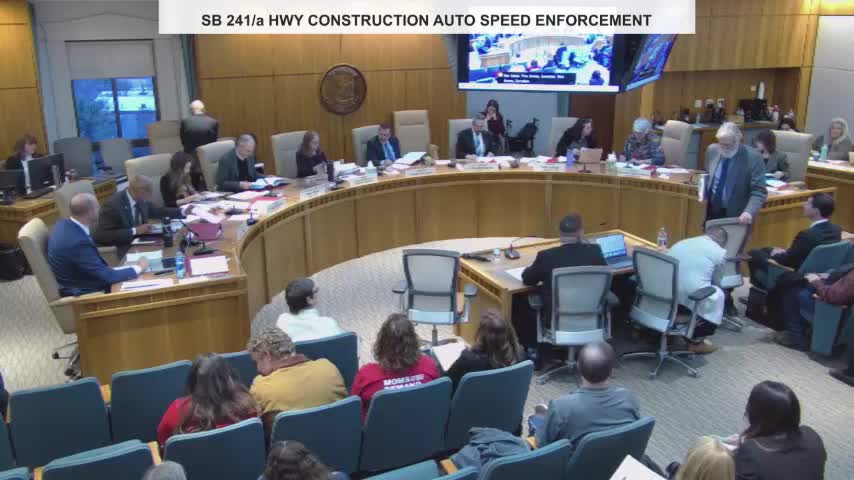
Senate committee tables bill to authorize automated speed cameras in construction zones after heated debate over appeals and enforcement
Summary
SB241 would have authorized state deployment of automated speed‑detection cameras in highway construction zones, created a fund to administer the program and established civil enforcement procedures. The committee debated appeals, evidentiary rules and collection practices and voted to table the bill.
The Senate committee debated Senate Bill 241, which would authorize automated speed‑detection cameras in highway construction zones, fund the program, and direct civil enforcement through hearing officers rather than criminal traffic courts. After extended questioning and public comment, the committee voted to table the bill.
Sponsor presentation and program goals
A senator introduced SB241 and said the Department of Transportation, in partnership with the Department of Public Safety, sought authority to place automated speed‑enforcement cameras on state roads within work zones and to issue civil fines aimed at protecting construction workers and travelers. Secretary Serna of the Department of Transportation and General Counsel Steve Hamilton joined the sponsor to present the measure.
Secretary Serna told the committee New Mexico is already among states that authorize automated enforcement in some form and said the bill limits state authority to construction work zones. He noted that between 2020 and 2023 there were 3,015 work‑zone crashes in the state and that New Mexico State Police issued nearly 14,000 speeding citations in work zones between 2020 and 2024. The bill, as amended, would create a dedicated fund to administer the Highway Construction Zone Automated Speed Enforcement Act and place program administration in the Department's traffic safety bureau.
Opposition and questions about due process, calibration and consequences
Kelly Stout Sanchez, who identified herself as a trial lawyer, spoke in opposition. Sanchez said the bill removes New Mexicans’ access to trial by jury for alleged speeding violations by routing cases to an appointed hearing officer where the rules of evidence would not apply and the standard would be a preponderance of the evidence. Sanchez argued the bill shifts the burden to vehicle owners to disprove a citation and lacks an appeal provision for hearing officer errors.
Several senators pressed the sponsor and agency officials on specific procedural and substantive issues: whether civil penalties would affect driving records or insurance (Secretary Serna said they would not because the program issues civil penalties outside the traffic code); how fines under the bill compare to existing penalties for being pulled over (agency officials said many current penalties are similar but some categories could differ and noted construction zones currently carry doubled penalties under other laws); whether contractors would be paid based on citation revenues (agency officials said contracts would cover service costs and would not be tied to fees collected); and whether camera calibration evidence could be used in a hearing (agency counsel said the department bears the burden to prove a violation by a preponderance of the evidence and that a defendant could present calibration evidence and other defenses).
Additional concerns raised by senators included the annual calibration requirement in the bill (several senators said on‑shift radar calibration for officers is more frequent), confusion in draft language about liability when a vehicle has multiple owners, and the potential for fines to be funneled back into the administering bureau and thus create perverse incentives.
Motion to table and outcome
Senator Duhigg moved to table SB241. The transcript records Senator Duhigg voting yes and Senator O'Malley also recorded as voting yes; the chair announced the bill was tabled and two members requested to explain votes. The chair later said the bill was tabled and that the committee would return to other items; sponsors and some members said they wanted to correct statutory inconsistencies before moving forward.
What the bill would have required (as discussed in the hearing)
- State authority limited to automated speed detection in construction/work zones on state roads; local governments may place cameras on local roads under existing procedures. - Creation of a dedicated fund to manage the Highway Construction Zone Automated Speed Enforcement Act; fund administered by the traffic safety bureau. - Civil enforcement through appointed hearing officers; the transcript references four enumerated defenses in the bill (vehicle sold, not the driver, vehicle stolen, citation already issued) and discussion whether other technical defenses (for example, camera calibration) would be allowed. - Annual calibration of cameras specified in the draft; senators asked whether that frequency is sufficient compared with in‑shift calibration for officer radar.
The committee paused consideration of further bills and took a recess; sponsors said they would revisit draft language to address procedural and technical concerns.