Get Full Government Meeting Transcripts, Videos, & Alerts Forever!
Kittitas County hearing draws debate over 90-megawatt Schnebly Coulee solar proposal
Summary
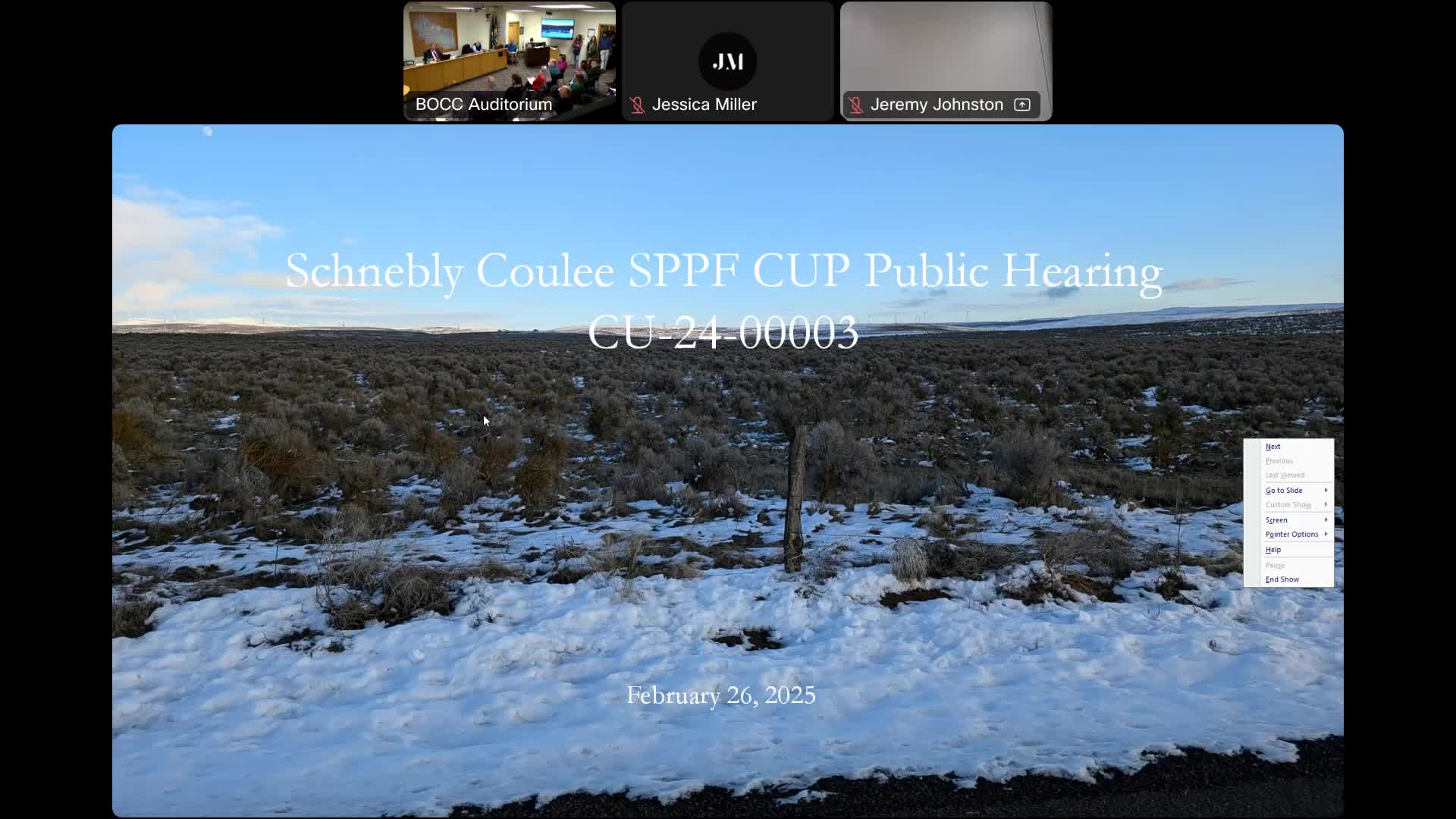
Kittitas County’s hearing examiner heard two hours of testimony Feb. 26 on Invenergy’s Schnebly Coulee conditional‑use application (CU24‑0003), a proposed 90‑megawatt solar facility covering about 1,314 acres; the examiner closed oral testimony, admitted late exhibits and said he will issue a written decision within 10 working days.
The Kittitas County hearing examiner on Feb. 26 heard roughly two hours of testimony for the Schnebly Coulee solar power production facility, a proposed 90-megawatt project spanning about 1,314 acres and sited primarily in the county’s Solar Overlay Zone 3. Community Development Services staff described the application and the code interpretation issue that will largely determine approval: how to read the ordinance phrase “routine view” in Kittitas County Code 17.61C, which governs screening and fencing for solar facilities.
The project, filed as conditional use application CU24-0003 and led by developer Invenergy, would place solar panels primarily in agricultural zoning (Ag-20) with a transmission corridor to the east. The applicant says roughly 695 acres would be fenced as the buildable area and proposes interconnection at the Poison Springs switch yard via about a 3.6-mile transmission line. The applicant provided a habitat management plan, cultural resources survey and other studies. The county issued a Mitigated Determination of Nonsignificance (MDNS) on Oct. 15, 2024; that MDNS was not appealed.
Why it matters: the hearing centered on two linked questions—whether the project meets the county’s land‑use and development standards, and how to apply the screening/fencing standard that requires being “consistent with the surrounding character” and to limit routine public views of the facility. Staff told the examiner that how the term “routine view” is interpreted will determine whether the project meets both the specific development standards and the conditional‑use review criteria.
Jeremy Johnston, Community Development Services, told the examiner the county’s code places the panels largely in Solar…
Already have an account? Log in
Subscribe to keep reading
Unlock the rest of this article — and every article on Citizen Portal.
- Unlimited articles
- AI-powered breakdowns of topics, speakers, decisions, and budgets
- Instant alerts when your location has a new meeting
- Follow topics and more locations
- 1,000 AI Insights / month, plus AI Chat