Get Full Government Meeting Transcripts, Videos, & Alerts Forever!
Get email alerts on the Department Of Agriculture Eo136 topic
No spam. Unsubscribe anytime.
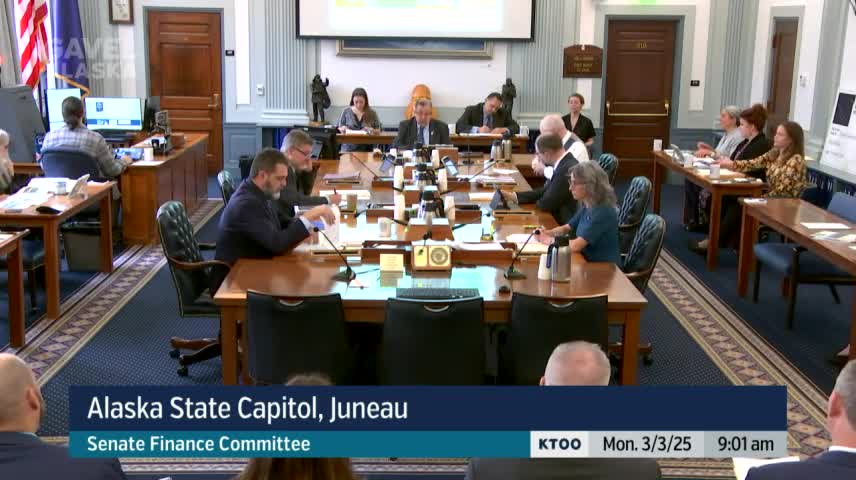
Senate Finance hears case for new Department of Agriculture; committee forwards resolution to disapprove executive order
Summary
Commissioner John Boyle, representing the Alaska Department of Natural Resources, told the Senate Finance Committee on March 3 that Governor Mike Dunleavy’s Executive Order 136 would separate the state’s Division of Agriculture from DNR and establish a standalone Department of Agriculture, effective July 1, 2025.
Commissioner John Boyle, representing the Alaska Department of Natural Resources, told the Senate Finance Committee on March 3 that Governor Mike Dunleavy’s Executive Order 136 would separate the state’s Division of Agriculture from DNR and establish a standalone Department of Agriculture, effective July 1, 2025.
"The division is led by Director Brian Scoresby, and he leads a team of roughly 37 people," Boyle said, describing the proposal as a "cut and paste" transfer of the existing division into a new cabinet-level department and saying the administration will seek to minimize new unrestricted general fund requests.
Deputy Commissioner Brent Goodrum told the committee the order implements recommendations from the governor’s 2022 Food Security and Independence Task Force and the legislature’s Alaska Food Strategy Task Force. Goodrum said the EO copies the Division of Agriculture’s statutory responsibilities unchanged into the new department, and that the administration originally requested roughly $2.7 million in fiscal year 2026 support but planned to submit an amendment to make the transition cost neutral by reclassifying existing positions and transferring two positions from DNR funding.
The presentation gave committee members details about the division’s current footprint: a Palmer-based staff of about 37, a FY25 management-plan budget approaching $7.2 million, administration of around $10 million in federal grant programs (including specialty crop block grants and local food purchase programs), oversight of the Alaska Grown marketing program, and management of the agricultural revolving loan fund with roughly $21.5 million in equity.
Committee members pressed on implementation details and scope. Senator Cronk asked whether forestry functions would move; Boyle replied that the Division of Forestry and Fire Protection would remain in DNR for now because of wildfire response, silviculture responsibilities and the state’s carbon-offset work. Senator Keel asked how mariculture and the state veterinarian’s functions would be handled; Boyle and Goodrum said mariculture and other duties currently spread across multiple agencies would remain in their existing departments initially but could be evaluated for future consolidation if the new commissioner and the administration recommended it.
Several public witnesses and industry groups testified in favor of creating a Department of Agriculture. "This budding interest is at risk," said hay producer Dylan Blankenship, who described difficulty accessing financing through the agricultural revolving loan fund. Bernie Carl of Chena Hot Springs described greenhouse and biomass successes and urged the committee to approve the department. Scott Mugridge, president of the Alaska Farm Bureau, and Amy Sites, policy director for Alaska Farm Bureau, both said a cabinet-level department would provide a sustained voice for agriculture between administrations. Rachel Lord of the Alaska Food Policy Council also testified in support, citing the need for coordination among federal, tribal, university and local partners.
Committee staff presented Senate Special Concurrent Resolution 1 (SCSR 1), a measure to disapprove Executive Order 136. Staff adviser Liz Harpold explained the resolution and noted that the hearing on the resolution does not reflect a member’s final intent for a later joint-session vote.
After public testimony and questions, a committee member moved to report SCSR 1 from committee with an attached zero fiscal note; the motion passed without objection. The committee also asked the administration to provide a revised fiscal note and any cost-neutral amendment language; the Office of Management and Budget was reported to be preparing that amendment.
Where the executive order stands procedurally: the administration transmitted EO 136 to the legislature on Jan. 21. Under the timeline presented, the legislature has 60 days from transmittal to disapprove the EO; if not disapproved, implementation would begin and the Department of Agriculture would be established July 1, 2025. Committee discussion repeatedly emphasized the state’s current fiscal constraints and the legislature’s constitutional responsibility to pass a balanced budget, and several senators said they sought more detailed fiscal information before supporting a structural change.
The committee did not take a final joint-session vote on SCSR 1 on March 3. The resolution was reported out of committee for consideration in the full legislature; the record notes that committee action did not indicate how individual members will vote in joint session.
The presentation and testimony reflected a mix of industry optimism about expanding Alaska-grown production and legislative caution about timing and cost. Administration witnesses emphasized using existing division resources and reclassifications to limit new general-fund obligations, and supporters urged the committee to preserve momentum for agricultural development and food-security initiatives.