Get Full Government Meeting Transcripts, Videos, & Alerts Forever!
Get email alerts on the Educator Evaluations topic
No spam. Unsubscribe anytime.
Tennessee Department of Education staff outline steps to finalize 2023–24 educator evaluations and partial-year exemptions
Summary
Amy Floyd, Tennessee Department of Education staff, led a remote guidance session explaining steps Tennessee administrators must take to finalize 2023–24 educator evaluations and how to identify partial-year exemptions.
Amy Floyd, Tennessee Department of Education staff, led a remote guidance session explaining steps Tennessee administrators must take to finalize 2023–24 educator evaluations and how to identify partial-year exemptions.
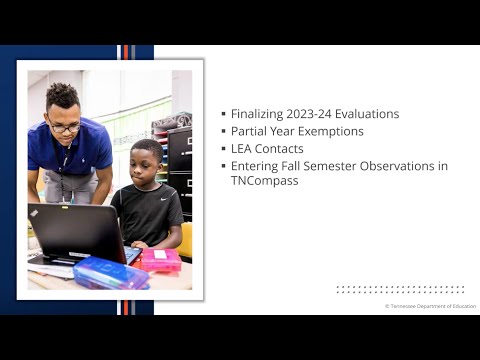
Floyd said, "Today, we're gonna talk about finalizing 23 24 evaluations," and walked attendees through signing procedures, missing-data fixes, how to mark partial-year exemptions (PYE) in TNCompass, and where districts should update local education agency (LEA) contact information.
The session matters because completion of evaluation records triggers LOE generation for educators and determines which staff receive an evaluation score for the school year. Department staff said administrators must sign LOEs so the system can complete the form and notify educators for acknowledgement.
Floyd explained the signature step in detail: administrators enter their PIN and click the "complete form" button. "Once the administrator puts their PIN number in and clicks the complete form button, it will pop up another window ... and ask you a question," she said, describing the on-screen prompt that allows educators to acknowledge or decline the LOE. If an educator declines or is unavailable (for example, on leave or no longer employed by the district), the administrator may enter the PIN again and save.
Staff described how to verify signatures using the evaluation scores-by-educator report: "Columns P through V has all of the information about the signing of the evaluations. Column P tells you if the administrator has signed it. Q will give you the date. R tells you who signed it, and the same things for the educator. Column V will tell you why they refused, if they refused to sign it," Floyd said.
If an LOE did not generate because of missing data (for example, an observation average or a growth/achievement measure), administrators can add the missing values via an administrative edit to trigger LOE generation. Staff said this is the time to make those edits so records are complete.
On partial-year exemptions, Floyd gave the department's criteria: educators employed for contracts of fewer than 120 days should be marked PYE; full-time teachers who cannot provide 120 days of instruction because of extended leave, intra-year transfer to another school, or a midyear move to a different role (for example, a teacher who becomes an administrator) should also be marked PYE. "Partial year exemptions must be identified by the charter school in the state evaluation system, which is TNCompass," she said.
Staff said districts may mark PYE directly on an individual educator's record or upload many records at once using the import wizard. Educators with a PYE do not receive an evaluation score or an LOE for that school year, the session noted.
District administrative housekeeping items included updating LEA contacts in the Administration tab of TNCompass (the organization contacts window), clearing or editing entries when personnel change, and saving changes. Staff also reminded team districts to use the pacing guide reports in TNCompass to confirm observation pacing so that educators receive an average observation score by year end.
Floyd listed available guidance documents and support contacts referenced in the session: an evaluation PIN-completion instruction (with screenshots), the TNCompass evaluation data management guide (for PYE and missing measures), TNCompass reports and charts (useful for team districts), and a partial-year exemption guidance note. Staff directed attendees with technical or workflow questions to the department's team and portfolio support addresses as referenced during the session; they gave roster-verification email as "rv.questions@TN.gov" and advised contacting the educator licensure unit for licensure or waiver issues.
During Q&A, an attendee described a principal whose license covers social studies but who was assigned to teach English language arts and said she could not submit a waiver. Department staff recommended contacting educator licensure: "They are the experts. I would just email them and send her license number," Floyd said.
On growth and achievement measures, Floyd clarified how individual growth scores interact with other measures: "They use this 35%. The individual growth score does not trump the achievement measure score, so you will still need to put that achievement measure score in. You can't use an individual growth score as an achievement measure," she said.
Next steps departmental staff set for districts were: ensure administrator signatures are completed on LOEs; enter any missing observation, growth, or achievement data via administrative edits; identify and mark educators who meet PYE criteria; review and update LEA contacts in TNCompass; and monitor observation pacing so LOEs and evaluation scores generate by year end. Staff closed by repeating available guides and contact points for follow-up support.