Get Full Government Meeting Transcripts, Videos, & Alerts Forever!
Get email alerts on the Stormwater 6ppd topic
No spam. Unsubscribe anytime.
Expert testifies bioretention likely removes 6PPD-derived toxin but long-term efficacy uncertain
Summary
At a Feb. 10 Kitsap County hearing on the Meadowview preliminary plat, consultant witness Mr. Kindred said studies show bioretention media can remove 6PPD-quinone from road runoff, but acknowledged long-term retention and durability remain research questions cited by the Washington Department of Ecology.
At a Feb. 10 hearing before Kitsap County Hearing Examiner Phil Albrecht, consultant witness Mr. Kindred said laboratory and field studies indicate that bioretention soils and engineered media can remove 6PPD-quinone — the tire-derived oxidation product tied to salmon mortality — from stormwater effluent.
The comment matters because the Meadowview preliminary plat will discharge treated runoff to a buffer and Barker Creek; opponents had cited Ecology guidance urging further study of 6PPD and road runoff.
Kindred, who described a career studying fate and transport of chemicals in the subsurface, told the examiner that early experiments exposing coho salmon to untreated freeway runoff showed nearly 100% pre-spawn mortality and that treating that runoff through bioretention media produced effluent that caused “0 mortality” in lab tests. “All the research done to date has proven that,” he said when pressed about removal during cross-examination.
He also acknowledged limits the Ecology document highlights. Asked about a quoted sentence from the Washington Department of Ecology stating that “the long term ability of healthy soil and engineered soil mixes to capture and retain 6PPDQ is a research need and is currently unknown,” Kindred answered, “I agree with that. They haven't done that research.” He said the available research shows both filtration and biodegradation play roles and that media replacement might be needed “decades in the future” if treatment capacity declines.
Opposing counsel had pointed to a Kitsap County exhibit citing the Ecology “6PPD and Road Runoff Assessment and Mitigation Strategies” guidance; Kindred said he had not reviewed that particular document but had followed related research and presentations by the scientists doing the work.
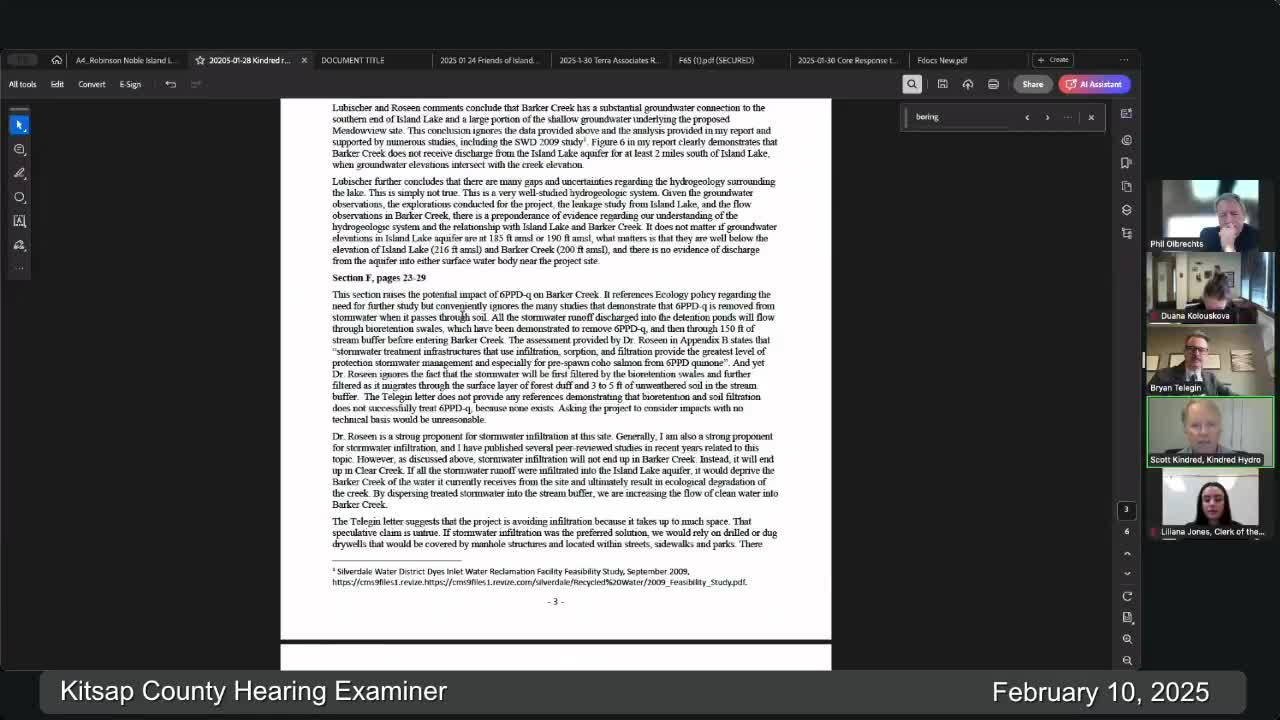
Kindred characterized the project’s plan as layered: he wrote in his comment letter that site runoff would pass through bioretention cells and then “through 150 feet of stream buffer before entering Barker Creek,” calling the buffer a “belt-and-suspenders” measure that provides additional treatment. When asked whether stream-buffer soils could eventually accumulate contaminants and require replacement, he said replacing large buffer soils would be “highly unlikely” and that, if replacement were necessary, it would more plausibly be the bioretention media that would be exchanged.
The hearing record shows disagreement over how definitively to treat Ecology’s cautionary language. Counsel for appellants repeatedly pressed whether bioretention reliably removes the particle sizes and concentrations associated with 6PPD and 6PPDQ; Kindred said his view differs from Ecology’s phrasing because the body of experimental work shows treatment effectiveness but conceded long-term questions remain.
The hearing closed after additional technical testimony and the examiner said a written decision would issue within the statutory time frame.
Ending: The hearing excerpt records technical debate rather than final agency action on 6PPD mitigation; the examiner will issue a written decision that could address whether the proposed bioretention and buffer measures meet county SEPA and stormwater requirements.