Get Full Government Meeting Transcripts, Videos, & Alerts Forever!
Get email alerts on the Literacy Standards topic
No spam. Unsubscribe anytime.
Tennessee Department of Education requires narratives, tightens standards-alignment process for educator-prep literacy reviews; materials due March 31
Summary
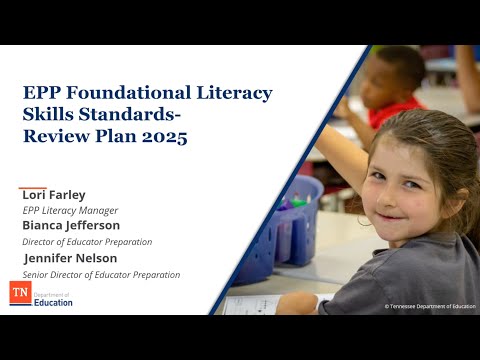
The Tennessee Department of Education on a webinar reviewed updates to the annual literacy-standards alignment review required by the Tennessee Literacy Success Act, telling educator preparation programs they must submit alignment matrices, syllabi and a now-required performance narrative by March 31.
Nashville — The Tennessee Department of Education on a webinar reviewed updates to the annual literacy-standards alignment review required by the Tennessee Literacy Success Act, saying educator preparation programs must submit standardized alignment matrices, corresponding syllabi and a now-required performance narrative by March 31.
Laurie, a presenter with the department's educator preparation team, told webinar participants that the 2025 review will retain the same three sections as last year'matrices (a map of alignment), course syllabi (artifacts of instruction) and a narrative (the story of alignment)'but includes several procedural changes intended to improve clarity and efficiency.
The change that drew most emphasis was the State Board of Education-driven decision to make the previously optional narrative a required upload. "The narrative should include evidence of the six components of the foundational literacy skill standards," Laurie said. She added that the department will provide guidance documents, examples drawn from Tennessee EPP submissions, and office hours and peer collaboration sessions to help programs meet the requirements.
Why this matters: The Tennessee Literacy Success Act seeks to ensure students reach grade-level reading proficiency by the end of third grade. The department framed the review updates as part of that law's implementation and pointed to recent statewide gains in ELA achievement to underline urgency. "When students master foundational literacy skills, the world of learning opens for them for life," Laurie said while presenting state TCAP data showing recent increases in third- and fourth-grade proficiency.
Key requirements and process notes
- Submissions required: the department said each educator preparation program (EPP) must submit its alignment matrices, the syllabi for all courses listed in those matrices, and the performance narrative by March 31. Laurie said these are the documents EPPs are responsible for uploading to the department's system.
- Matrices format and content: The department will return matrices to EPPs for verification. Programs must use black font only in the matrices to reduce confusion and should include only primary courses that teach and assess the foundational literacy standards. EPPs must be specific in mapping course assessments and clinical experiences to the standards.
- Syllabi uploads and naming: Syllabi must be uploaded for every course included in a matrix. The department will provide a naming-protocol chart; a syllabus used in multiple licensure areas only needs one upload if named according to the protocol and placed in the general folder in TNAtlas.
- Special education: The review matrices now include separate tabs for special education'one for interventionists and one for comprehensive special-education preparation'to allow more accurate review of program emphases.
- Evidence and follow-up: The Tennessee Literacy Success Act requires reviewers to provide evidence supporting alignment, and the law calls for corrective action plans when reviewers find misalignment. Laurie said review results will be published in annual reports and on EPP report cards.
Additional supports and logistics
The department said it will provide a short review plan document similar to last year's three-page plan plus a longer guidance document with extensive examples and an appendix of sample syllabi alignments. Laurie also announced three office hours sessions and facilitated EPP collaboration sessions; dates will be released in follow-up emails.
The webinar was recorded; attendees will receive the PowerPoint, guidance documents and the recording when available, Laurie said. She also noted a new presentation disclaimer and told attendees that "the state of Tennessee does not currently permit the use of generative AI tools in meetings," asking participants to review the slide.
What the department asked EPPs to do next
Laurie said EPPs should review returned matrices for accuracy, add updates where needed, consult the 2024 reviewers' feedback even if meeting expectations, and follow the syllabus naming conventions when uploading documents. She told programs to look for the guidance files in an end-of-week follow-up email and to register for office hours if they have procedural questions.
No formal vote or board action took place on the webinar; the session functioned as guidance and instruction from the department to EPPs about how to prepare materials for the statutorily required review.
Next steps and timeline
Laurie closed by reiterating the submission deadline: "All documents, the matrices, the narrative, and the syllabi by March 31." The department will return matrices and provide reviewer feedback; corrective actions will be required where reviewers find misalignment under the Tennessee Literacy Success Act.
The department emphasized that the updates are intended to make the review process more efficient and to maintain fidelity to the foundational literacy standards required by law. Attendees were invited to use the new guidance materials and office hours to clarify procedural questions and alignment expectations.