Get Full Government Meeting Transcripts, Videos, & Alerts Forever!
Get email alerts on the Instructional Practice Guides topic
No spam. Unsubscribe anytime.
Tennessee Department of Education trainer reviews Instructional Practice Guides, urges formative use and norming
Summary
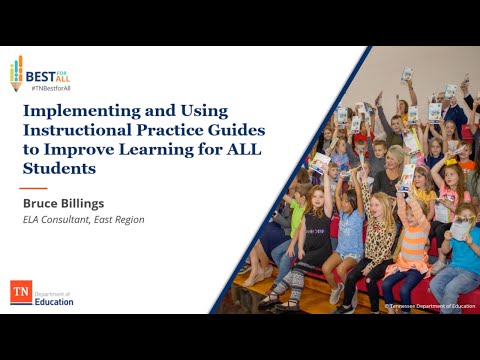
Bruce Billings, East Region ELA consultant for the Tennessee Department of Education, led an hour-long training on the state's Instructional Practice Guides (IPGs), covering the knowledge-building and foundational-skills guides, observation norms, and updates including a new "HCOM Access for All" core action added in November 2024.
Bruce Billings, East Region ELA consultant for the Tennessee Department of Education, led an East Tennessee virtual training on instructional practice guides that the department uses to define classroom expectations and to norm instructional quality across schools.
Billings said instructional practice guides "define the vision for strong instruction," and described two ELA-specific guides: a foundational-skills IPG for pre-K–2 and a knowledge-building IPG for pre-K–12. He said the guides are being scaled beyond ELA "into math, science, and beyond." The session focused on the knowledge-building guide's structure—culture of learning, core action 1 (high-quality text), core action 2 (teacher question and task design), and core action 3 (student engagement)—and on practical application for leaders doing learning walks.
Why it matters: Billings presented the IPG as a common language and monitoring tool to support continuous improvement. He emphasized that the guides are intended for formative feedback, not as a substitute for a formal teacher evaluation. Participants discussed how the IPG can produce actionable, content-specific feedback for teachers and leaders and how it connects to an "intellectual preparation" cycle of backwards planning and student-work analysis.
In the presentation, Billings outlined implementation details and clarifications for observers: observations are typically short ("15 to 20 minutes"), and teams should debrief after walks to calibrate ratings. He recommended using curriculum and lesson materials as anchors when rating classrooms so ratings are comparable across observers and schools.
Billings described the IPG rating language and offered a practical rubric for estimating student engagement by share of class participating: he suggested thinking of "yes" as essentially full-class engagement, "mostly" as about 75%, "somewhat" as about 50% and "not yet" as about 25% of students engaged in the standards-based activity. He cautioned observers to prioritize discussions that norm expectations rather than getting stuck on minor differences between "yes" and "mostly."
The presenter noted a November 2024 update that added core action 4, "HCOM Access for All," to sharpen attention to student subgroups — English learners, students with Individualized Education Programs (IEPs) and economically disadvantaged students — and their access in tier 1 instruction. He also said the training modules available through the Best for All Central hub currently include culture of learning and core actions 1–3; core action 4 had been added to the IPG but not yet to those modules.
Participants from multiple roles (examples given in chat: CTE, ELL, technology, school culture) discussed adapting the IPG for different instructional settings. One participant described using the IPG to support nontraditional classrooms such as CTE, where materials and texts may look different but the guide's principles are still applicable. The group also discussed practical steps for leaders before learning walks: create a plan, communicate expectations with teachers, bring lesson materials, and use coaching questions in feedback rather than handing back a completed form as an evaluative document.
No formal votes or policy adoptions took place; the session was instructional. Billings offered to share a recording of a session for participants who could not attend their scheduled meeting. The session concluded with logistical reminders about module enrollment and a brief Q&A.
The conversation repeatedly distinguished between discussion (clarifying how to apply the IPG), direction (recommendations for observer practice and use of curriculum as an anchor), and decision (no formal board or policy decisions recorded in the session).