Get Full Government Meeting Transcripts, Videos, & Alerts Forever!
Get email alerts on the Wildlife Management topic
No spam. Unsubscribe anytime.
Kitsap County approves $3.64 million wildlife management contract; relocation remains preferred but unavailable
Summary
The Board of Commissioners approved a $3,636,227 contract with USDA for wildlife management services after Parks staff said relocation is preferred but currently infeasible because the county lacks a husbandry facility and vetted relocation sites. Public commenters urged nonlethal measures and questioned past removals at Point No Point.
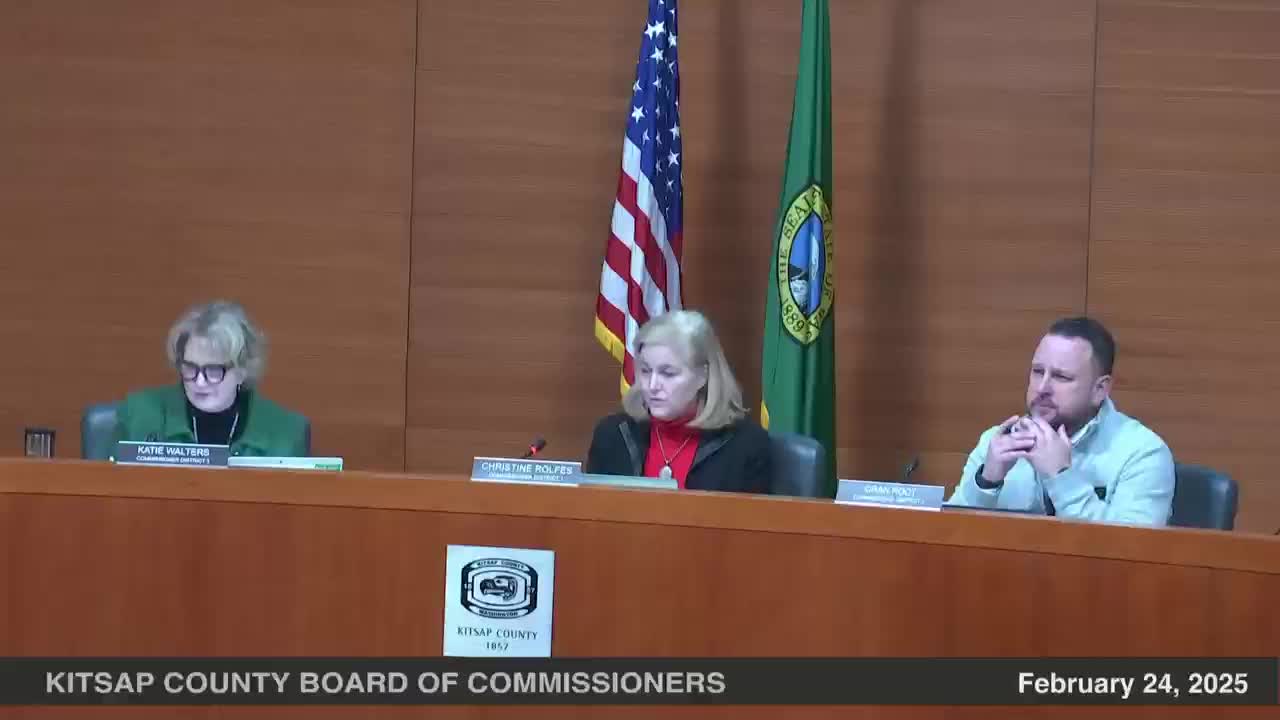
KITSAP COUNTY — The Kitsap County Board of Commissioners on Feb. 24 approved a $3,636,227 contract with USDA for wildlife management services to provide licensed trappers and related work should the county move to mitigation that could include removal of beavers from county parks.
Parks presenter Irene (last name not provided), who summarized the department's beaver-management approach, said relocation is the preferred outcome but that relocation requires two things the county currently lacks: a beaver husbandry facility and permanent relocation sites vetted by Washington Department of Fish and Wildlife (WDFW). "Currently, within Kitsap County, we don't have access to a beaver husbandry facility, nor do we have any permanent relocation sites," Irene said. She described the county's decision framework as avoid, minimize, mitigate — with removal considered only as a last resort when public infrastructure or safety is at risk.
Why it matters: Beavers alter habitat in ways that benefit other wildlife but can also overwhelm stormwater infrastructure. At Point No Point, Parks staff reported ongoing impacts to a narrow stormwater ditch that are causing overflow into roads and nearby structures; Parks is using continual notching of dams as a short-term measure while larger estuary or stormwater redesign work is pursued.
County presentation and staff guidance Irene told the board that Parks manages conflicts using an "avoid, minimize, and mitigate" sequence. Avoid measures include closing or rerouting trails and moving infrastructure. Minimize measures include fencing, partial dam notching, and leveling devices — all of which require state permitting. If avoid and minimize fail, Parks said it moves to mitigation, which can mean beaver removal. She said relocation requires a husbandry facility to hold and health-check animals and a permanent relocation site approved by WDFW — resources Kitsap does not currently have. "If relocation areas are available, that would be our first priority but as we have discussed, there are no relocation opportunities available within the Greater Kitsap region at this time," Irene said.
Public comment and board reaction Several residents urged nonlethal options and questioned past practice. "It does sound like there's effectively been a decision made to kill the beaver family up at Point No Point again," said Joe Lubisher of Indianola during public comment, asking the board three direct questions about alternatives, due diligence, and long-term estuary design. Carol Price, who joined online, said simply: "We need beavers, and a beaver relocation program would be a better way to spend that money."
Commissioners and staff said the contract is intended to place licensed trappers and necessary services under contract so the county can respond if mitigation becomes necessary; it would also cover licensed capture for relocation if an approved relocation site and husbandry facility become available. Parks staff noted coordination with Public Works on a separate stormwater study and said some restoration options will require federal permits and grant funding.
Board action A motion to approve the contract — introduced verbally during the meeting as "move to approve the contract to USDA AHIS KC TAC605 TAC24 for wildlife management services, for $3,636,227 dollars" — was seconded and adopted by voice vote. The commissioners decided to put the contract in place as a tool the county may use if avoid and minimize strategies are exhausted.
Outlook Staff and several commissioners said the contract does not mean immediate lethal removal; relocation remains the stated preference but is constrained by the lack of local husbandry and relocation sites. Parks encourages public- and private-sector participation to identify or establish relocation capacity. Separately, Public Works is pursuing a stormwater study and design work at Point No Point that Parks officials said is needed to address the underlying drainage and estuary conditions that create recurring conflicts with beaver activity.
Votes at a glance - Motion to approve USDA wildlife management contract, $3,636,227 — outcome: adopted (voice vote).