Get Full Government Meeting Transcripts, Videos, & Alerts Forever!
Get email alerts on the Math Instructional Practice Guide topic
No spam. Unsubscribe anytime.
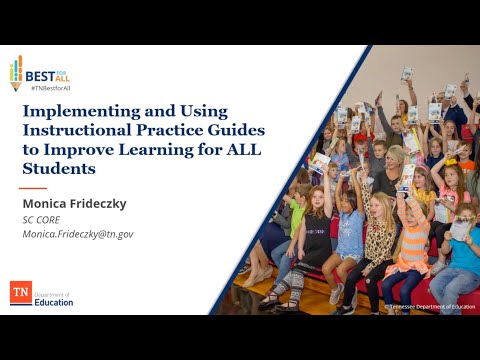
Tennessee DOE consultant reviews Math Instructional Practice Guide and implementation supports
Summary
Monica Fredeski of the Tennessee Department of Education reviewed the Math Instructional Practice Guide (Math IPG) in a webinar, explaining its three core actions, links to instructional focus documents and High-Quality Instructional Materials, and how leaders can use the guide for learning walks, intellectual prep, and teacher feedback.
Monica Fredeski, Southcentral Math Corps consultant for the Tennessee Department of Education, led a webinar overview of the Math Instructional Practice Guide (Math IPG), describing how district and school leaders can use the guide to support math instruction rather than to evaluate teachers. Fredeski shared the guide’s structure, described connections to Tennessee math standards and Instructional Focus Documents (IFDs), and outlined steps for using the guide during classroom learning walks and collaborative lesson preparation.
The Math IPG, Fredeski said, is designed to build a culture of continuous learning among educators and students. She cited the guiding line often attributed to instructional-coaching pioneer Jim Knight: "When teachers stop learning, so do students," and said the IPG frames teachers and students as investigators refining practice to improve learning.
Fredeski described the Math IPG’s organization: a foundational Culture of Learning plus three core actions. Core Action 1 focuses on the three mathematical instructional shifts — focus (standards alignment), coherence (connections across lessons and grades), and rigor (conceptual understanding, procedural skill and fluency, and application). Core Action 2 addresses teacher math practices and intentional teacher moves, including questioning and use of materials to give all students access. Core Action 3 describes the eight math student practices that indicate students are thinking and engaging with mathematics rather than simply giving answers.
Fredeski emphasized tools and resources leaders should use when conducting observations or learning walks. She recommended that observers preview the High-Quality Instructional Materials (HQIM) for the lesson and consult the Tennessee Instructional Focus Documents (IFDs) — available on the Best for All Central site — which list the aspects of rigor for each standard and include level 1–4 evidence statements (level 3 indicates grade-level mastery). Fredeski suggested downloading the combined IFD document for easier searching and using IFDs in PLCs to analyze student work and assessment alignment.
On teacher preparation and lesson-internalization, Fredeski connected the IPG to the intellectual-prep cycle. She said effective lesson prep includes identifying the mathematical goal and big idea, completing tasks teachers will assign, anticipating student struggles, and using margin notes in the teacher edition of HQIM for question sequences and scaffolds. During learning walks, observers should record noticings tied to IPG indicators and use those notes to debrief with teachers and collaborative prep teams.
Fredeski also highlighted supports for diverse learners, noting that accommodations or temporary supports should enable access to grade-level tasks for students with disabilities, English-language learners and economically disadvantaged students. She urged observers to look for evidence of student agency, discourse, and whether students carry the cognitive load of the lesson.
The webinar closed with implementation resources Fredeski identified on Best for All Central: an Intellectual Prep Hub, the math standards resource page, mention of an Acceleration for All network (currently active for ELA and coming for mathematics), and a forthcoming Math Implementation Network. Fredeski offered her contact information (monica.friedeski@tn.gov) for follow-up questions and encouraged participants to use the IPG indicators when planning professional learning and feedback cycles.