Get Full Government Meeting Transcripts, Videos, & Alerts Forever!
Kitsap County staff recommends denial of Spring Hill preliminary plat; applicants and Corps, Ecology continue technical review
Summary
A Kitsap County planner recommended denial of the Spring Hill preliminary plat and performance‑based development permit for a 230‑unit townhouse project in the Kingston urban growth area, citing an unresolved critical‑area variance and outstanding technical items including stormwater and sewer commitments.
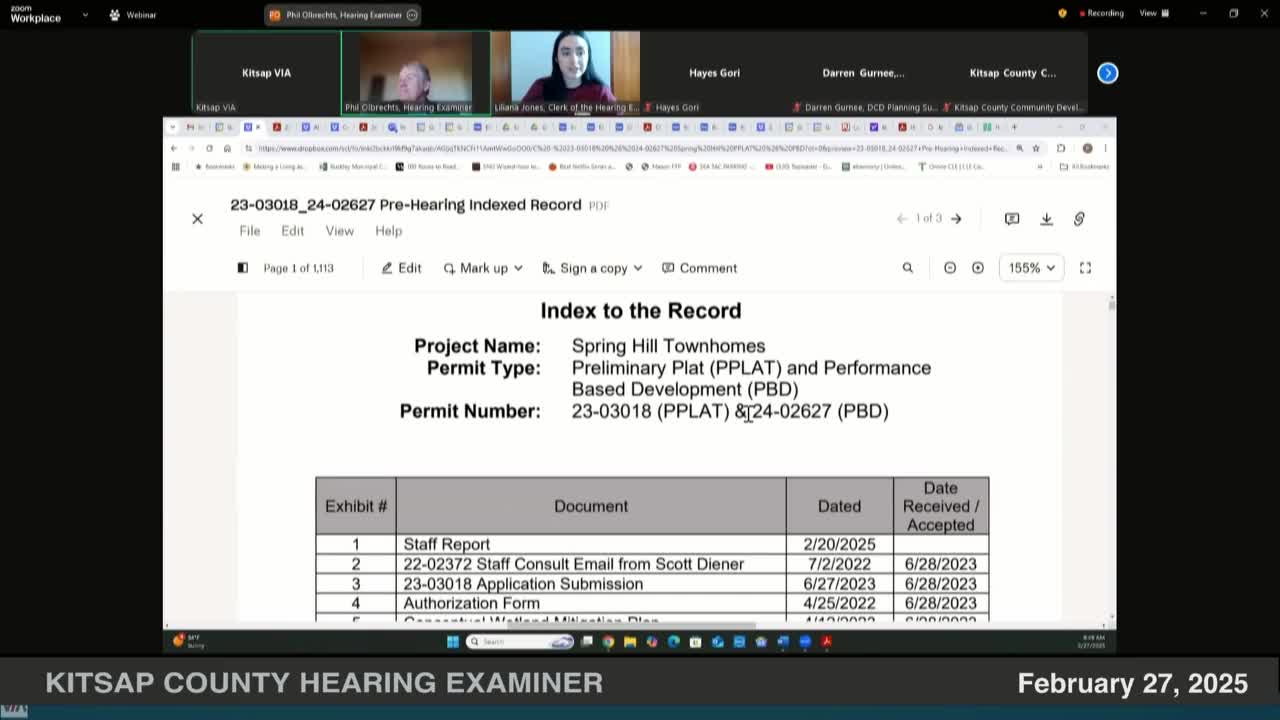
A Kitsap County planning supervisor recommended denial of the Spring Hill preliminary plat and associated performance‑based development (PBD) permit during a consolidated hearing on Feb. 27, 2025, after staff found the application lacked an approved critical‑area variance tied to proposed wetland impacts and had outstanding infrastructure and stormwater issues. The hearing examiner kept the record open and scheduled further proceedings; the applicant and federal and state reviewers are continuing parallel technical reviews of wetland mitigation and permit requirements.
Staff recommended denial because the project as submitted would impact mapped wetlands and the county had not received the critical‑area variance or other required approvals that staff said were needed to show compliance with Kitsap County Code and the county’s critical areas ordinance. Planning supervisor Darren Gurnee told the hearing that staff had issued a SEPA determination of significance because the project requires a critical‑area variance under KCC 19.101.135 and KCC 19.202.20; without that variance staff said it could not recommend approval. Gurnee also listed outstanding technical items on stormwater, fire access, and sewer availability that, in the county’s view, remained unresolved.
The applicant team, represented in the hearing by attorney Hayes Gorey and project manager David Smith of Spring Hill Townhomes LLC, said the project is an affordable housing development intended to deliver 230 single‑family‑attached units (townhomes), including a large share of income‑restricted units. The applicant disputed the county’s view that a critical‑area variance is required before the county can consider mitigation sequencing. Applicant witnesses —…
Already have an account? Log in
Subscribe to keep reading
Unlock the rest of this article — and every article on Citizen Portal.
- Unlimited articles
- AI-powered breakdowns of topics, speakers, decisions, and budgets
- Instant alerts when your location has a new meeting
- Follow topics and more locations
- 1,000 AI Insights / month, plus AI Chat