Get Full Government Meeting Transcripts, Videos, & Alerts Forever!
Get email alerts on the Spring Hill Preliminary Plat topic
No spam. Unsubscribe anytime.
Kitsap County staff recommends denial of Spring Hill preliminary plat; applicants and Corps, Ecology continue technical review
Summary
A Kitsap County planner recommended denial of the Spring Hill preliminary plat and performance‑based development permit for a 230‑unit townhouse project in the Kingston urban growth area, citing an unresolved critical‑area variance and outstanding technical items including stormwater and sewer commitments.
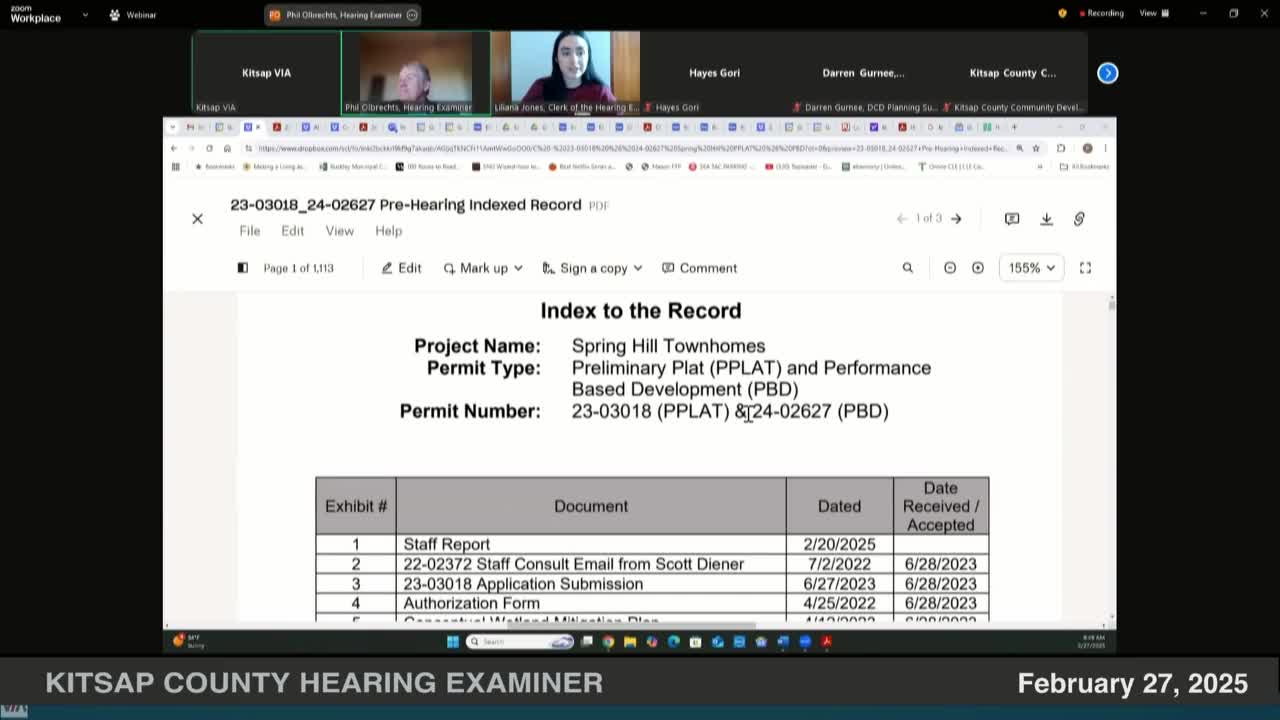
A Kitsap County planning supervisor recommended denial of the Spring Hill preliminary plat and associated performance‑based development (PBD) permit during a consolidated hearing on Feb. 27, 2025, after staff found the application lacked an approved critical‑area variance tied to proposed wetland impacts and had outstanding infrastructure and stormwater issues. The hearing examiner kept the record open and scheduled further proceedings; the applicant and federal and state reviewers are continuing parallel technical reviews of wetland mitigation and permit requirements.
Staff recommended denial because the project as submitted would impact mapped wetlands and the county had not received the critical‑area variance or other required approvals that staff said were needed to show compliance with Kitsap County Code and the county’s critical areas ordinance. Planning supervisor Darren Gurnee told the hearing that staff had issued a SEPA determination of significance because the project requires a critical‑area variance under KCC 19.101.135 and KCC 19.202.20; without that variance staff said it could not recommend approval. Gurnee also listed outstanding technical items on stormwater, fire access, and sewer availability that, in the county’s view, remained unresolved.
The applicant team, represented in the hearing by attorney Hayes Gorey and project manager David Smith of Spring Hill Townhomes LLC, said the project is an affordable housing development intended to deliver 230 single‑family‑attached units (townhomes), including a large share of income‑restricted units. The applicant disputed the county’s view that a critical‑area variance is required before the county can consider mitigation sequencing. Applicant witnesses — including wetland biologist Robin Myers and civil engineer David Nason — testified the mitigation plan follows state and federal guidance and that the Army Corps of Engineers and Washington Department of Ecology have been actively reviewing the federal permits and water‑quality certification. The corps’ project lead, via email in the record, said the corps had completed its delineation review and was coordinating with Ecology on mitigation and the water‑quality certification.
Key technical points in evidence and testimony - Project scale and layout: The application originally described 283 units in an earlier version; the current proposal before the examiner is for 230 single‑family‑attached units on roughly 20 acres in the Kingston UGA. The applicant said this revision reduced wetland impacts and improved the mitigation plan. - Wetlands and mitigation: Applicant‑hired wetland specialists (Joanne Bartlett and Robin Myers) described an on‑site mitigation plan that includes wetland creation and enhancement and perimeter buffers. Myers testified the plan is consistent with Ecology and Corps guidance and that the mitigation is intended to achieve no net loss or a functional lift. Applicant counsel said the mitigation sequencing (avoid → minimize → mitigate) in KCC 19.202.30 authorizes the proposed impacts if adequate mitigation and regulatory permits are approved. - County position on variance: County staff said the critical‑area variance procedure is the appropriate mechanism for review because the project would reduce required buffers and includes direct fill of wetland areas. Staff argued the variance must be addressed before a recommendation for approval can be issued. The applicant disagreed, saying mitigation sequencing (and parallel federal/state permitting) is the controlling process for review of wetland impacts. - Army Corps and Ecology review: The record includes Corps and Ecology correspondence showing detailed, multi‑agency technical review is underway. A Corps message in the record said it had no further comments on the delineation and was reviewing mitigation and coordinating with Ecology on water‑quality certification. Applicant counsel said the Corps has indicated the nationwide permit is near completion but cannot be finalized until Ecology issues or waives the state water‑quality certification; Ecology and the Corps have been working together on the application. - Infrastructure and other technical issues: Staff raised outstanding concerns about stormwater drainage designs, final stormwater calculations, fire access and turnaround geometry, transportation impacts (the applicant’s traffic consultant estimated approximately 916 average daily trips), and sewer letter/commitment from the sewer provider. Applicant engineers said the stormwater approach is feasible and that final SDAP (site development activity permit)‑level plans would resolve remaining technical details. - Parking and design: The applicant proposes one garage space per unit (230) plus 25 surface parking stalls (total 355 stalls). The applicant asked the examiner to treat the product as multi‑family townhouses for parking calculations (which would reduce the code‑required parking), to count enclosed garage spaces toward the parking total, and to apply code incentives (bicycle parking, EV charging) that would allow administrative parking reductions.
Public comment reflected both support and opposition. Supporters, including members of the Kingston Affordable Housing Working Group and the Kitsap Building Association, said the UGA location and proposed affordable units respond to an urgent housing need. Opponents and nearby residents raised concerns about impacts to wetlands, tree removal, traffic and pedestrian safety on Lindvog/Lindbogg Road, school capacity, emergency response, and whether proposed mitigation and buffers would be sufficient.
Where the process goes next The hearing examiner admitted the project and public comment exhibits into the record, and parties agreed to continue testimony and evidence at a follow‑up hearing on March 7, 2025, for additional witnesses and cross‑examination. The examiner noted the record will remain open for some written comments and said the final decision will follow the consolidated hearing schedule. Separate proceedings noted in the record include the SEPA appeal filed by an interested party; that appeal will be addressed within the consolidated process. No final decision on the plat or PBD was issued at the Feb. 27 hearing; staff’s current administrative recommendation in the record is denial, and the applicant is pressing for an approval with conditions pending the Corps and Ecology reviews and completion of technical items.
Ending: The case remains active. The county’s Planning Division has reserved staff time to complete the administrative record and respond to applicant and public filings; the hearing examiner set a continuation date (March 7, 2025) to receive remaining testimony and evidence. Parties reported ongoing multi‑agency technical work with the Army Corps and Washington Department of Ecology and signaled they will present more detailed mitigation, stormwater and traffic analyses at the continued hearing.