Get Full Government Meeting Transcripts, Videos, & Alerts Forever!
Get email alerts on the Middle Housing topic
No spam. Unsubscribe anytime.
Governor's bill would expand middle‑housing and offer density bonuses for affordability and accessibility
Summary
State officials and a broad stakeholder panel testified March 3 on House Bill 21,38, the governor’s middle‑housing and infill proposal, which would expand where duplexes, triplexes, quadplexes, townhomes and cottage clusters are allowed and create a statewide density bonus tied to accessibility or affordable units.
State officials and a wide range of stakeholders presented March 3 on House Bill 21,38, the governor’s middle‑housing and infill proposal, which seeks to expand legal middle‑housing locations, remove barriers to development and incentivize affordable and accessible units.
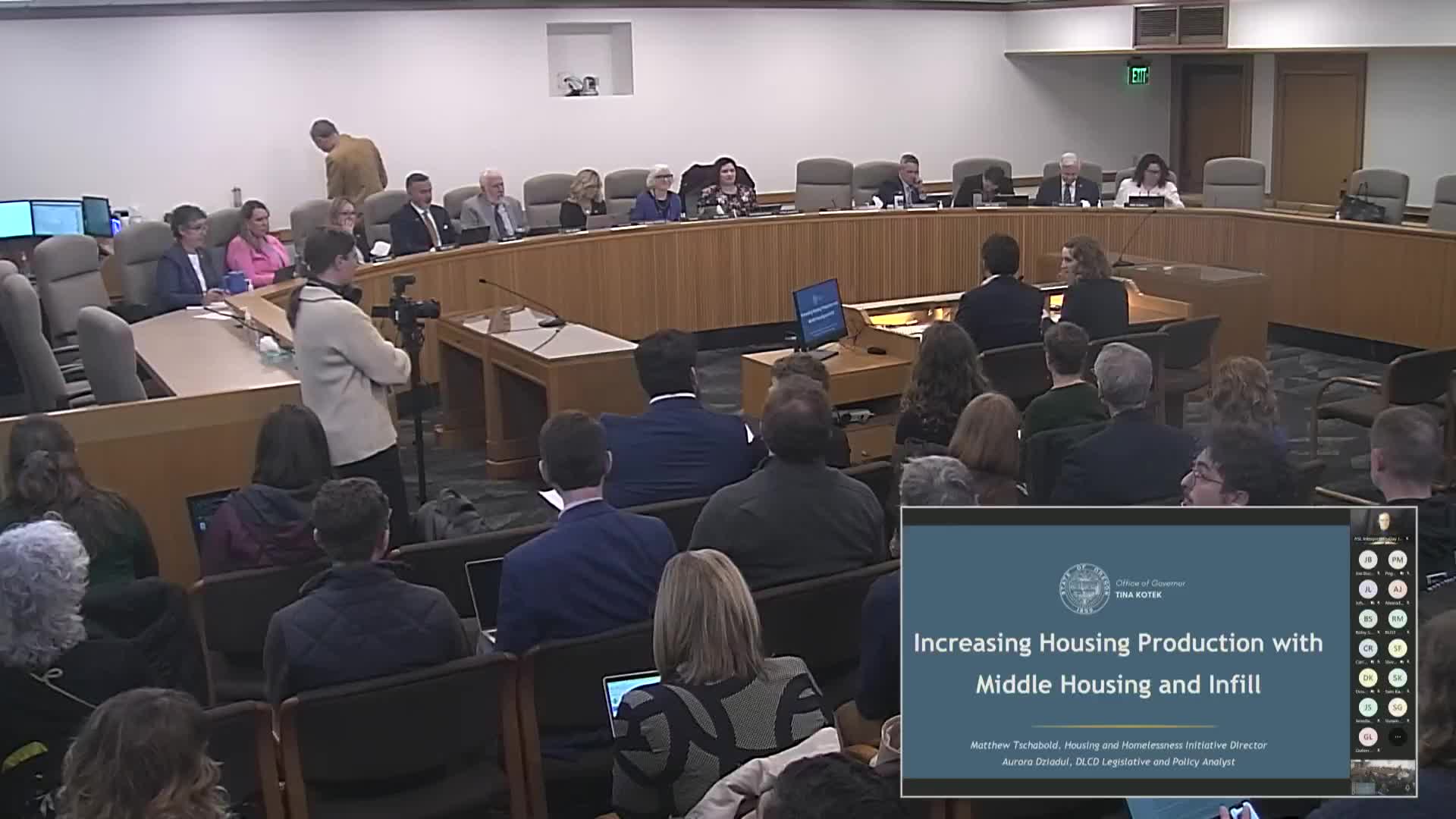
Matthew Schawbold, director of the Governor’s Housing and Homelessness Initiative, and Aurora Jettl, a legislative and policy analyst at the Department of Land Conservation and Development (DLCD), told the committee the state faces a substantial shortfall in housing production: the Oregon Housing Needs Analysis cited a current deficit of roughly 100,000 units and a projected need of another 400,000 units over the next 20 years. Executive Order 23‑04 set a goal of 36,000 units per year, they said, and middle housing is a core part of meeting that target because it provides smaller‑footprint units that can be built in established urban neighborhoods.
The bill’s principal changes described in the dash‑1 amendment include: legalizing middle housing in all urban areas (including urban unincorporated lands subject to an urban services capacity test); requiring cities to allow middle housing on lots that already contain single‑family homes, ADUs or duplexes; invalidating private covenants that bar middle housing where state law would otherwise allow it; permitting detached as well as attached middle housing; allowing a combined subdivision and middle‑housing land‑division process to avoid duplicative reviews; removing notice and appeals for middle‑housing land divisions to align the process more closely with single‑family standards; and directing DLCD to pursue administrative rule changes on siting and design standards for ADUs, SROs and manufactured middle housing.
To promote affordability and accessibility, the dash‑1 refines a proposed statewide density bonus. Under the revision, developers who either include a Type A (wheelchair accessible) unit or sell one unit at an affordable price point to an income‑qualified household would receive additional density (one or two extra units) for their middle‑housing project. Schawbold described the density bonus as an economic incentive to encourage both mission‑driven and market builders to deliver at least one accessible or income‑restricted unit in exchange for increased yield.
The bill also includes technical assistance funding: Schawbold said the proposal contains $1.5 million for local governments specifically in this bill and he noted a broader $7 million total in technical assistance across related agency budgets in the governor’s request. Committee members and city representatives asked detailed questions about three categories of concern that remain under negotiation: how the bill treats traffic impact analyses and off‑site exactions (the administration is working to limit disallowance to very expensive, non‑proportionate off‑site exactions and to avoid preempting relevant adjacent improvements); how to make urban‑services standards (water, sewer, stormwater, transportation) clear and objective without stripping needed engineering discretion; and whether demolition‑review or cottage‑cluster language should be modified or removed (administration said some demolition provisions will be removed in a forthcoming amendment).
Cities and local government groups — including the League of Oregon Cities and representatives from Hillsboro and Lake Oswego — testified with caution or neutrality. Their written and oral testimony emphasized implementation burdens on local planning staffs, the need to preserve the ability to require proportionate public improvements and the difficulty of translating some engineering standards into the statutory “clear‑and‑objective” framework. The League said it shares the goal of increased housing production but opposed certain draft provisions as written and signaled it would submit detailed comments. Developers and builders — including testimony from the Oregon Home Builders Association, small infill builders and rural developers — generally supported the bill as a necessary next step to increase production and remove barriers they encounter in practice.
Accessibility advocates supported the bill’s incentive approach. Matt Sears of the Oregon Council on Developmental Disabilities said incentives for Type A units would increase the supply of wheelchair‑accessible housing and produce more buildings with four or more units, which triggers federal Fair Housing Act requirements for adaptable units.
The committee did not take action after the hearing. Sponsors said they intend additional amendments (a dash‑2) to refine traffic‑exaction language, remove or narrow demolition‑review provisions, rewrite the affordable and accessible bonus language based on feedback, and clarify that SDCs are not preempted.
Ending: House Bill 21,38 drew broad testimony on March 3 from cities, builders, accessibility advocates and the governor’s team. Lawmakers flagged remaining drafting issues about urban services, traffic exactions and demolition review; the administration said it will return with further amendments for additional committee consideration.