Get Full Government Meeting Transcripts, Videos, & Alerts Forever!
Get email alerts on the Das Budget 2527 topic
No spam. Unsubscribe anytime.
DAS budget hearing: ARPA funds wind down, Workday reorganization and capital investments highlighted
Summary
DAS leaders presented the governor's 2025–27 recommended budget March 3, noting ARPA‑funded programs are ending, investments for IT security and capital improvements are proposed, and a reorganization will move Workday into the Chief Operating Office with future replacement of the financial system anticipated.
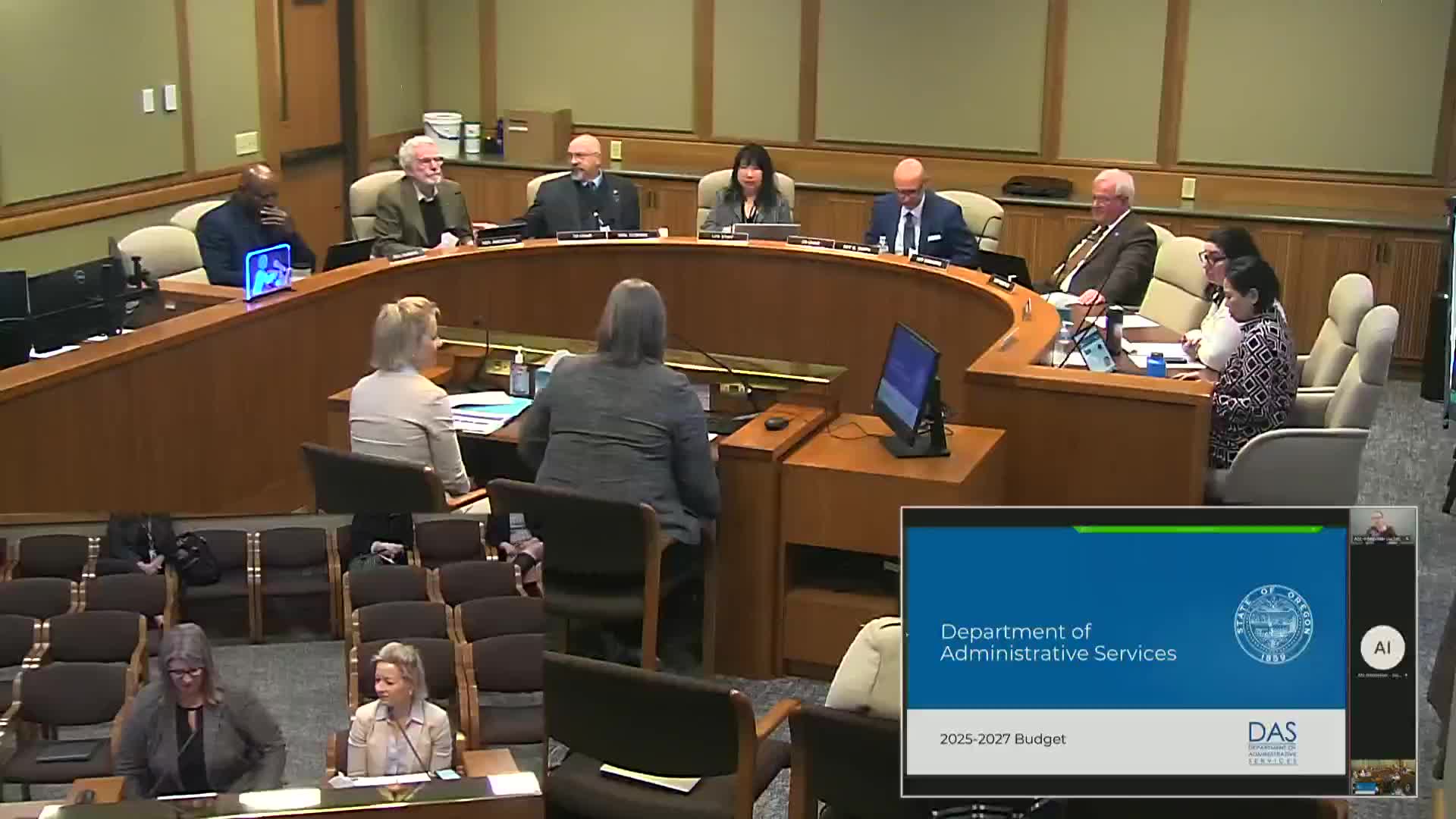
Renee Klein, chief financial officer for the Department of Administrative Services (DAS), and Barry Leslie, DAS director, presented the governor's recommended 2025–27 DAS budget to the Ways and Means Subcommittee on General Government at an informational hearing March 3.
Klein said the department is managing several ongoing pressures that shaped the budget request: expanded client demands for payroll, accounting, HR and IT services; increased enterprise information services needs for cybersecurity and infrastructure; and the risk fund's need for higher balances to cover larger claims. She told the committee that the most recent ARPA (American Rescue Plan Act) expenditures that boosted DAS's budget have largely concluded, leaving roughly $165 million remaining to wind down in this biennium.
"The department continues to see several ongoing challenges that have directly impacted budgetary decisions," Klein said, listing customer demand, information security needs and the risk fund as drivers of the request.
Klein walked the committee through expenditure categories and revenue sources, explaining that a large portion of DAS's operating budget is financed by other funds derived from rates and assessments charged to client agencies; general fund and lottery fund dollars appear primarily in pass‑throughs. She noted the 2023–25 biennium included sizable general fund pass‑throughs for legislatively authorized grants and that the ARPA‑funded programs will largely sunset during 2025–27.
Klein also summarized strategic changes in agency organization. Workday — the state's human resources and payroll information system — will be moved into the Chief Operating Office to centralize Workday resources and lessons learned from rollout issues. DAS leadership also described plans, not scheduled for this session, to replace the state's financial system and place financial system resources under the Chief Financial Office when that work begins.
Klein outlined proposed one‑time capital investments in the 2025–27 request, including deferred maintenance and building upgrades and a complete renovation of the Labor and Industries Building. She said other investments include expanded enterprise information services for managed security and infrastructure upgrades, and a statewide initiative to add EV charging stations at state properties.
Barry Leslie provided a broader description of DAS's dual role: managing agency operations and leading enterprise administrative functions for the executive branch. "DAS is really in the back of the house... we're in the kitchen, we're making meals, we're cleaning the floors," Leslie said, using the analogy to emphasize DAS's shared‑services role.
Leslie and Klein described DAS's strategic priorities — customer service, employee success and well‑being, diversity/equity/inclusion/belonging, and operational excellence — and highlighted specific programs: enterprise goods and services (procurement, printing and mail), enterprise asset management (real estate, fleet and surplus property), internal audit, and financial shared services. Klein noted printing and mailing operations process more than 12 million pages per month and presort mailings to reduce postage costs.
On the risk fund, Klein said DAS has built proposals to bolster fund solvency to meet expected larger claims. She told the committee DAS staff would follow up with legislators on details, including the agency’s capital depreciation monitoring and data‑center lifecycle questions. Senator Manning and other committee members asked clarifying questions about ARPA drawdown timing and whether federal funds remain subject to federal reimbursements; Klein said remaining ARPA allocations are being spent and are on track for the applicable deadlines.
Several members requested deeper follow‑up sessions. The committee asked for further detail on Workday efficiencies, depreciation and maintenance tracking for state buildings, and on the DAS internal audit role; DAS officials noted that the DAS internal audit office currently employs two people but also convenes 29 internal audit offices statewide for coordination and statewide reporting.
The hearing was informational; no formal committee actions were taken. DAS will return for additional budget sessions and deeper dives into Workday, procurement and enterprise information services this budget week.