Get Full Government Meeting Transcripts, Videos, & Alerts Forever!
Get email alerts on the Public Safety Budget topic
No spam. Unsubscribe anytime.
Oregon State Police budget hearing spotlights trooper recruiting, fentanyl enforcement and facility land buys
Summary
At an informational hearing on House Bill 5029, Oregon State Police officials outlined a governor-backed budget that adds troopers to a high-visibility enforcement unit, funds overdose investigations and requests land-acquisition bonds for Coos Bay and Ontario while noting ongoing medical examiner and staffing pressures.
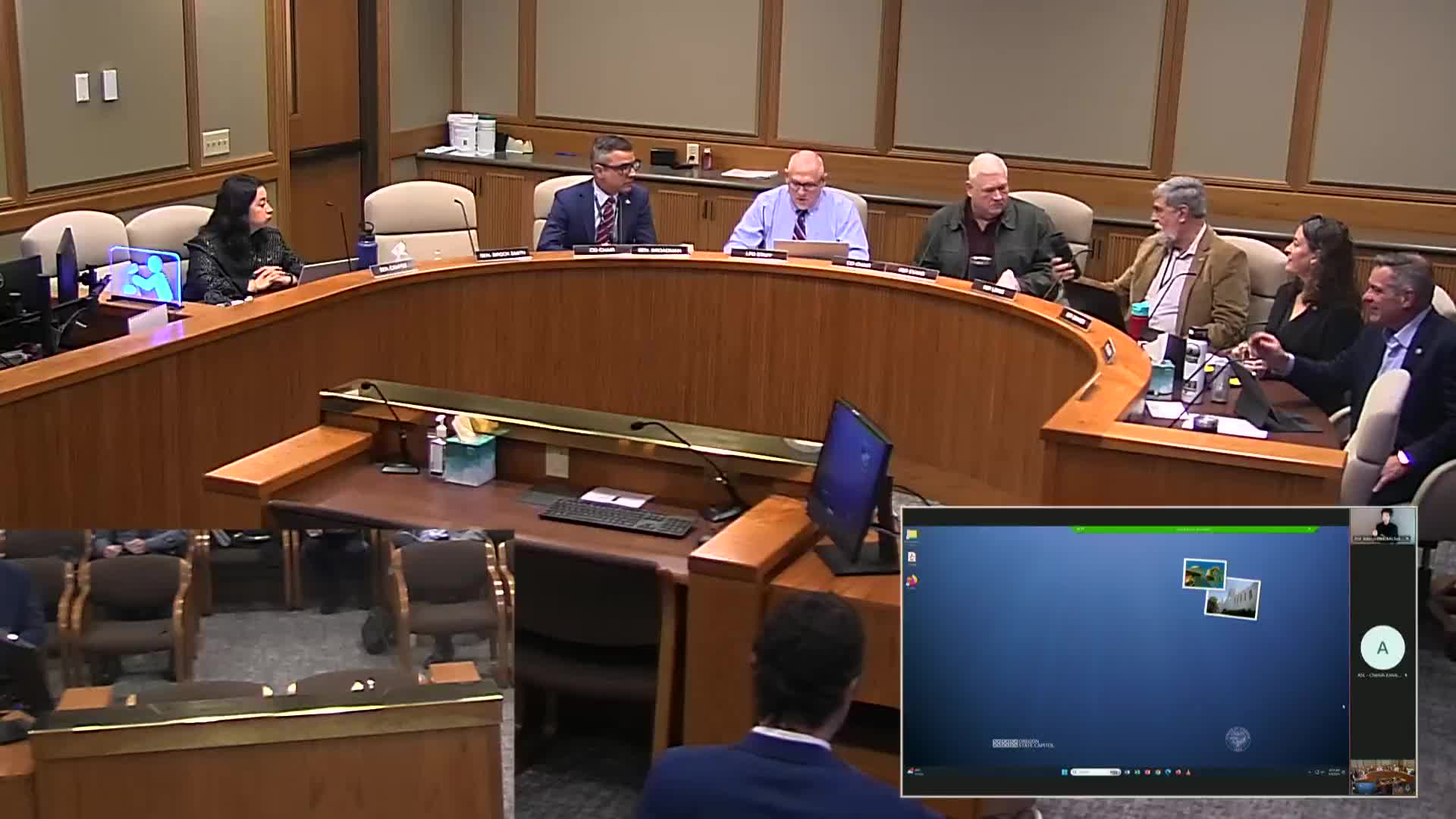
Co-chairs opened an informational hearing on House Bill 5029 on March 3, 2025, to review the Oregon State Police governor’s proposed budget and related programs ahead of upcoming work sessions.
OSP leaders told the Public Safety subcommittee the governor’s 2025–27 budget maintains core operations and adds targeted public-safety investments, while staffing pressures — especially trooper recruitment and medical examiner capacity — remain a concern. “Trooper retention and recruitment…is an ongoing concern,” said Jonathan Bennett, Chief Financial Officer, Department of Administrative Services, summarizing trends the governor’s request tries to address.
The budget figures described at the hearing set a context for the request. Committee staff said the 2025–27 current service level totals about $702.8 million and 1,377 positions; testimony also noted the 2023–25 legislatively approved budget at about $705.7 million and 1,393 positions. Oregon State Police officials said the governor’s proposal increases funding modestly and adds positions targeted to public-safety priorities.
Why it matters: the agency’s budget covers patrol, criminal investigations, forensic services, the state medical examiner’s office and IT/records systems used statewide. About three quarters of the agency’s revenues come from the general fund, officials said; roughly 90% of spending is for personal services and operating support.
Key program and budget items explained at the hearing
- High-visibility enforcement unit (HVEU): The governor’s budget creates ongoing funding for an HVEU originally piloted in 2023. OSP requested 16 positions for the unit (12 troopers, two sergeants, one lieutenant and one administrative specialist) and associated operating funds; testimony quantified the package at roughly $7.1 million general fund. Officials said the unit focuses on highway safety, impaired driving and dangerous driving behaviors.
- State Overdose Response Team (SORT): The governor’s request includes one-time funding — roughly $713,000 general fund, per testimony — to seed a criminal-investigation team focused on overdose deaths (one detective trooper and one sergeant). Superintendent Casey Cotting and other witnesses tied this to the department’s fentanyl enforcement work begun in 2023.
- Fentanyl and interdiction work: OSP leaders described the fentanyl Strategic Enforcement and Disruption Initiative and K9 interdiction efforts. Captain Evan Suther said canine teams “were responsible for preventing over 2,000,000 doses of fentanyl from reaching our communities in the last couple of years,” and described multiagency operations and seizures routed from transportation corridors.
- Facilities and bond authority: The governor’s budget requests Article XI‑Q bond proceeds to acquire land for replacement patrol facilities in Coos Bay and Ontario. Testimony listed $7 million in bond authority for land acquisition (about $3.5 million each for Coos Bay and Ontario).
- State Medical Examiner workload: DAS and OSP witnesses flagged capacity and staffing concerns at the state medical examiner’s office, citing a 2024 report responding to House Bill 4003 that recommended changes but did not quantify a total funding need.
- IT, records and forensic systems: OSP leaders described upgrades to LEHI (LEDS/LEHI 2020), the Firearm Instant Check system (FIX), laboratory information management systems (LIMS) and other applications. Sean Joyce, director of Criminal Justice Information Services, said the agency cleared a major WebQ firearms backlog and that automated fingerprint processing times have dropped markedly.
- Funding sources and special payments: Witnesses said about 77% of available revenue is general fund, Measure 76 lottery transfers support 29 trooper positions for wildlife enforcement, and roughly $13 million of special payments go to ODOT for the statewide radio project.
Questions and follow-up items
Committee members pressed for more detail on trooper staffing baselines, the mix of lateral hires versus new recruits, and commercial motor vehicle enforcement on major corridors such as I‑84. Superintendent Cotting and patrol leaders said they would provide additional numbers offline (for example, precise past-era trooper counts and county-by-county deployment data). Representatives also asked for data on heavy-truck crash trends, motor carrier safety inspections and the geographic distribution of vacancies.
No formal votes were taken; the committee closed the informational hearing and scheduled continuation of OSP’s budget overview in a subsequent work session.
Ending: OSP and DAS staff said they will return for at least one work session later in the week to continue review of House Bill 5029 and related policy packages, and committee members requested additional staffing and program data before any final budget actions are taken.