Get Full Government Meeting Transcripts, Videos, & Alerts Forever!
Get email alerts on the Corporate Activity Tax topic
No spam. Unsubscribe anytime.
Senate committee hears testimony on bills to raise corporate activity tax thresholds
Summary
The Senate Committee on Finance and Revenue opened public hearings March 3 on measures to raise exemptions in Oregon's corporate activity tax (CAT), including proposals to change the CAT threshold from $1,000,000 to $5,000,000 and to create a $10,000,000 threshold for home-building contract receipts.
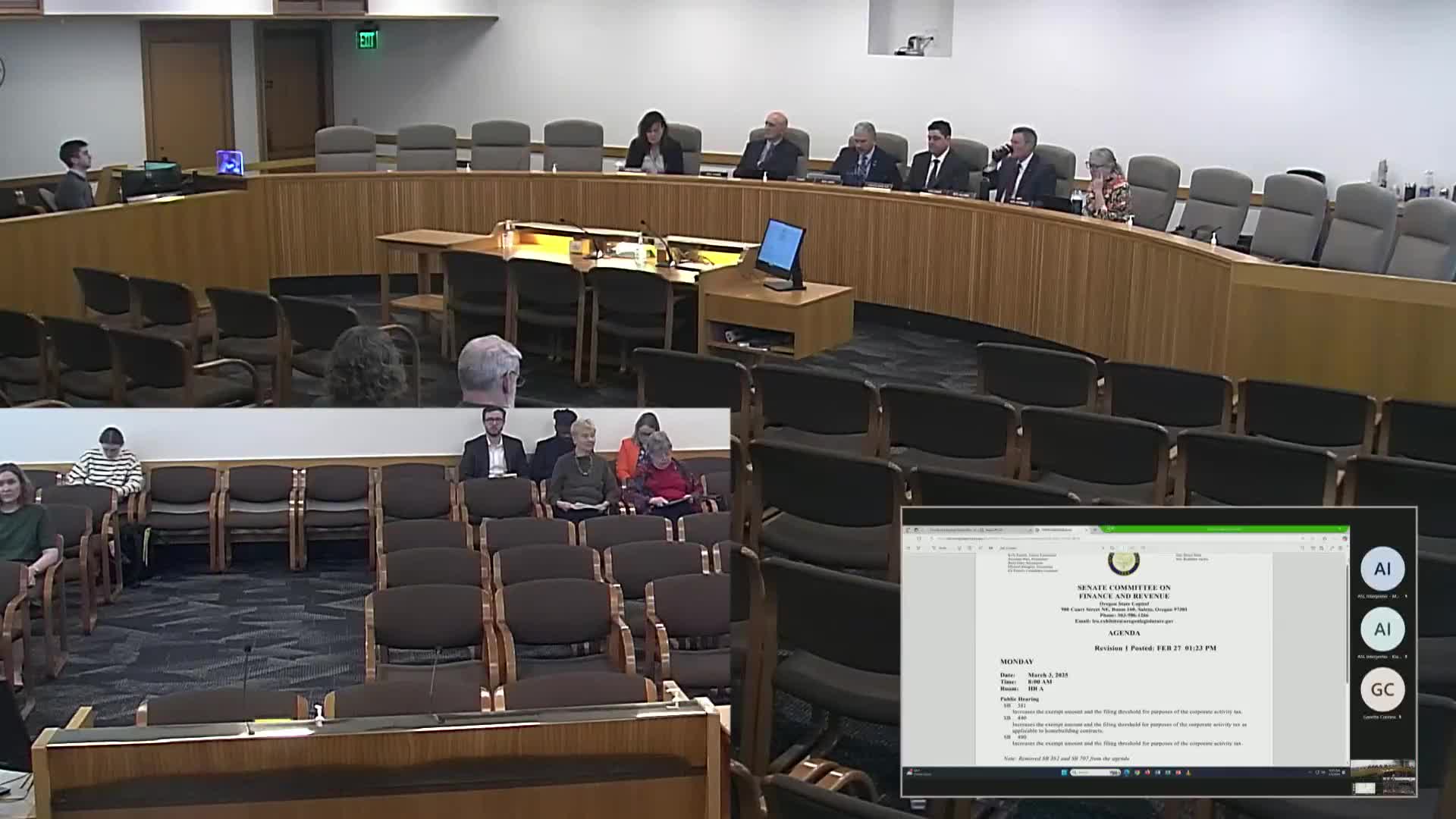
SALEM, Ore. — The Senate Committee on Finance and Revenue opened public hearings March 3 on measures that would raise exemptions in Oregon's corporate activity tax, known as the CAT, drawing competing testimony from business groups and education and labor advocates.
Senate Bill 381 and Senate Bill 490 would change the CAT filing requirement and taxability threshold from more than $1,000,000 in commercial activity to more than $5,000,000. Senate Bill 440 would raise the filing and tax thresholds for amounts received from home-building contracts to more than $10,000,000. The committee took public testimony but did not vote on any bill.
The measures matter because CAT revenue largely funds the Student Success Act, the statute enacted in 2019 that directs CAT proceeds to K-12 and early-childhood investments. Supporters said raising the thresholds would relieve many smaller businesses while preserving most CAT revenue; opponents said the bills would shrink the revenue stream for schools and other services unless offsets are identified.
Sponsor remarks and proponents
Senator Suzanne Weber, who identified herself as representing District 16, told the committee that SB 381 "makes a very, very modest adjustment." Weber said the bill would exempt the first $5,000,000 of gross sales rather than $1,000,000 and left most of the Student Success Act revenue intact while offering "a lifeline to many Oregonian businesses."
Business groups and small employers argued the CAT as written burdens low-margin firms because it is based on gross receipts rather than profit. Anthony Smith, Oregon state director for the National Federation of Independent Business, said the threshold change would be meaningful for small firms and estimated that the change would "exempt about 70% ish of current CAT filers but that 70% only accounts for about 6.5% of total CAT revenues." Smith told the committee many business owners object to paying a tax on gross sales in years they do not make a profit.
Derek Singston, policy director and counsel for Oregon Business & Industry, cited Legislative Revenue Office data and said raising the threshold as proposed would "exempt over 14,000 of Oregon's smallest businesses from the CAT while maintaining over 93% of the $1,200,000,000 generated for schools during the 2022 tax year." He urged the committee to pass either SB 381 or SB 490.
Megan Perona, who identified herself as part owner of ARE Manufacturing in Newberg, described the effect on a single employer: "Last year we paid about $13,000 in CAT tax. If we were able to keep that $13,000 in our company ... it actually covers the wage for 1 student to work part time during the school year and then full time during the summer." Perona said her company averages 40 employees and that its break-even point is about $5,000,000 in sales.
Tax Fairness Oregon's Jody Weiser said the idea of raising the exemption is reasonable but must be paid for. "You could either increase the rate, which is 0.57 right now, or you could . . . change that from 35 to maybe 30% and I'm sure the economists could work to figure out what the numbers needed to be to do a pay for," Weiser testified.
Opposition and concerns about revenue loss
Education and public-employee witnesses urged caution and asked for revenue-neutral changes. Louis DeSitter, testifying for the Oregon Education Association, said OEA is "opposed to SBs 381 and 490" as written and called for broader stakeholder conversations before structural changes to the CAT.
Stacy Mickelson of the Oregon School Boards Association said the Student Success Act investments have funded behavioral-health staff, school meals and supports for high-cost disability students, and warned that "any change in the tax without an appropriate offset will reduce the funding available to schools." Lamar Wise, political director for Oregon AFSCME, representing public employees, also urged rejection of the bills unless revenue neutrality is achieved, saying the proposals "threaten to put even greater financial strain on Oregon's state budget."
On the home-builder exemption, SB 440 drew separate testimony. Senator David Brock Smith, the bill's sponsor alongside Sen. Anderson, said SB 440 would raise the CAT threshold for amounts received under home-building contracts to $10,000,000 to reduce tax-related costs on housing development and encourage construction. Marcia Kelly of the Oregon Women's Rights Coalition noted that builders already receive layered exemptions and cautioned that any carve-outs should avoid creating incentives for very high-cost home construction. Kelly pointed to large national builders as an example and urged revenue neutrality.
Points of detail and requests for data
Witnesses offered differing estimates of who would benefit and how much revenue would be affected. Proponents cited LRO figures showing the bills would exempt many filers while leaving the bulk of CAT revenue intact; opponents said even relatively small reductions in CAT receipts would harm education and called for offsets.
Senators asked clarifying questions about how pass-through contractor receipts affect CAT liability and requested additional analysis. Senator Taylor asked staff for historical context on business-related taxes and who has paid them over recent decades; the committee agreed that would be a useful informational hearing. Chair Meek said the committee will continue the CAT conversation at a follow-up meeting.
Next steps
The committee closed the public hearing on SB 381 and SB 490 and then opened and closed a public hearing on SB 440; no committee votes were taken. The chair announced the committee will continue CAT-related work at a meeting scheduled for Wednesday, March 5 at 8 a.m.
(Reporting in this article is limited to statements made during the March 3, 2025 public hearing and to documents and figures cited in testimony.)