Get Full Government Meeting Transcripts, Videos, & Alerts Forever!
Get email alerts on the Election Records topic
No spam. Unsubscribe anytime.
Committee backs bill to preserve electronic election records for government research
Summary
A House committee voted 8-1 to recommend passage of HB 263, which would require counties to retain electronic election records and limit access to government research purposes; clerks raised cost and workload concerns.
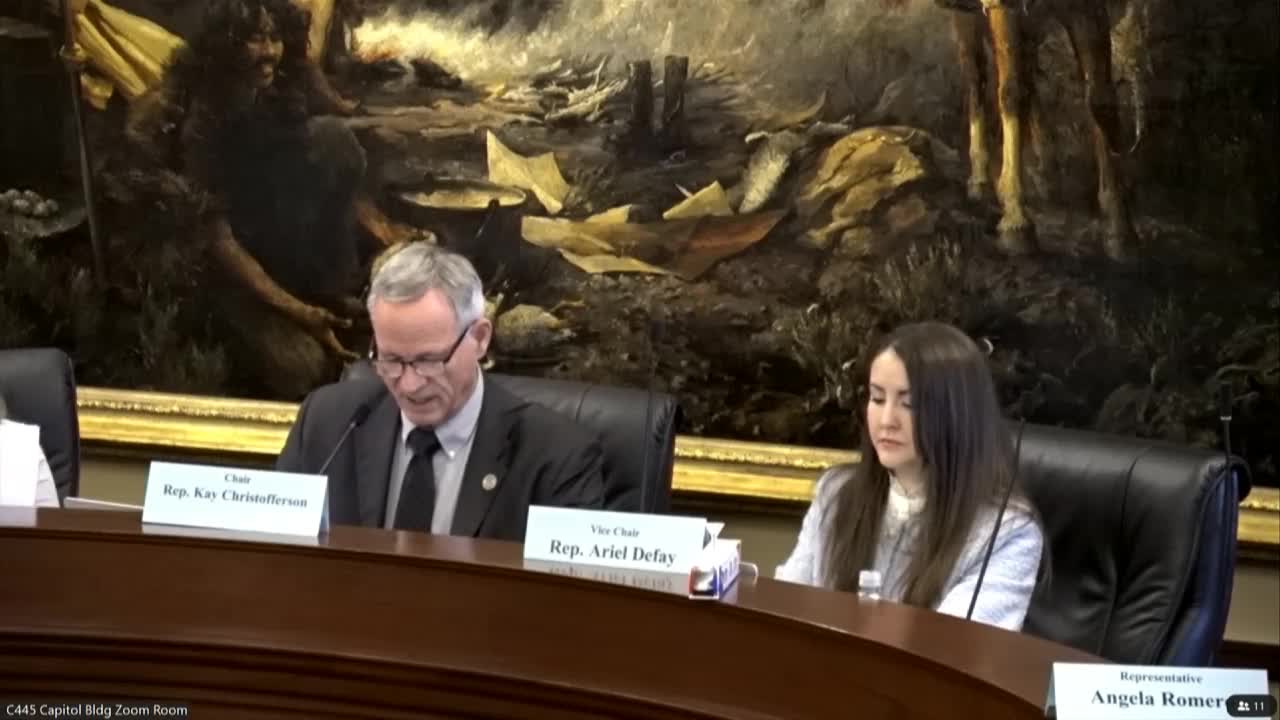
A House committee on March 3 voted 8-1 to favorably recommend House Bill 263, titled “Election Record Amendments,” after discussion about which election materials should be retained, how long they should be kept and who should be allowed access.
Representative Michael Thurston, the bill sponsor, told the committee the measure clarifies which election materials must be preserved, requires an electronic copy of certain records and limits access to government purposes such as legislative committees, the lieutenant governor, the attorney general and auditors. “What the bill does is there's three parts to this. One, it clarifies what election records are to be made public,” Thurston said. He described the second part as addressing retention and the third as regulating access.
The bill’s backers said the measure aligns statute with current digitization practices and would let researchers and legislative committees examine electronic records instead of relying only on auditors or courts. Thurston said county offices currently digitize materials and then, by practice, destroy many electronic files after the statutory retention period, which he noted prevents longitudinal research into election processes.
County clerks and the Utah Association of Counties opposed aspects of the bill at committee. Ricky Hatch, who identified himself as a county clerk and chair of the clerks’ legislative committee, told the committee that a new daily reconciliation requirement would “cause us to stop all of our ballot processing to perform these reconciliations.” He also warned that storing electronic documents would require climate-controlled, secured storage and periodic data refreshes, which take both time and money.
Tooele County Clerk Tracy Shaw said the fiscal impact to counties could exceed $100,000 statewide, and called long-term digital storage “not quite so easy” compared with retaining paper. “This takes money, but it also takes time,” she said, urging caution because election records are sealed to provide finality once contests are resolved.
Supporters pushed back that some reconciliation reports are already required and that the bill is intended to clarify statutory expectations rather than create an entirely new task. Thurston said the bill does not open all digitized records to the general public: access would require an approved research purpose and authorization by a government entity (for example, a county commission approving a county clerk’s research proposal).
Action and vote: Representative Thurston moved that the committee favorably recommend HB 263. The motion passed 8–1; Representative Romero was recorded as the lone “no.”
Why it matters: The bill changes how long and in what format election materials are retained and who can request them. Supporters say preserved electronic records will let legislators and auditors answer policy questions and track trends; clerks warn of new costs and operational burdens.
What’s next: HB 263 will advance from committee with a favorable recommendation. Because the bill limits broad public access and restricts use to government research purposes, its operational impacts will depend on how counties implement scanning and storage processes and on any additional fiscal mitigation the Legislature provides.