Get Full Government Meeting Transcripts, Videos, & Alerts Forever!
Get email alerts on the Housing Homelessness topic
No spam. Unsubscribe anytime.
Sponsor urges $50M program to build permanent supportive housing; developers and health groups testify to cost savings
Summary
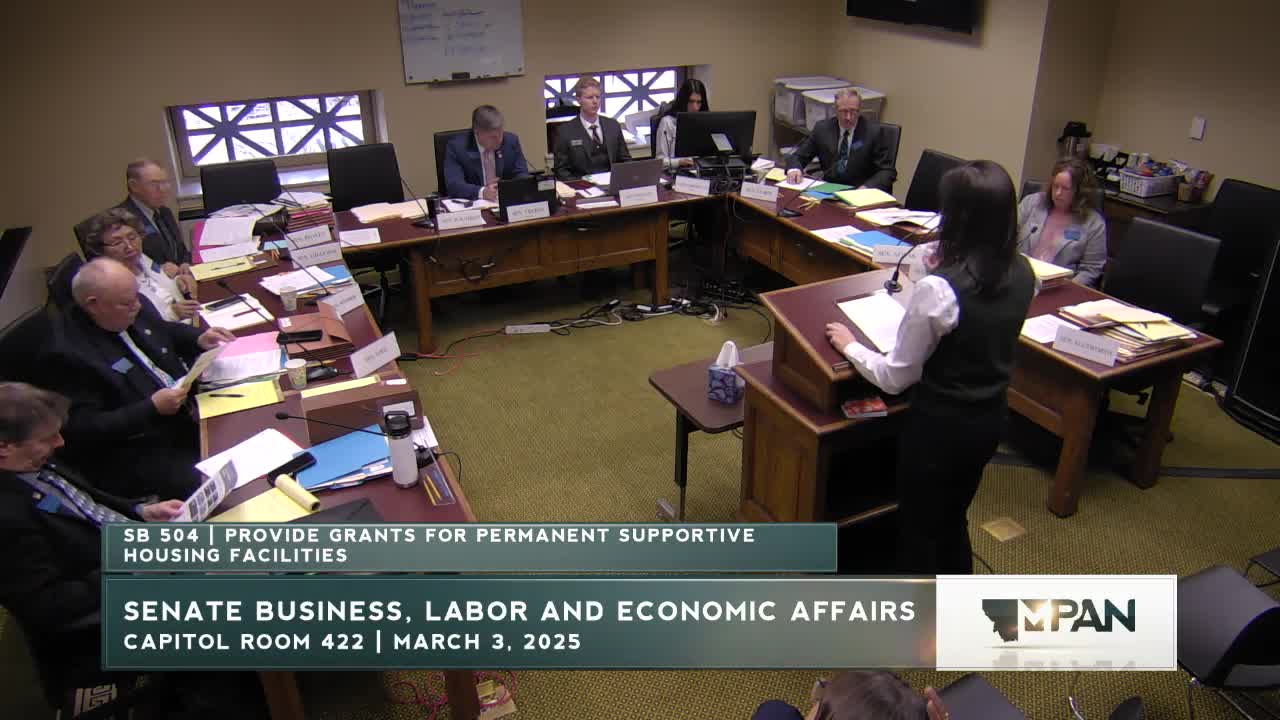
Sen. Cora Newman said Senate Bill 504 would create a grant program to fund construction, acquisition or rehabilitation of permanent supportive housing paired with on‑site voluntary services for people experiencing or at risk of homelessness.
Sen. Cora Newman, sponsor of Senate Bill 504, told the committee the bill would create a permanent supportive housing development grant program to fund acquisition, construction or rehabilitation of housing for people who are homeless or at risk of homelessness, paired with voluntary on‑site services for addiction treatment, mental‑health care, employment training and other supports.
Newman described Montana’s growing housing affordability crisis and said supportive housing — a "housing‑first" model that does not require sobriety for entry — produces better outcomes than crisis‑driven responses. "Studies show that every dollar spent on permanent supportive housing saves up to $3 per person in emergency health care, law enforcement, and public service costs," she told the committee, citing national and state program evaluations and local Montana pilots.
Multiple local nonprofit developers, the Montana League of Cities and Towns, NAMI Montana, the Montana Coalition to Solve Homelessness and Homeward (a Montana affordable housing developer) testified in support. Presenters gave Montana examples: Bozeman’s Housing First Village and Great Falls’ BATS Block Apartments, and Missoula’s Blue Heron Place. Homeward and NeighborWorks Great Falls described reductions in emergency department visits, inpatient days and shelter stays after rehousing; the Montana Healthcare Foundation reported similar savings in projects it funded.
Proponents said a state grant program would help fill financing gaps for projects that require layered funding (tax credits, federal HOME/CDBG funds, philanthropic and pandemic-era homelessness grants) and would leverage ongoing federal resources. Witnesses said projects typically require community partnerships for case management and ongoing operations and urged the committee to pair capital grants with sustainable operational funding sources.
Committee members asked about project scale, average lengths of homelessness and operating funding. The sponsor said chronic homelessness generally lasts 12 months to three years and that federal funding streams (Community Development Block Grant, HOME, National Housing Trust Fund, Section 8) can be layered to support operations. She also said she was open to negotiating the initial appropriation and grant-size caps with stakeholders.
No opponents had signed up; the sponsor asked for a due‑pass recommendation.