Get Full Government Meeting Transcripts, Videos, & Alerts Forever!
Get email alerts on the Pharmacy Access topic
No spam. Unsubscribe anytime.
Senate passes bill to allow pharmacists to test and start treatment for minor acute conditions
Summary
The Senate Health and Human Services Committee approved Senate Bill 7 41 to let pharmacists, working under standing orders from physicians or local health‑department medical directors, test for and initiate drug therapy for certain minor, nonchronic conditions; author says measure targets rural access concerns and will be revised further.
Senator Galahara presented Senate Bill 7 41 to the Senate Health and Human Services Committee, saying the bill is part of a package aimed at supporting small‑town pharmacies and improving access to care in medically underserved rural Oklahoma. He said the bill would authorize a pharmacist operating under a standing order from a physician or a county or local health‑department medical director to test or screen for and initiate drug therapy for minor, nonchronic health conditions.
The measure matters because many rural communities lack primary‑care providers but do have pharmacies that could provide initial treatment, proponents said. "Many rural Oklahoma counties are medically underserved," Senator Galahara said, asking the committee for an opportunity to continue improving the bill’s language and protocols.
Committee members pressed the sponsor on safeguards. Senator McIntosh asked whether the bill had been discussed with groups representing nurse practitioners, physician assistants and physicians and whether an extra screening requirement at every visit was contemplated. Senator Galahara acknowledged concern the draft was “too broadly written” and said he had been consulting with both sides, including doctors, pharmacists and the osteopathic council, and that he was "trying to be extremely careful" to avoid harm and to put patient well‑being first. Senator Doss asked who would issue the standing orders; Galahara responded that a standing order would come from a physician or the medical director of a county or local health department and would include clinical protocols for the covered conditions.
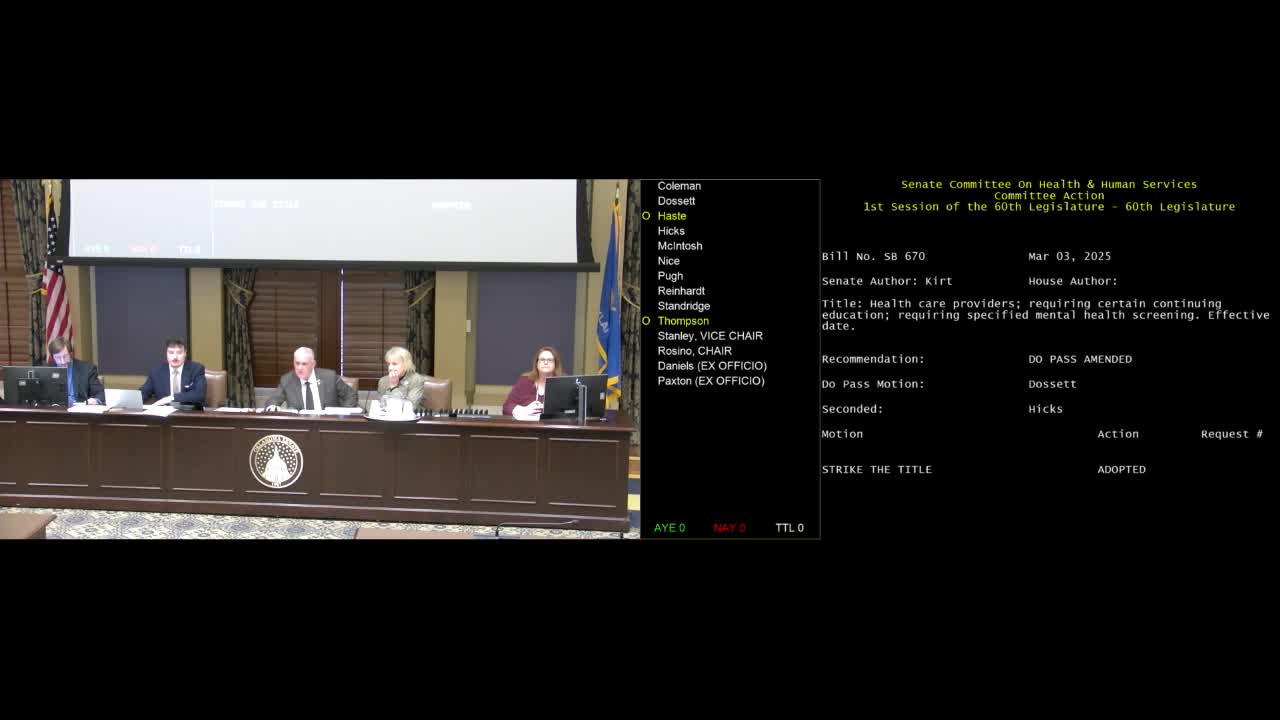
Supporters said the bill aims to allow pharmacists to provide timely initial treatment for simple acute conditions—examples cited by the author included head lice and poison ivy—where full physician access is not available locally. The author and the chair stressed the bill is a "work in progress" and that the sponsor asked to strike the title and continue refining screening and protocol language before floor action.
The committee voted to pass the bill. The clerk recorded 10 ayes and 1 nay, and the chair declared Senate Bill 7 41 passed. The author said he will continue working with stakeholders to refine the bill’s language and protocols.
Votes at a glance: The committee recorded 10 ayes and 1 nay on SB 7 41. The roll call list was read aloud; a full, named yea/nay roll was not included in the committee record excerpt.
What’s next: The author intends further negotiations on screening language and standing‑order protocols before the bill moves to the floor.