Get Full Government Meeting Transcripts, Videos, & Alerts Forever!
Get email alerts on the Workers Compensation Immigration Travel topic
No spam. Unsubscribe anytime.
Committee hears bill to end benefits for workers who leave U.S.; state agencies warn of legal, policy risks
Summary
House Bill 805 would bar workers’ compensation benefits for people the bill labels as "illegal aliens" and allow closing claims when claimants leave the United States; the Department of Labor and Industry and unions warned of constitutional and policy problems.
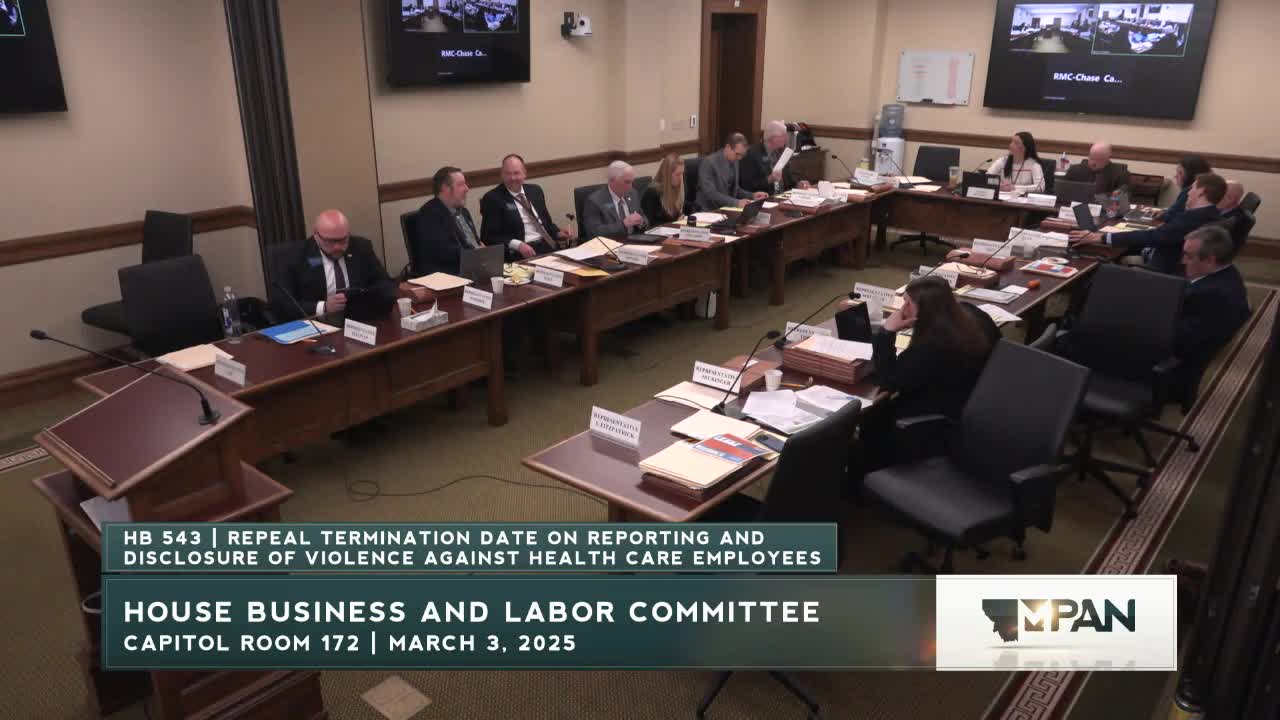
Helena — A proposal to deny workers’ compensation benefits to people described in the bill as “illegal aliens,” and to allow closure of claims when claimants leave the United States, prompted detailed legal opposition at a House Business and Labor Committee hearing.
Representative Nellie Nickel introduced House Bill 805, which would clarify how Montana’s workers’ compensation system treats claimants who are not authorized to work in the U.S. and claimants who travel outside the country. Nickel said the bill responds to unspecified gaps in current law and aims to prevent employers and insurers paying claims when recipients are outside the U.S. and unavailable for treatment or return to work.
The Montana Department of Labor and Industry and its legal counsel urged the committee to oppose the bill. Quinlan O’Connor, chief legal counsel for the department, said key provisions are constitutionally problematic and would likely be preempted by federal law. He cited the Montana Supreme Court’s earlier ruling about the use of the term “illegal alien” and read from the U.S. Supreme Court decision Kent v. Dulles (1958) on the constitutional right to travel. O’Connor warned the bill could encourage “bad actor” employers to hire unauthorized workers to avoid liability.
Amanda Frickle of the Montana AFL‑CIO and other opponents raised practical and moral concerns: denying benefits could incentivize employers to hire unauthorized workers, and the bill’s travel restrictions could impinge on the constitutional liberty of American citizens who have workers’ compensation claims but then choose to travel. Legal opponents noted the bill would change appellate standards and discipline authority for a narrow class of licensees and could conflict with work‑authorization enforcement already managed at the federal level.
Several workers’‑compensation and trial‑lawyer advocates described scenarios involving visa‑tied employees (for example, H‑2A agricultural workers) and foreign workers with work visas who become injured; opponents said current practices allow claims to be pursued while treatment arrangements are made, and that denying benefits would create perverse incentives and practical hardships for injured people who may be unable to remain in the U.S. to receive care.
Representative Nickel suggested penalties or enforcement tools against employers who knowingly hire unauthorized workers could be a separate solution, and said the legislation aims to make the law clearer. After extended testimony, the committee adopted a substitute motion to table HB 805 during executive action.
Why it matters: Workers' compensation rules define the safety net available after workplace injury. This bill would alter eligibility in ways opponents say are legally vulnerable and could create incentives that worsen outcomes for injured employees.
Next steps: The committee tabled the bill during executive action. Opponents urged study and stakeholder engagement if lawmakers pursue changes in future sessions.