Get Full Government Meeting Transcripts, Videos, & Alerts Forever!
Get email alerts on the Health Workforce Mental Health topic
No spam. Unsubscribe anytime.
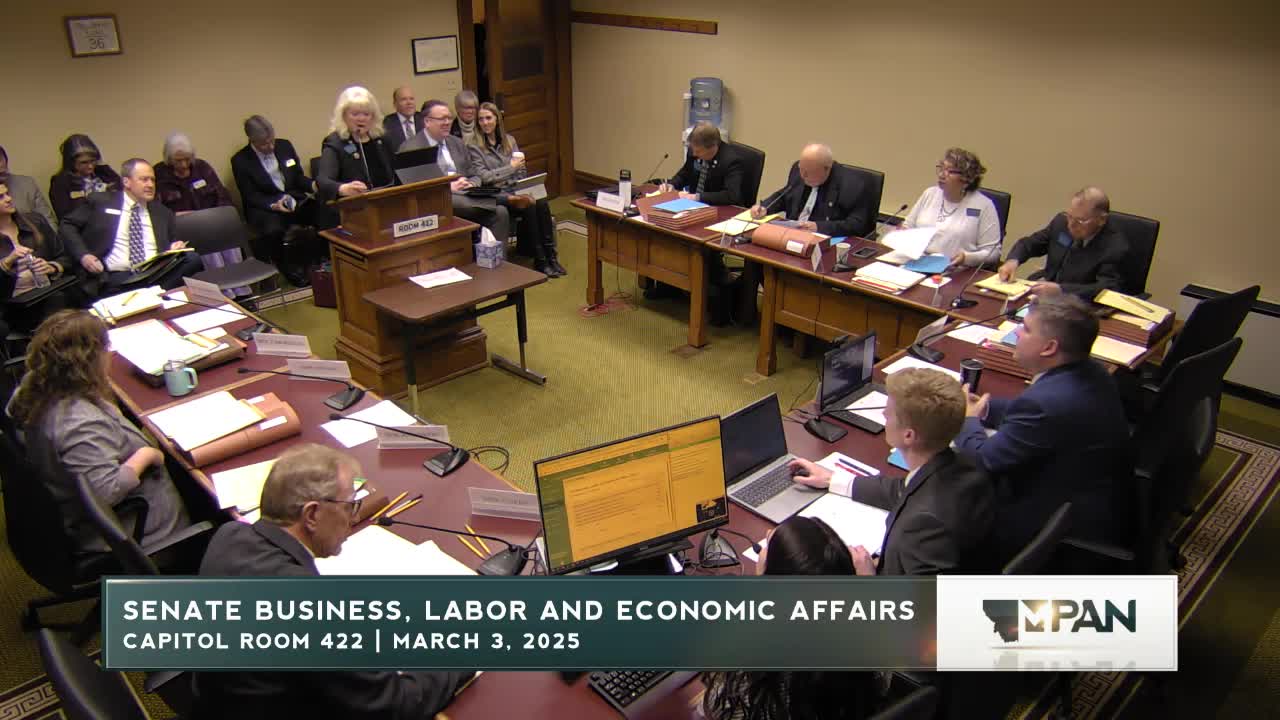
Senate committee hears bill to create confidential ‘safe haven’ care program for Montana health professionals
Summary
Sen. Wendy McCamey told the Senate Business and Labor Committee that Senate Bill 497 would create a confidential program to let licensed health professionals receive early behavioral-health care without automatic licensure reporting.
Sen. Wendy McCamey (sponsor) told the Senate Business and Labor Committee that Senate Bill 497 would create a confidential pathway for licensed health-care professionals to get early behavioral-health counseling without automatically triggering licensure reporting obligations.
The bill’s sponsor said the measure “addresses the confidentiality, which clearly matters,” and proponents — including the Montana Medical Association and Montana Nurses Association — said removing reporting barriers could increase early help seeking and reduce burnout, errors and turnover in rural Montana.
Supporters framed the bill as a workforce and patient-safety measure. Jean Branscomb, CEO of the Montana Medical Association, told the committee that a 02/2024 Montana Medical Association survey found that about 46 percent of Montana physicians reported that they or a colleague delayed or did not seek behavioral-health treatment when needed, and witnesses described suicide and staffing losses linked to burnout. Proponents asked for statutory privilege and limited immunity for vetted, non-governmental peer assistance or assistance programs so clinicians would feel safe accessing early counseling and coaching. Justin Cole, a healthcare attorney representing the Montana Medical Association, said the bill is modeled on statutory privileges similar to peer-review protections and reiterated that the bill still requires reporting when a participant is “not competent to continue to practice or is a danger to themselves or others.”
Opponents led by Sarah Swanson, commissioner of the Department of Labor and Industry, said as written the bill would reduce boards’ and the department’s ability to protect patients. Swanson told the committee that occupational licensing’s “number one role and purpose … is public health and safety” and warned the bill “doesn’t fully align” with existing mandatory-reporting duties found in statute, which she read aloud during the hearing. The department asked to continue working with the sponsor and stakeholders on statutory language to preserve a board’s ability to investigate risks to patient safety while making early-help programs truly confidential and useful.
Committee discussion focused on whether the bill properly balances clinicians’ access to confidential early care with licensing boards’ duty to act when patient safety is at risk. Supporters said the program targets early, non-crisis help (coaching, peer support, confidential consultations) and that the bill preserves reporting when the evaluator determines a clinician is unsafe. Opponents said the language is not yet aligned with existing Montana reporting statutes and could create a gap in board oversight. Several physicians and professional groups described existing low use of employer employee assistance programs and the need for psychologically safe, third-party options.
The committee held the hearing; no formal vote or amendment was recorded during the session.
The sponsor said she will continue to work with the department and stakeholders to refine the bill’s language to keep confidentiality protections while preserving patient-protection reporting obligations.