Get Full Government Meeting Transcripts, Videos, & Alerts Forever!
Get email alerts on the County Finance topic
No spam. Unsubscribe anytime.
Financial adviser warns Monroe County against treating high 2024 interest income as sustainable
Summary
Financial Solutions Group told the council the county’s strong 2024 ending balance and elevated interest income are unlikely to persist; advisers recommended conservative budgeting, a review of salary commitments, and building self‑insurance reserves.
The county’s municipal advisor told Monroe County Council on Feb. 25 that the county’s strong balance sheet in 2024 should not be treated as a durable revenue source and urged conservative budgeting and new controls on appropriations.
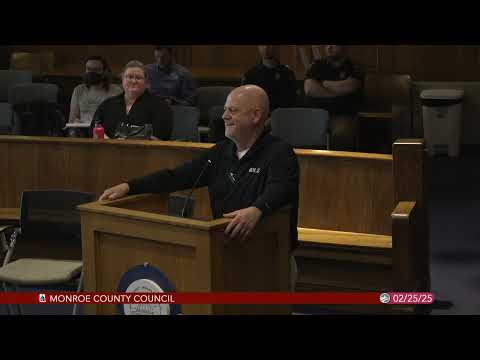
Greg Garritas of Financial Solutions Group, the county’s municipal advisor and certified public accountant, said the county finished 2024 with an unusually high interest income and a strong ending general fund balance. “We have a very strong $30,000,000 — 30.1 million dollars ending balance,” Garritas said, but he warned that interest income that pushed totals higher in 2024 was driven by elevated short‑term interest rates and could fall sharply if rates decline.
Why it matters: Garritas said the county’s one‑time gains from interest and pandemic (ARPA) funds cannot be relied on for ongoing operating costs. He urged the council to plan now for lower revenue assumptions in the 2026 budget cycle.
Key points and recommendations reported to the council: • Interest sensitivity: Garritas said if interest rates fall—he cited a hypothetical 2.5% Federal Reserve rate—interest income could drop substantially from 2024 levels and the county should not assume similar receipts going forward. •Budget discipline: He recommended a near‑term pause on nonessential additional appropriations and suggested departments be asked to identify durable reductions and travel or noncritical spending to delay. •Salary and staffing scrutiny: The advisory recommended separating mandatory step increases from discretionary raises when projecting salaries for 2026 so the council can see which portions are recurring and which are policy choices. •Reserves and insurance: Garritas advised building the self‑insurance reserve (the county’s internal fund for claims) toward a target many counties set near $3 million and to monitor stop‑loss and other health‑insurance costs. •Capital financing: He recommended use of GEO (lease‑rental) bonds as a long‑term tool for capital financing and noted the county’s equity funds (bridges, major projects) can serve as an “equity” portion alongside bond financing.
Councilors asked several follow‑up questions about the timing of possible state and federal changes, the effect of annexation on tax distributions and whether the county’s current fund mix (general fund, EDIT, jail correctional facility tax and ARPA) was being used optimally. Garritas said the county should run a first‑quarter annualized comparison of receipts and expenditures and a midyear review to detect early signs of revenue deterioration.
Council direction and next steps: Councilors asked staff and the auditor to circulate Garritas’ recommendations and the auditor’s reversion trend reports to all department heads; Council President Crossley asked that departments look for nonessential travel and other near‑term cuts and that PAC (the personnel advisory committee) and the council coordinate on any proposed salary actions.