Get Full Government Meeting Transcripts, Videos, & Alerts Forever!
Get email alerts on the Homelessness topic
No spam. Unsubscribe anytime.
Eureka council directs staff to draft camping and sit‑and‑lie ordinance updates, hears homeless action plan progress
Summary
At a Jan. 14 special meeting, the Eureka City Council reviewed legal changes after the U.S. Supreme Court ruling in City of Grants Pass v. Johnson, heard police and service‑provider briefings and gave informal direction to staff to draft updates to the city’s camping and sit‑and‑lie ordinances while continuing diversion and housing efforts.
The Eureka City Council on Jan. 14 directed staff to draft updates to the city’s camping and sit‑and‑lie ordinances and reviewed the city’s homeless action plan, including a near‑term transitional housing site and a new resource center.
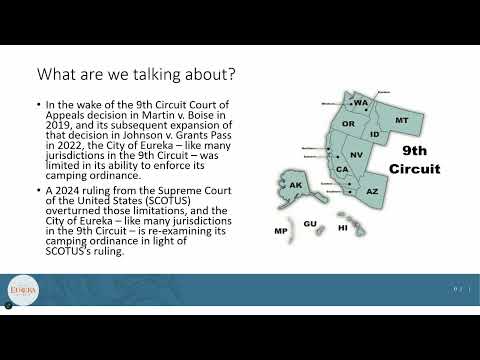
City Attorney Luna framed the legal reason for the review: the Supreme Court’s June 2024 decision in City of Grants Pass v. Johnson overturned Ninth Circuit limits that had constrained local no‑camping enforcement. Luna told the council the court majority, written by Justice Neil Gorsuch, rejected the Ninth Circuit’s prior approach and noted the decision returned more latitude to local governments. "Justice Gorsuch wrote that ‘federal judges shouldn't decide the nation's homeless policy,'" Luna said while summarizing the opinion and a dissent by Justice Sonia Sotomayor.
The council heard three operational presentations: Sgt. John Omi described enforcement and CSET outreach and cleanup burdens, Managing Mental Health Clinician Jacob Rosen outlined clinical barriers to voluntary treatment, and Special Project Manager Jeff Davis updated the council on housing and services.
Why it matters: council members and staff said the change in federal case law creates latitude to rewrite local code, but they stressed any changes must be paired with services to avoid simply displacing people. City Manager Miles Slattery said staff will return with draft ordinance language and implementation recommendations for council review.
Key facts and proposals
- Ordinance review: Staff said the city will review its municipal code provisions currently at EMC 130.12 (sit/lie) and 93.02 (camping) and present draft revisions. Council gave informal direction — a thumbs‑up consensus — for staff to prepare draft ordinance language for future council meetings; no formal vote was taken.
- Enforcement tools and diversion: Sgt. Omi described the day‑to‑day approach of CSET: "Most individuals we contact at camps voluntarily comply," he said, but added there is a smaller group that does not accept offers of help and creates repeated public‑safety and environmental problems. Police and service staff discussed re‑implementing a law enforcement‑assisted diversion model (LEAD/LEAD‑style pre‑booking diversion) so that, when appropriate, low‑level cases are held while participants engage with outreach partners and services.
- Clinical context: Jacob Rosen summarized treatment barriers, saying about a third of clients show symptoms of anosognosia — a clinical inability to recognize one’s own illness — which reduces voluntary engagement with services. "One third of our clients have the symptom of anosognosia," Rosen said, explaining why coercive or court‑ordered pathways are sometimes considered for people who refuse treatment.
- Homeless Action Plan and housing: Jeff Davis said the city has obtained a pro‑housing designation that enables more funding opportunities and reported progress on multiple projects, including a waterfront transitional housing site on the Crowley property. Davis said the site will include 33 units, 38 beds and "up to 40 people" and hopes to begin move‑ins in the coming month. He also announced the Uplift Eureka Resource Center (1111 E Street) has opened with soft hours and public open houses and will expand hours in February.
- Trash and environmental impact: CSET statistics were cited during the meeting; Sgt. Omi said CSET coordinated removal of nearly 100,000 pounds of trash last year and that encampments are causing environmental damage along trails and wetlands.
Public comment and community concerns
Public speakers represented a range of views. Trail volunteers and the Humboldt Trails Council described environmental damage and safety concerns on the Waterfront Trail and urged stronger protections for wetlands and trail corridors. Other residents urged expanded low‑barrier shelter options, safe‑parking and sanctioned, serviced camping locations; some asked that enforcement be paired with guaranteed alternatives. Service providers and residents also urged continued investment in diversion, outreach and shelter capacity.
Council direction and next steps
Council did not adopt an ordinance at the meeting. Instead, staff were directed to draft ordinance updates reflecting the legal change and to return to the council with proposed language, implementation steps and associated policies. City staff and the city attorney cautioned the council that policy details and operational protocols (for example, diversion enrollment steps, thresholds for escalating enforcement, and data‑review timelines) are typically handled through staff policy and program materials rather than buried in code text.
Quotes from presenters
"Most individuals we contact at camps voluntarily comply," Sgt. John Omi said, describing typical outreach and compliance patterns.
"One third of our clients have the symptom of anosognosia," Managing Mental Health Clinician Jacob Rosen said, explaining clinical reasons some people do not engage with voluntary services.
"We are getting very close to seeing this come to fruition — 33 units, 38 beds, and up to 40 people will be residing here," Special Project Manager Jeff Davis said about the Crowley waterfront transitional site.
What the council and staff said about oversight
Council members asked staff to return with clear checks, reporting requirements and an implementation plan before any ordinance adoption. Staff agreed to draft code that is enforceable and to include recommended policies and performance measures so council can review both legal text and operational safeguards.
Where this goes next
Staff will prepare draft ordinance language, implementation procedures for diversion and enforcement, and a timeline for council review and public hearings. The council’s direction was to bring drafts back for formal introduction and subsequent adoption hearings; no formal adoption occurred at this meeting.
Ending note
The meeting highlighted the balance the council seeks: a legal framework that is enforceable under the new Supreme Court precedent while pairing enforcement tools with outreach, diversion and new housing capacity so enforcement is not merely displacement but part of a broader effort to connect people to services and reduce environmental and public‑safety harms.