Get Full Government Meeting Transcripts, Videos, & Alerts Forever!
Get email alerts on the Housing Zoning Debate topic
No spam. Unsubscribe anytime.
Residents split on zoning and housing: advocates urge reform, neighbors press preservation
Summary
Public commenters were sharply divided during the Land Use Commission hearing: housing advocates and some residents urged zoning reform and more housing options; other residents and preservation groups warned against broad upzoning and urged protections for single‑family character and historic fabric.
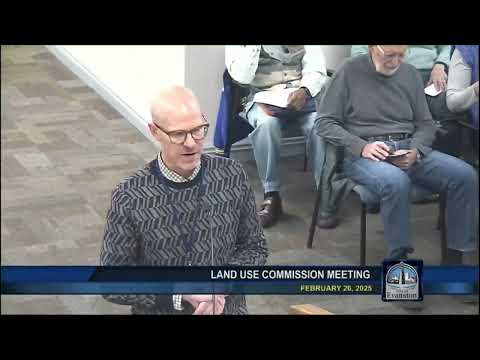
The Land Use Commission hearing on Feb. 26 produced sharply divided public testimony on zoning, housing affordability and neighborhood character.
Sarah Friedman, a Sixth Ward resident, spoke in favor of allowing more housing options in single‑family areas, saying she and neighbors hosted discussions about zoning and “have heard no hesitancy toward the idea of upzoning in the Sixth Ward.” Scott Roberts, speaking for the Say Yes to Duplexes campaign, urged the plan to explicitly recognize duplexes and historic double houses as part of Evanston’s housing fabric, saying those forms predate modern residential zoning and provide lower‑cost ownership opportunities.
Opponents warned that broad upzoning would damage neighborhood character, increase congestion and not necessarily produce affordable units. Architect and First Ward resident Michelle Klabeck cited U.S. Census data showing a stable or declining population and a 7% vacancy rate and questioned whether “significant additional housing” is the right approach in Evanston. Multiple speakers including Steve Tuss and Julia Foragash urged that single‑family neighborhoods be preserved except where a transparent, community‑led process identifies specific lots appropriate for denser uses.
Housing advocates and nonprofit leaders told the commission the draft’s chapter 10 policy recommendations on housing provide a framework to support affordability, but they urged stronger narrative language tying the plan’s metrics (income inequality, life expectancy gaps, housing cost burden) to explicit equity priorities. Sue Lohlbach of Connections for the Homeless—speaking for Joining Forces for Affordable Housing—noted the draft’s policies are “based on evidence and emerging best practices” but said the narrative portions are broad and “open to interpretation” and would benefit from clearer emphasis on equity.
Speakers who addressed the mechanics of affordability noted that market‑rate upzoning is not a direct substitute for subsidized affordable housing. Several commenters urged the city to pair zoning flexibility with targeted tools—subsidies, nonprofit partnerships, community land trusts, or incentives—to produce permanently affordable units.
Preservation advocates asked for stronger language and an institutional mechanism to ensure design quality. Jack Weiss of Design Evanston recommended strengthening text that currently references a “design review committee” so it specifically directs the city to “establish a community design commission comprised of professional designers and related experts” rather than a light‑touch advisory group.
Why it matters: The comprehensive plan’s narrative and policy phrasing will shape the conversation about eventual zoning changes; commissioners and staff noted the need for the plan to reflect competing priorities and for subsequent zoning code work to provide detailed implementation measures.
What was requested of the commission: Multiple speakers asked commissioners to clarify what “character” means in the plan; preservation groups requested stronger protection language and a path for a community design commission; housing advocates urged clearer equity‑focused narrative and a follow‑up strategic housing plan to move policy toward concrete programs and funding.