Get Full Government Meeting Transcripts, Videos, & Alerts Forever!
Get email alerts on the Gender Identity Legislation topic
No spam. Unsubscribe anytime.
West Virginia Senate passes bill defining 'men' and 'women' after extended floor debate
Summary
On Feb. 28, 2025, the West Virginia Senate passed Engrossed Committee Substitute for Senate Bill 456, which defines 'men' and 'women' in state code and restricts certain single‑sex spaces; the measure passed on third reading 32‑1 with one senator absent after multiple senators delivered floor remarks both supporting and criticizing the bill.
Engrossed Committee Substitute for Senate Bill 456, defining "men" and "women," passed the West Virginia Senate on third reading Feb. 28, 2025, by a vote of 32 ayes, 1 nay and 1 absent, the chamber announced after the roll call.
The bill, offered on third reading, inserts a statutory definition of "men" and "women" into state law and includes provisions that domestic public‑occupancy restrooms and changing rooms "should be designated for the exclusive use of either males or females," according to the bill text read on the floor.
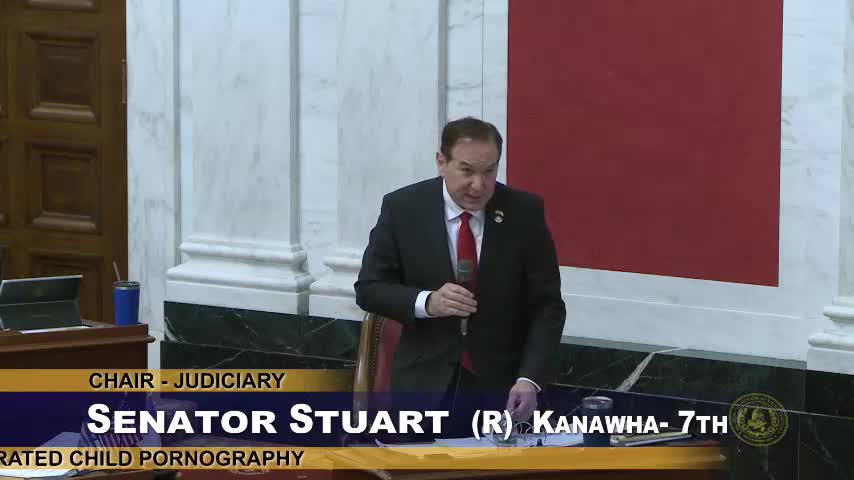
Supporters argued the language preserves privacy and safety for women in certain single‑sex spaces. The senator who presented the bill on third reading, identified in the transcript as the Junior Senator from the Seventh Senatorial District, said on the floor, "This is the bill, mister president, and I urge passage." The sponsor said the measure came from the governor's office and was modeled on prior legislation addressing the same subject.
Opponents and some colleagues urged caution and emphasized compassion for affected neighbors. The Senator from Marion, during an extended floor statement, urged care for people the bill would affect and invoked religious and moral considerations, saying, "We need to love our neighbor," and asking the body to consider whether the measure would harm vulnerable people.
Floor remarks addressed both practical and moral concerns. Senators who supported the bill described it as intended to preserve privacy in restrooms and changing rooms and to codify a biological definition in state law; senators who opposed or questioned it warned of potential harms to transgender and gender‑questioning West Virginians and emphasized limited evidence cited for the bill's prohibitions. At least one speaker highlighted possible consequences for domestic violence shelters and said providers there do not routinely single out victims by such categories.
On the procedural record, the bill came to the floor as an engrossed committee substitute for third reading. After debate, the clerk reported 32 ayes, 1 nay and 1 absent; the president declared the bill passed and instructed the clerk to communicate the action to the House of Delegates.
The Senate did not record a named mover or seconder on third reading in the transcript. No floor amendment was recorded during the third‑reading sequence in the transcript excerpt provided.
What happens next: the clerk will convey the Senate's action to the House of Delegates; the transcript does not state whether the House has concurred or whether the bill will return to the House for further action.
Clarifying details from the floor record: the measure was presented as coming from the governor's office; the language explicitly addresses designation of restrooms and changing rooms for exclusive use by males or females; the transcript records extended moral and policy arguments but does not show subsequent statutory cross‑references or implementation guidance.
Votes at a glance (this article): Engrossed committee substitute for Senate Bill 456 — passed on third reading, 32 ayes, 1 nay, 1 absent, declared passed.