Get Full Government Meeting Transcripts, Videos, & Alerts Forever!
Get email alerts on the Healthcare Workforce topic
No spam. Unsubscribe anytime.
Committee advances $1,000 preceptor tax credit aimed at expanding health workforce
Summary
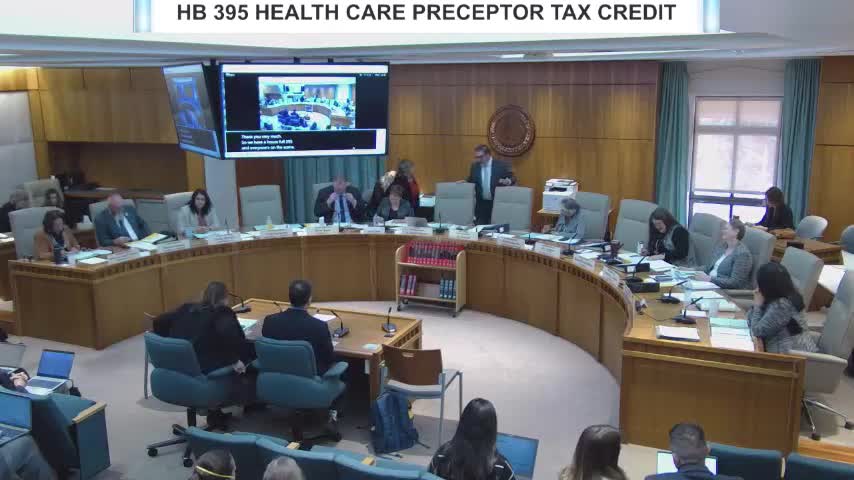
The House Education Committee gave a due‑pass recommendation to House Bill 395, which would create a $1,000 personal income tax credit for volunteer health‑care preceptors who supervise at least one residency rotation during the taxable year.
The House Education Committee gave a due-pass recommendation to House Bill 395, which would create a $1,000 personal income tax credit for qualifying volunteer health-care preceptors who supervise at least one residency rotation during the taxable year.
Representative Gonzales, the bill sponsor, said the credit is intended to expand clinical training capacity across New Mexico by compensating volunteer clinicians who supervise residents and other trainees. The amended bill clarifies that preceptors may be volunteers affiliated with universities or community sites and specifically names nurse‑midwives among the covered license types.
Matthew Probst, an expert witness, described the credit as a way to “bust open the bottleneck” in clinical training by valuing clinicians who mentor the next generation of health professionals. Testimony in support came from Think New Mexico, the New Mexico Nursing Association, the American College of Nurse Midwives (New Mexico affiliate), Southwest Bone and Joint Institute, and the Greater Albuquerque Chamber of Commerce. Supporters said the credit is one low-cost policy among several to increase the number of trained clinicians who may then remain in New Mexico.
The bill sets basic eligibility and administration rules: an eligible preceptor must be a volunteer (non‑compensated for the precepting activity), complete at least one full residency rotation during the taxable year, and obtain a certificate from the supervising institution to attach to their tax filing. Committee testimony noted residency rotations vary in length and that the bill does not differentiate credit amounts for multiple rotations; one qualifying rotation in the taxable year is sufficient to claim the single $1,000 credit.
Representative Baca and others pressed for clarifications about timing (academic rotation vs. tax year), verification of successful preceptorship, how the credit treats preceptors who also receive compensation or stipends, and whether credits would be capped. Witnesses said the credit is limited to volunteer preceptors and would be claimed with an institutional certificate; the bill does not include a statewide dollar cap. The fiscal analysis projects the credit beginning in fiscal year 2026 with multi‑year projections through FY2029 but the sponsor said she did not include a sunset clause and the credit is intended to be ongoing until legislative action changes it.
Representative Roybal Caballero moved a due‑pass recommendation; the motion was seconded and the committee advanced the bill to the next stage.
Supporters urged the committee to adopt the credit to increase clinical training slots statewide and to help rural and tribal communities recruit clinicians trained in those communities. No witnesses spoke in opposition during the hearing.