Get Full Government Meeting Transcripts, Videos, & Alerts Forever!
Get email alerts on the Teacher Licensure topic
No spam. Unsubscribe anytime.
Committee gives due-pass to bill to join Interstate Teacher Mobility Compact
Summary
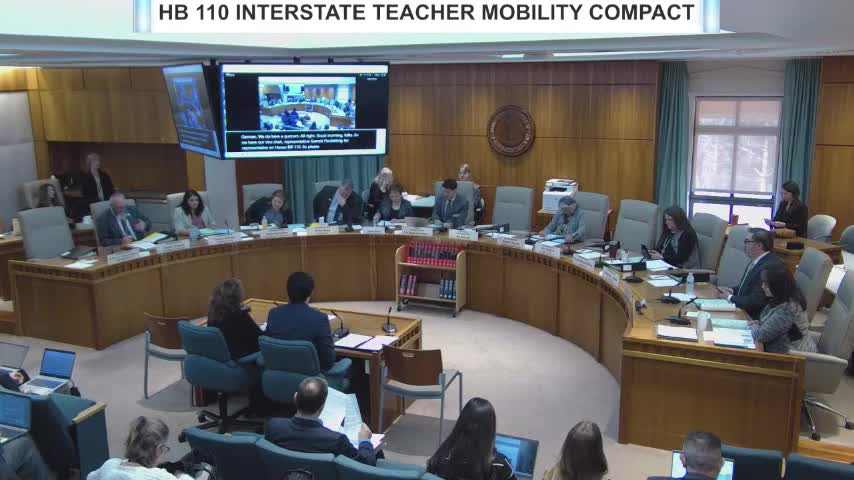
The House Education Committee gave a due-pass recommendation to House Bill 110 on a voice/roll call vote, advancing legislation that would enter New Mexico into the Interstate Teacher Mobility Compact.
The House Education Committee gave a due-pass recommendation to House Bill 110 on a voice/roll call vote, advancing legislation that would enter New Mexico into the Interstate Teacher Mobility Compact.
House Bill 110 would allow an educator who holds an initial, valid and unencumbered teaching license from another compact member state to be granted an equivalent initial license in New Mexico. The compact’s provisions would apply to the initial license issued by the receiving state; renewal or advancement of that license would remain subject to New Mexico’s existing requirements.
Supporters told the committee the compact streamlines credentialing for educators who move between states and said the measure is a Department of Defense priority intended to ease licensing burdens on military families. Adam Dier Singh, a policy analyst with the Council of State Governments’ National Center for Interstate Compacts, described the compact’s development, said a national commission is being stood up and noted the compact’s data system is under construction.
Megan Delarosa, representing the Military Based Planning Commission, told the committee the compact “directly benefits our military families by allowing licensed teachers to transfer credentials across state lines more easily,” and Allison Riley with the New Mexico Chamber of Commerce said the bill would help alleviate teacher shortages by reducing bureaucratic barriers.
Lawmakers asked several procedural and implementation questions. Representative Baca asked whether state-specific requirements—such as fees, constitution exams or timeframes for meeting licensing conditions—would still apply; Adam Dier Singh said states may retain such requirements but the compact intends they be met after the initial license is granted and before the first renewal. Representatives also raised questions about New Mexico’s tiered licensure (levels 1–3), how the compact would map out-of-state licenses to New Mexico levels, and how lifetime licenses issued by other states would be handled. Committee testimony indicated those determinations remain with the state licensing agency and with rulemaking by the Public Education Department (PED).
After discussion, Ranking Member Baca moved a due-pass recommendation and Representative Collin seconded. The committee completed a roll call and the vice chair announced the bill had a due pass recommendation.
The bill’s supporters said it is aimed primarily at teachers who move states frequently—notably military families—and that compact membership has not been shown in other professions to drive professionals to leave their home states. Committee members who supported the bill said they favored passage while seeking follow-up clarifications from PED on implementation details.
No members of the public spoke in opposition during the committee hearing.
A next step will be the bill’s consideration by the full House after the committee report and any required rulemaking clarifications are addressed.