Get Full Government Meeting Transcripts, Videos, & Alerts Forever!
Get email alerts on the Information Technology topic
No spam. Unsubscribe anytime.
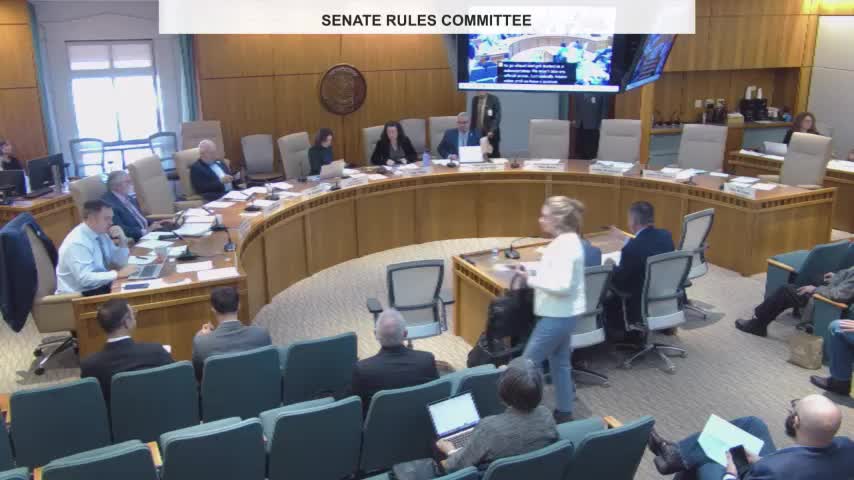
Senate panel advances Manny Barretas as cabinet secretary and state chief information officer
Summary
A Senate Rules subcommittee advanced the nomination of Manny Barretas to lead New Mexico’s Department of Information Technology after testimony on his public-safety experience, plans for broadband and cybersecurity, and questions about centralizing IT and conflicts of interest.
A Senate Rules subcommittee voted to send Manny Barretas’s nomination for Cabinet Secretary and State Chief Information Officer at the Department of Information Technology (DoIT) to the full Senate for confirmation.
Senator Michael Padilla, who sponsored the nomination, told the subcommittee Barretas has “over 26 years of experience in sales, business development, and government relations all in the information technology arena,” and that Barretas has served in an acting capacity at DoIT during a period of transition.
Barretas told the committee he aims to “modernize, secure, and expand New Mexico’s digital infrastructure so that every resident…has access to reliable, cost effective, secure technology.” He highlighted priorities including bridging the digital divide, strengthening cybersecurity, streamlining delivery of government services, investing in IT workforce development, and adopting cloud and automation where appropriate.
Supporters in the hearing pointed to Barretas’s experience with public-safety communications. Pete Casetes, a retired New Mexico State Police chief, said he relied on Barretas’s “straight direct answers” while consolidating dispatch centers and that Barretas “understands” the work. Rick Brown described Barretas’s role in building a countywide radio system now used by “60 plus public safety agencies” with more than 9,000 radios.
Committee members pressed Barretas on several operational and governance questions. Senators raised the fragmented structure of state IT — multiple departments running separate servers and help desks — and asked whether Barretas would pursue centralization. Barretas said he and his team are “working together to try to centralize” IT functions and to adopt a statewide cybersecurity plan in coordination with cabinet secretaries and agency CIOs. He identified the Office of Cybersecurity as a unified function and described the Office of Broadband as administratively attached to DoIT.
Lawmakers also asked about conflicts of interest tied to Barretas’s private-sector background. Barretas said he spent nearly two decades with Motorola Solutions and reported leading multimillion-dollar public-safety contracts, including delivering about $400,000,000 in mission-critical systems. He told the committee he would follow ethics guidelines and recuse himself from decisions that posed conflicts; he also described plans to move procurement and contract work out of DoIT’s enterprise project management office to the General Services Department (GSD) to expedite contracting and reduce redline workload.
On policy questions, senators asked how Barretas would approach artificial intelligence. Barretas said the state currently lacks a standardized AI policy or statute and that his team is working on a “game plan” to standardize AI platforms and governance.
Barretas said DoIT “doesn't really rely on too many federal funds” and that the Office of Broadband, which is administratively attached to DoIT, does pursue federal grants. Committee members noted a previously discussed federal broadband grant of roughly $670,000,000 that could be at risk and asked how DoIT might help protect or accelerate projects tied to such grants.
After public and member remarks, Senator Townsend moved to advance Barretas’s nomination to the full Senate for confirmation. The motion carried; the subcommittee recorded nine votes in favor to move the nomination forward.
If confirmed by the full Senate, Barretas pledged to work in a bipartisan manner to strengthen cybersecurity, expand broadband access in rural and tribal areas, and modernize state IT systems.