Get Full Government Meeting Transcripts, Videos, & Alerts Forever!
Get email alerts on the Homelessness topic
No spam. Unsubscribe anytime.
Knoxville council hears Office of Housing Stability update: warming centers, long wait lists and plan for new Continuum of Care board
Summary
The city’s Office of Housing Stability told the City Council workshop that warming centers sheltered hundreds this winter, coordinated-entry wait lists remain long and a newly constituted Continuum of Care board must approve the office’s strategic plan before it is finalized.
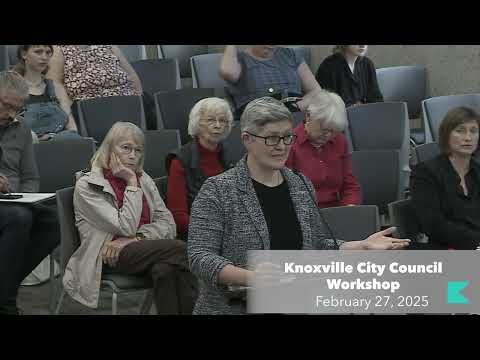
Erin Reed, executive director of the Knoxville Knox County Office of Housing Stability, told the City Council workshop on Feb. 27 that warming centers and coordinated services helped hundreds this winter but that long housing wait lists and limited case-management capacity are trapping people in homelessness.
“On an average day, we have about 2,300 individuals accessing homeless services,” Reed said, noting the daily count has risen from about 1,000 in 2018. She told council members warming centers were open 32 nights between Nov. 29 and Feb. 22 and that “over the course of the entire 32 nights, warming centers provided over 7,600 bed nights.” Reed said the warming centers’ busiest night, Jan. 21, sheltered 387 people in addition to the roughly 370 beds at CARM.
The strategic-context nut graf: Reed described system-level shortages — available housing units, case managers and outreach capacity — that drive a backlog in the city’s coordinated-entry list and slow exits from homelessness. She said that until the city and its partners increase housing and prevention resources, faster case management mainly expands waiting lists rather than shortens them.
Reed summarized system modeling from the Homeless Management Information System and the CHAMP coordinated-entry tool. She said the current CHAMP waiting list would require 586 single-bedroom efficiency units and 91 multi-bedroom units to house everyone who has completed a CHAMP assessment. Reed added that, for people who do get housed after assessment, the average time from assessment to housing is about four months: “it takes a little over 4 months right now.”
Council members pressed Reed on capacity and follow-up. Councilmember Roberto asked whether people who get housed remain so; Reed replied that exit stability rates are high for programs in use locally: “Over 95% of people who go into permanent supportive housing remain, stably housed in the long term,” she said, and she added that the similar outcome applies to rapid rehousing.
Reed described governance changes underway for the local Continuum of Care (CoC), a HUD-defined structure for homeless services. She said consultants were hired to align local governance with HUD standards and that the Homeless Coalition has agreed to form a new CoC board and to delegate lead-agency duties to the Office of Housing Stability. Reed said the new CoC board, which she expects to be constituted in April, “must approve the strategic plan,” and that is one reason a final plan was not yet before the council.
Council members and Reed discussed several operational and policy details raised in public listening sessions and interviews with people with lived experience: the effect of rising housing costs since about 2018, trauma and service aversion among some people who are unsheltered, transportation barriers, and the role of criminal justice records in blocking housing and employment access. Reed said two-thirds of people who became homeless in the fourth quarter of last year became so because of eviction, job loss or inability to find affordable housing; she noted lack of affordable housing was the largest single factor (about 46% of that cohort) and eviction about 10%.
On case management and outreach, Reed told council that while “several dozen organizations” have theoretical capacity to accept coordinated-entry referrals, many have paused referrals because of backlogs. She said the number of agencies actively taking referrals through coordinated entry is “under five” at the moment. Reed also said outreach staffing is below pre‑COVID levels after loss of some funding.
Council members proposed near-term and longer-term responses. Several members urged expanding day‑center or “one‑stop” models where multiple providers share space to triage needs, find small, immediate housing placements and connect people to services; Reed and other council members pointed to existing localized pilots such as CAC’s homeless‑court model as examples. Members also discussed alternatives for more housing supply: rehabilitating motels, promoting smaller units and exploring tiny‑home villages; Reed and others warned such models must include sustainable operations funding and compliance with local zoning and licensing rules.
Reed outlined next steps and a tentative timeline: continued work with providers in March to finalize details, constitution of the CoC board and a first meeting in April, plan approval by that board, and the start of implementing priorities beginning in May. She said the city’s affordable housing fund and federal financing sources (such as tax-credit financing used in prior permanent supportive housing developments) have been instrumental in closing financing gaps for projects already built.
No formal council votes were recorded during the workshop. Reed closed by thanking council members and volunteers and by emphasizing that the strategic plan and the CoC board’s approval are the immediate administrative steps needed before the office will publish a final plan.
Ending: The workshop left clear lines for follow-up: finalize the strategic plan once the CoC board is constituted, complete an after-action review of warming centers to prepare for next winter, and pursue both short-term triage/day-space options and long-term increases in permanent supportive and rapid-rehousing capacity.