Get Full Government Meeting Transcripts, Videos, & Alerts Forever!
Get email alerts on the Equity Agenda topic
No spam. Unsubscribe anytime.
Albany auditor outlines equity agenda audit, urges clearer roles and sustained funding
Summary
Albany’s chief senior auditor presented an audit of the city’s Equity Agenda legislation, saying departments have not consistently followed established procedures for capital projects, streets and parks; commissioners discussed staffing, monitoring and a need for a dedicated office and sustained funding.
Dorcia Plears, Chief Senior Auditor for the City of Albany, presented the results of an audit of the city’s Equity Agenda legislation and urged clearer roles, dedicated staffing and stable funding to implement the law.
Plears told the Human Rights Commission that the Equity Agenda was born of efforts to address the root causes of gun violence, and that the legislation targets social determinants such as education, economic opportunity, housing, health, criminal justice and the built environment. “As a councilwoman I saw it firsthand … if I feel good about where I live, my decisions may look differently,” Plears said.
The audit found inconsistencies between the city’s stated ranking system for streets and the work actually performed. “Yes, the city does rate the streets. But what we found was that even streets that were rated in good condition were still being repaved over streets that were consistently rated poor,” Plears said, describing data that she said forced the engineering department to rethink allocation practices. Plears said similar patterns appeared in parks and capital project planning.
Plears described the violence-prevention elements of the legislation, including a standing violence-prevention task force and allocation of city funding to community organizations that already work on violence prevention. She said the legislation envisions a community-participatory funding process, but audit findings show the city has not yet created the specific account and participatory allocation the legislation calls for. “We were told that the funds were allocated. We met with the mayor’s office and there's supposed to be a specific account for these funds. … That has not happened,” Plears said.
Commissioners and other commissioners in the room pushed back on implementation and staffing. Several speakers said prior staff assigned to the work left or lacked support. One commissioner who served on the earlier task force said the process was “very, very slow” and that the person leading it received insufficient help from the City of Albany. Another commissioner argued that the person hired to coordinate these efforts needs a larger team and not just a single staffer: “I think it should be an office. One person is not gonna be enough,” she said.
Plears recommended better monitoring and public follow-up. She described her own practice as city auditor — publishing audit reports, press releases and sending findings to both the mayor’s office and the City Council — and suggested the Human Rights Commission demand written responses and set deadlines when it submits recommendations. “If you need a written response, I recommend that you in every report … ask for a response by this date,” Plears said, offering her office’s help to follow up.
Commissioners discussed specifics raised by the audit: disparities in lighting, sidewalk conditions, trash pickup and capital investment across wards (Plears highlighted the First Ward and Buckingham Park as examples). Panelists also raised the challenge of measuring racial equity while departments use objective tools that may mask neighborhood disparities — an engineering grading tool, for example, can rate streets objectively but not capture differences in amenities such as flower beds or lighting.
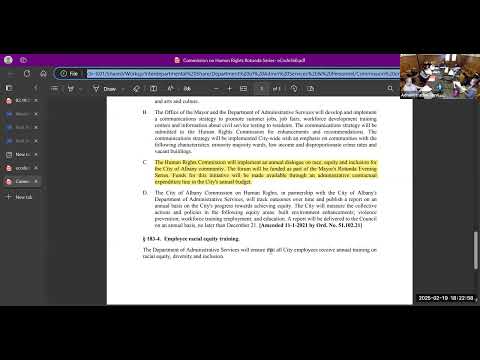
Plears and commissioners discussed tying the commission’s role to monitoring the legislation: the Equity Agenda gives the Human Rights Commission power to review and submit recommendations to the mayor’s office. Plears said parts of the legislation fall to the executive branch (mayor’s office, department heads) and parts to the legislative branch (Common Council). Commissioners agreed the lack of a single, sustained point of accountability has limited progress and recommended asking for a funded office with data analytics support and administrative staff.
Commissioners also accepted an invitation to partner with the Albany Health Task Force and heard that a follow-up Equity Agenda report will be available in May and could be distributed to the task force and to the commission for additional review and metric development.
Votes at a glance
- Motion to adopt the January minutes: moved by Vice Chair Young Wilkins, seconded by Commissioner Alexander; outcome: approved (voice vote). - Motion to establish a standing committee on budgets to prepare future funding requests: moved by Vice Chair Young Wilkins, seconded by Commissioner Luke Love; outcome: approved (voice vote).
The commission discussed next steps including drafting budget requests in time for the 2026 budget season, seeking a dedicated office or expanded staffing for Equity Agenda implementation, and working with the auditor’s office to demand written responses from the mayor’s office and department heads. Plears offered the auditor’s office as a partner to follow up on outstanding items and recommended the commission track recommendations in a single location and request deadlines for responses.