Get Full Government Meeting Transcripts, Videos, & Alerts Forever!
Get email alerts on the Workforce Culture Audit topic
No spam. Unsubscribe anytime.
Albany committee urges audit after staff complaints; $75,000 secured to begin review
Summary
An Albany common council subcommittee reported allegations of discriminatory discipline, problematic shift changes and other workplace issues and said it secured $75,000 for an audit; members outlined a possible audit scope and legal limits under New York law.
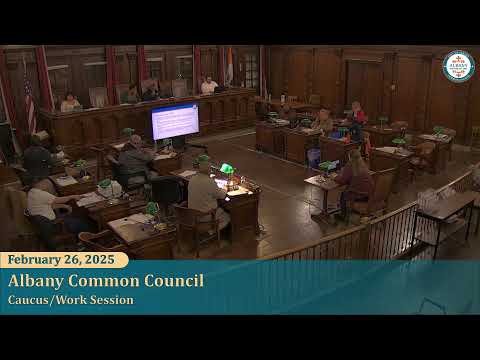
Albany — The Ethics and Workforce Culture Committee reported findings from its first review of workplace complaints at a Feb. 26 Albany common council caucus and work session, saying it has secured $75,000 for an audit and is preparing a request for proposals to investigate allegations including discriminatory discipline, improper shift reassignments and questionable promotion practices.
The committee, which the presenters said was created in September 2024, summarized testimony from about 20 current employees and five to six additional confidential contacts and recommended an audit that could look at overtime records, promotions, discipline consistency, workplace “shop talk” and nepotism policies. "We advocated for and secured $75,000 for the Office of Audit and Control to conduct an audit into the allegations received during this past fiscal year," said Megan, a committee member and presenter.
The report said the committee had already obtained council approval for a separate resolution to secure documents tied to public comments on the allegations; reviewers are awaiting completion of the city’s redaction process before staff and committee members can inspect records. Committee members said the city consolidated two separate reporting policies into one unified policy and recommended additional procedural changes.
Why it matters: Committee members described allegations that could affect job security and payroll integrity for several low-paid city employees and argued an independent audit is necessary to determine whether discipline and payroll practices were applied consistently across departments. The committee cautioned that legal constraints under state law will limit how far a personnel-focused audit can pursue historic disciplinary charges.
Key findings and concerns - Contract provisions and discipline: The committee flagged contract language in the blue-collar workers’ agreement that it described as discriminatory or outdated — including parental-leave language that guaranteed extended parental leave only to pregnant employees and not to adoptive or non–birthing parents. Committee members urged the city and the union to consider negotiating revisions, but noted that collective-bargaining rules mean both sides must agree to reopen specific clauses.
- Shift changes and attendance discipline: Testimony summarized in the report alleged that managers shifted employees’ work hours in ways that made some employees vulnerable to attendance discipline, including suspensions without pay. The committee said the contract allows the city to place employees off payroll for up to 30 days while a disciplinary grievance proceeds; committee members described that outcome as especially harmful for lower-paid employees.
- Payroll and overtime allegations: Committee members told the council that one frequent allegation involved the misuse of overtime — described by witnesses as "no-show overtime" potentially paired with improper exchanges of goods or services. The presenter cautioned that some conduct, if proven, could carry criminal exposure and would be treated differently than ordinary disciplinary matters.
- Promotions and favoritism: Several witnesses alleged promotions or assignments that bypassed qualified candidates. The committee recommended the audit review promotion records and the documentation used to justify advancement decisions.
Scope, process and legal limits The committee outlined possible audit components: review of overtime with corroborating logs and GPS data, promotion decisions, application and consistency of discipline across departments, and assessment of workplace culture via surveys or interviews. The presenter warned the council that Article 75 of the New York State Civil Service Law limits disciplinary review windows: "you have 18 months to issue charges," she said, noting the committee cannot use the audit as a broad, retrospective "fishing expedition." The presenter also said criminal findings (for example, repeated false overtime clock-ins) would change the review pathway and could involve public officers' law violations.
Records, redactions and next steps Committee members said they secured a council resolution to obtain documents referenced in public comments but that the city is still redacting personal information. The funds the committee identified would be administered by the Office of Audit and Control; the presenter said the $75,000 allocation was secured but warned that if the city does not contract and spend the money within the current fiscal year the funds could revert to the general fund and would have to be re-budgeted.
Questions from council members focused on the number and mix of witnesses and on whether the union had previously raised similar contract concerns in bargaining. Council Member Robinson asked, "How many employees were interviewed, came forward?" Megan replied that the committee summarized testimony from roughly 20 employees and five to six confidential contacts and reiterated that the report weaves public and private statements together while preserving confidentiality where requested.
What comes next Committee members asked the full council for feedback on the audit scope after they complete a preliminary review of requested records. The immediate tasks are to (1) complete the document review once redactions are finished, (2) finalize the audit scope and issue an RFP in collaboration with the Office of Audit and Control, and (3) negotiate timing so the allocated funds can be committed before the end of the fiscal year if the council wishes to proceed.
The Ethics and Workforce Culture Committee met Sept. 25 and Dec. 4, 2024, and presented this update at the Feb. 26 caucus and work session. The committee recommended the council and administration weigh contract negotiation as one avenue for remedying structural concerns but noted that bargaining outcomes require agreement between the city and each union.