Get Full Government Meeting Transcripts, Videos, & Alerts Forever!
Get email alerts on the State Budget And Tax Policy topic
No spam. Unsubscribe anytime.
Governor pushes half-point tax cut, cites $4.6 billion savings and conservative budgeting
Summary
At a press event at the Oklahoma State Capitol, the governor said he will pursue a half-percentage-point income tax cut and a “path to 0,” while defending the state’s $4.6 billion in savings and a conservative revenue forecast; he acknowledged competing financing needs including a mental-health consent decree and hospital funding.
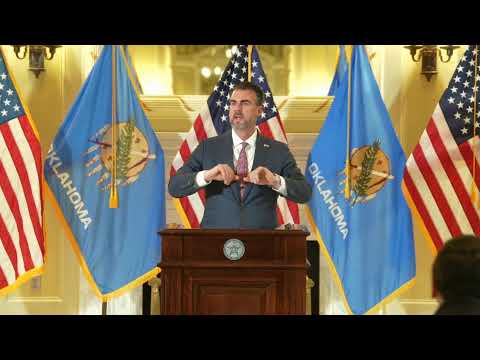
The governor told reporters at the Oklahoma State Capitol that he will seek a half‑point income tax cut this session and a “path to 0,” while saying the state has built “the largest savings account we’ve ever had.”
The governor said the state currently has $4,600,000,000 in savings and emphasized conservative budgeting. He noted appropriations rose from about $8,000,000,000 in February 2019 to over $12,000,000,000 and said that his administration aims to limit annual base spending growth while allowing strategic investments. “We need more taxpayers, not more taxes,” he said.
Why it matters: The governor framed the tax plan as a means to return funds to residents and to keep Oklahoma competitive for businesses, while acknowledging that agencies and programs will still press for more revenue. He named specific competing claims on the budget: a mental‑health consent decree and hospital funding needs.
Details and context The governor said the state will receive Board of Equalization estimates on Feb. 14 that set the legislature’s spending limit for the session. He described the administration’s approach to forecasting as conservative and said historically Oklahoma has outperformed its revenue estimates under his administration.
Asked how a significant tax cut would square with agency requests, the governor replied that “government will spend every dime that you give them” and that there must be limits on annual spending growth. He said he is “not saying we can’t strategically invest in infrastructure or a mental health hospital,” but repeated that a lower tax burden encourages economic growth.
The governor also cited last year’s elimination of the grocery tax as an example of prior tax policy changes intended to ease costs for working families.
Unresolved details The governor provided target policy goals (a half‑point cut and a path to zero) but did not specify the fiscal mechanics, estimated fiscal impact for the upcoming fiscal year, or a legislative bill number. He also did not provide a precise price tag for the mental‑health consent decree or the hospital funding request; those figures were described only as budgetary needs raised by state agencies.
Next steps The Board of Equalization estimate on Feb. 14 will set the available appropriation level for the legislature to consider the governor’s proposed cut and competing funding needs.