Get Full Government Meeting Transcripts, Videos, & Alerts Forever!
Get email alerts on the Committee Votes Roundup topic
No spam. Unsubscribe anytime.
Ways & Means advances dozens of bills to Rules with fiscal notes on housing, education, online safety and health
Summary
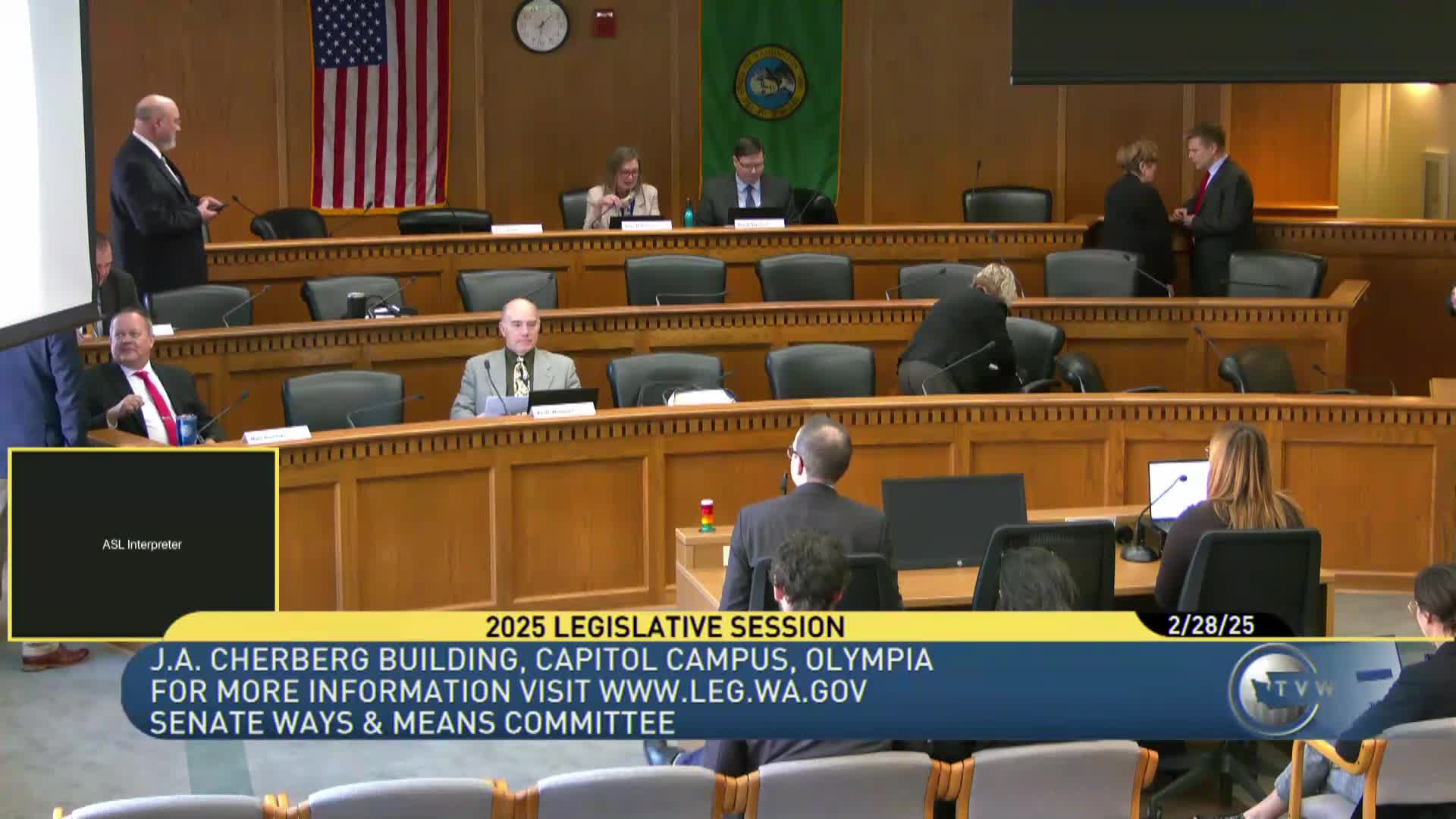
The Washington Senate Ways & Means Committee met in executive session on Friday, Feb. 28, and advanced a large packet of bills to the Rules Committee, recommending many for passage and reporting a small number without recommendation.
The Washington Senate Ways & Means Committee met in executive session on Friday, Feb. 28, and advanced a large packet of bills to the Rules Committee, recommending many for passage and reporting a small number without recommendation. The committee discussed fiscal notes, several adopted amendments and a handful of bills that it did not act on during the session.
The committee’s work at the fiscal cutoff focused on measures with near‑term or multi‑biennium fiscal impacts, including housing bills, education funding changes, online protections for minors and several health‑ and long‑term‑care–related proposals. Staff briefings accompanying the packet cited newly published fiscal notes for multiple bills; committee members debated amendments and, in a number of cases, rolled adopted amendments into second substitutes before voting.
Among the bills the committee discussed at length were substitute Senate Bill 5,469, a measure to prohibit certain uses of rental‑market data and algorithmic tools to recommend rents to landlords; substitute Senate Bill 5,496, which would limit certain entities’ ownership of single‑family homes and create enforcement under the Consumer Protection Act; and substitute Senate Bill 5,708, a package of restrictions on online services’ treatment of minors that would limit profiling and the use of “dark patterns.” Staff presented fiscal notes for those bills: SB 5,469 included an updated estimate of roughly $415,000 in state funds over the 2025–27 biennium for attorney‑general investigations and support; SB 5,496 showed estimated costs of about $468,000 in total state funds in 2025–27; and SB 5,708 carried estimated impacts of about $470,000 in total state funds for the current biennium and $898,000 over the outlook period, largely to the Attorney General’s Office for investigations and litigation.
The committee also considered housing‑related measures with larger fiscal notes and programmatic effects. Substitute Senate Bill 5,613 (clear and objective development regulations and a Commerce model code) carried a fiscal estimate of about $766,000 in 2025–27 and $1.2 million over four years; Senate Bill 5,587 (biennial housing report enhancements) had an estimated $309,000 GFS cost in 2025–27; and a set of bills addressing school funding and enrollment calculations (including proposed constitutional changes) were discussed with larger, sometimes indeterminate, estimated fiscal consequences.
On education and workforce issues, substitute Senate Bill 5,358 (prototypical funding for sixth‑grade career and technical education) arrived with an indeterminate fiscal impact but an estimated $1.3 million general‑fund figure in staff briefings; the committee adopted an amendment (offered by Senator Wellman) that removes sixth graders from the prototypical funding model while allowing districts to offer CTE to sixth graders, which staff said would reduce the state fiscal impact to zero if adopted.
Several bills affecting health, long‑term care and the Developmental Disabilities Administration drew fiscal analysis and substitute language. Staff briefed the committee on SB 5,211 (parent care waiver changes for DDA), SB 5,337 (memory care certification for assisted living), and SB 5,394 (changes to the DDA no‑paid‑services caseload), among others. Staff presented a proposed substitute for the parent care waiver that would require the Department of Social and Health Services to submit a CMS waiver request and noted costs would be subject to appropriation.
Some bills produced focused debate over specific amendments. On substitute SB 5,496 (limits on ownership of single‑family homes), the committee adopted Amendment 1 clarifying foreclosure‑acquisition exemptions and voted down Amendment 2, offered by Senator Gildan, after he argued the amendment would align the bill with exemptions for banks and financing arrangements: "the intent of this bill is to, mitigate the impact of, large home buyers, but it doesn't mean to prohibit banks and financial institutions from the purposes of the bill," Gildan said. On SB 5,708 (online protections for minors), Senator Wagner urged support for an amendment that preserves parents’ ability to be notified when they monitor a minor’s account: "This amendment will remove the requirement that the minor know if their parents are monitoring that," Wagner said, urging that parental involvement be supported.
The committee voted on most bills in the packet. Many measures received a "due pass" recommendation to the Rules Committee (the committee’s recommendation on whether a bill should proceed), several were adopted as second substitutes with amendments rolled in, and at least one bill (substitute SB 5,486, open motion picture captioning) was reported out without recommendation to Rules. A small number of bills were not acted on in the session and were held from the vote list.
Votes at a glance (selected bills and committee actions): - Substitute Senate Bill 5,486 (open motion picture captioning): Reported without recommendation to the Rules Committee (motion moved and seconded; voice vote). Motion mover: Mr. Vice Chair. Note: staff indicated the fiscal estimate arrived after referral and was below referral threshold. - Substitute Senate Bill 5,469 (algorithmic rent fixing): Committee gave a due‑pass recommendation to Rules. Fiscal note: estimated $415,000 total state funds in 2025–27 (AGO investigations/support). Motion mover: Senator Stanford. - Substitute Senate Bill 5,496 (limits on ownership of single‑family homes): Committee voted to give a due‑pass recommendation to Rules after adopting Amendment 1 (clarifying foreclosure exemptions) and rejecting Amendment 2. Fiscal note: estimated $468,000 total state funds in 2025–27. Motion mover: Senator Stanford. - Senate Bill 5,708 (online protections for minors): Committee adopted Amendment 3 and Amendment 5, rolled them into the substitute, and gave SB 5,708 a due‑pass recommendation to Rules. Fiscal note: roughly $470,000 in 2025–27 and $898,000 over the outlook period to the AGO. Motion mover: Senator Stanford. - Substitute Senate Bill 5,358 (sixth‑grade CTE funding): Committee adopted Amendment 7 (offered by Senator Wellman) removing sixth graders from the prototypical funding model and gave the second substitute a due‑pass recommendation to Rules. Staff said the amendment would make the fiscal note zero if adopted. Motion mover: Senator Stanford. - Substitute Senate Bill 5,613 (clear and objective residential development regulations): Committee adopted proposed second substitute 10 (Senator Trudeau) and gave the bill a due‑pass recommendation to Rules. Fiscal note: about $766,000 in 2025–27 and $1.2 million over four years. - Substitute Senate Bill 5,686 (foreclosure mediation expansion with an $80 fee): Committee adopted Amendment 11 and recommended the second substitute to Rules; staff said additional program costs should be covered by the new fee revenue (estimated roughly $7 million per fiscal year to the Foreclosure Fairness account). Motion mover: Senator Trudeau. - Substitute Senate Bill 5,355 (safety and survivor rights at higher‑education institutions): Committee adopted proposed second substitute 16 (Senator Hansen) and recommended the bill to Rules. Staff estimated a fiscal impact of roughly $23 million in 2025–27 and $46 million over four years for the substitute as briefed; committee staff said the proposed second substitute could reduce the fiscal note to zero. - Substitute Senate Bill 5,628 (lead in cookware): Staff reported an updated fiscal note reducing impacts to zero; committee recommended the substitute to Rules. Motion mover: Senator Stanford. - Substitute Senate Bill 5,703 (waste‑to‑energy CCA treatment for municipal facilities): Committee adopted Amendment 20 and recommended the substitute to Rules; staff noted a potential $4.6 million reduction in Climate Commitment Act revenues related to the Spokane facility beginning in FY27.
What the committee did not act on: the chair identified a set of bills that would not be taken up in the session, including substitute SB 5,066, SB 5,422 (one of the earlier referenced items), and others noted at the start of each packet’s voting slate.
The committee’s packet included many more bills and fiscal notes than can be summarized in one article; staff repeatedly told members that multiple fiscal notes were updated or newly available for bills in the packet and that a number of bills carried indeterminate costs subject to appropriation. Where a bill was discussed and an amendment adopted on the floor, the committee typically rolled the amendment into a second substitute and then moved the substitute to Rules. Meeting participants repeatedly emphasized that signatures and clerical matters (for a gubernatorial appointment form) would be addressed separately.
The committee will forward the bills it recommended to the Rules Committee; each measure’s next step and any further fiscal adjustments will be set during subsequent floor and budget proceedings.