Get Full Government Meeting Transcripts, Videos, & Alerts Forever!
Get email alerts on the Appropriations Committee Roundup topic
No spam. Unsubscribe anytime.
House Appropriations Committee advances scores of bills, debates interpreter costs, competency services and housing near transit
Summary
The House Appropriations Committee met for hearings and an executive session and reported a large package of bills out of committee on a wide range of policy areas, including court interpreter funding, competency restoration services, K‑12 funding items and transit‑oriented housing rules.
The House Appropriations Committee held an extensive meeting and executive session to consider staff briefings, amendments and final committee votes on a large set of bills covering court access, behavioral health, education funding, environmental policy and housing near transit. The committee adopted and reported a number of bills out of committee with “do pass” recommendations and debated several fiscal and policy tradeoffs.
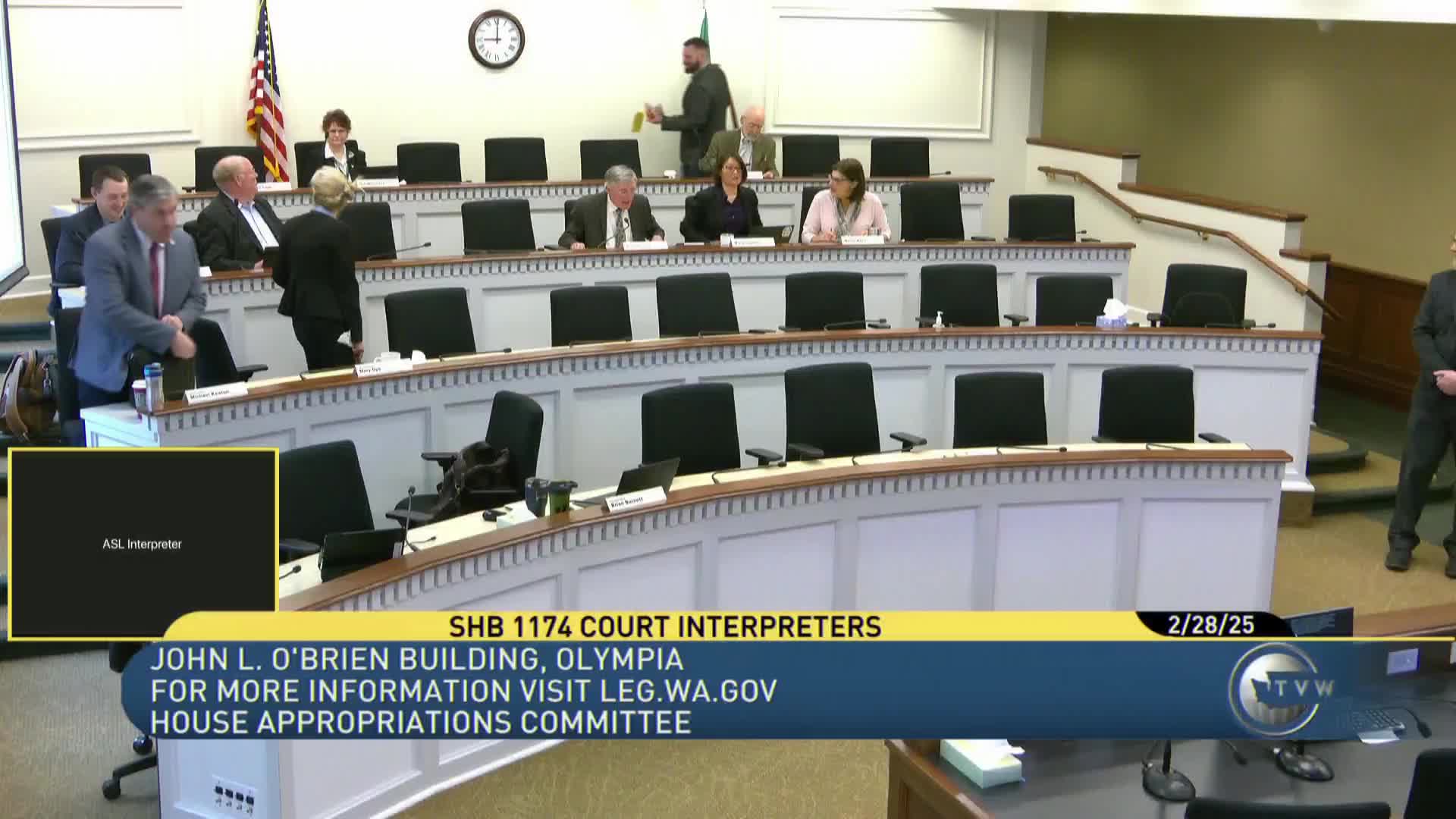
At the opening of the executive session the committee considered substitute House Bill 1174, which updates statutory provisions relating to the court interpreter program administered by the Administrative Office of the Courts (AOC). Committee members adopted Representative Peterson’s amendment (Walker 4-38) that removed added fiscal impacts and the committee reported the bill out with a due-pass recommendation. Debate centered on access to justice and which entities should bear interpreter costs in some court-related proceedings.
The committee also spent substantial time on House Bill 1218, which revises competency evaluation and restoration services for criminal defendants. Staff described a proposed second substitute that would have required the Department of Social and Health Services (DSHS) to establish a growth-cap program and potentially assess penalties to counties and cities that exceed baseline inpatient-competency referral caps; Representative Caldier offered an amendment (Adams 160) to strike the growth-cap and related penalties (that amendment failed), and a standard null-and-void amendment was adopted. Members debated use of carrots and sticks to incentivize local diversion and restoration services and concerns about rural capacity, workforce and potential penalties. The committee reported the bill with a due-pass recommendation.
Education bills drew lengthy fiscal discussion. Substitute House Bill 13 38 would increase the per-pupil maintenance supplies and operating costs (MSOC) allocation; committee amendments trimmed the original proposal, produced significant debate about accountability and permitted uses of MSOC funds, and the committee reported the measure to the floor with a do-pass recommendation after a close roll call. Substitute House Bill 13 57, concerning special education multipliers and pilot grants for inclusionary practices, was amended to change pilot counts, safety-net timing and accounting methodology; staff briefed a multi‑hundred‑million dollar four-year fiscal outlook for the underlying proposals, and the committee reported the substitute with a due‑pass recommendation.
On environmental and land-use matters, substitute House Bill 13 03 added an environmental-justice element to SEPA; amendments reduced some Ecology rulemaking and added reporting for local lead agencies. Substitute House Bill 14 91 (transit-oriented development, TOD) generated extended debate about affordability requirements and local flexibility; the committee adopted a set of amendments that changed some affordability targets, added ability for local exemption by ordinance, and shifted the effective date in one amendment; the third substitute was reported out.
Other highlights: - House Bill 12 93 (littering) originally included a Department of Ecology task force; an amendment removed the task force and associated one-time costs. Committee members debated the scale of litter and the value of a funded task force versus immediate cost savings. - House Bill 15 83 expanded Medicaid reimbursement options for traditional Indian medical practitioners and was reported out after committee adoption of a null-and-void amendment to preserve bill formatting. - House Bill 18 34 (Attorney General request) on protections for minors and online services drew many amendments on scope, age-estimation retention and library filtering; the committee adopted a number of technical and policy changes and reported the bill with a due-pass recommendation.
Votes at a glance (committee outcomes and roll-call tallies): - Substitute HB 11 74 (court interpreters) — adopted amendment Walker 4-38; reported out, due pass (18 ayes, 12 nays, 1 excused). - Proposed second substitute HB 12 18 (competency evaluation/restoration) — reported out, due pass (17 ayes, 13 nays, 1 excused); amendment Adams 160 (strike growth-cap) failed; standard null-and-void adopted. - HB 12 71 (technical/null-and-void amendment adopted) — reported out, due pass (30 ayes, 0 nays, 1 excused). - Substitute HB 12 73 (CTE dual-credit pilots) — adopted amendments reducing pilot sites and other changes; reported out, due pass (29 ayes, 0 nays, 2 excused). - Substitute HB 12 85 (financial-education graduation requirement) — adopted amendments removing certain reporting burdens; reported out, due pass (29 ayes, 0 nays, 2 excused). - HB 12 93 (littering penalties; task force removed) — reported out, due pass (22 ayes, 6 nays, 3 excused). - Substitute HB 13 03 (environmental justice element for SEPA) — adopted multiple amendments including mitigation guidance and local reporting; reported out, due pass (17 ayes, 13 nays, 1 excused). - HB 13 27 (horse racing statute updates) — reported out, due pass (26 ayes, 4 nays, 1 excused). - Substitute HB 13 38 (MSOC increase) — multiple amendments on allowable uses and reporting; reported out, due pass (16 ayes, 15 nays, 0 excused). - Substitute HB 13 57 (special education/inclusion pilots and multipliers) — multiple amendments adjusting pilot counts, safety net distribution and accounting; reported out, due pass (28 ayes, 3 nays, 0 excused). - Second substitute HB 13 91 (juvenile diversion, amended to remove some grant elements) — reported out, due pass (30 ayes, 0 nays, 1 excused). - HB 14 60 (protection-order hope card technical changes) — reported out, due pass (30 ayes, 0 nays, 1 excused). - Third substitute HB 14 91 (transit oriented development: TOD) — multiple amendments; reported out, due pass (19 ayes, 11 nays, 1 excused). - Second substitute HB 15 16 (condominium insurance / affordable homeownership analysis) — reported out, due pass (26 ayes, 4 nays, 1 excused). - Second substitute HB 15 49 (apprenticeship / on-the-job training incentive) — reported out, due pass (30 ayes, 0 nays, 1 excused). - Second substitute HB 15 83 (traditional Indian medical practitioner Medicaid reimbursement; 11/15 waiver authorization) — reported out, due pass (30 ayes, 0 nays, 1 excused). - Second substitute HB 15 87 (Opportunity Scholarship local-government partner pilot changes) — reported out, due pass (19 ayes, 11 nays, 1 excused). - Second substitute HB 16 14 (capital gains tax technical corrections) — reported out, due pass (20 ayes, 10 nays, 1 excused). - HB 16 47 (DNR request legislation; reclamation fees/procedures) — reported out, due pass (20 ayes, 10 nays, 1 excused). - Second substitute HB 16 62 (boards and small education-related entities administratively independent of OSPI; implementation delay amendment adopted) — reported out, due pass (30 ayes, 0 nays, 1 excused). - Second substitute HB 18 13 (behavioral health crisis services; second substitute narrowed some carve-outs and directs HCA to prepare for procurement rather than immediately carve out crisis facilities) — reported out, due pass (23 ayes, 7 nays, 1 excused). - Second substitute HB 18 34 (online protections for minors; Attorney General request bill with multiple amendments adopted) — reported out, due pass (18 ayes, 12 nays, 1 excused). - Second substitute HB 19 12 (renewable project tax/technical changes) — reported out, due pass (26 ayes, 4 nays, 1 excused). - Second substitute HB 19 60 (renewable energy excise structure; local/state split of rate; second substitute adopted) — reported out, due pass (30 ayes, 0 nays, 1 excused). - HB 19 69 (law enforcement aviation support/grant program; administrative changes adopted) — reported out, due pass (30 ayes, 0 nays, 1 excused). - Substitute HB 20 15 (local criminal-justice grant program funded by optional local 0.1% sales tax; amendments adopted clarifying eligibility and deadline) — reported out, due pass (18 ayes, 12 nays, 1 excused).
What mattered - Access to courts: HB 11 74 prompted unanimity on the policy goal (interpreter access) but division over fiscal and implementation details and who pays in specific settings. - Behavioral health and competency services: HB 12 18 rekindled earlier debates about statewide capacity, local incentives and potential penalties for exceeding inpatient baselines; members debated penalties for local governments and ways to encourage local restoration options. - Education funding accountability: HB 13 38 (MSOC) produced intense debate about whether to protect categorical funds tightly or preserve local flexibility; multiple amendments attempted to balance added MSOC funding against reporting and accountability mechanisms. - Housing near transit: HB 14 91 produced a long debate over affordability targets, the role of tax incentives and the limits of local control versus statewide supply goals.
What’s next Bills reported out of committee will go to the House floor for further action. Several measures (notably competency services, transit‑oriented development and special education funding) contain appropriations or fiscal impacts that will be considered in the broader budget process.
Sources and evidence This article is based on the committee transcript of the House Appropriations Committee meeting that recorded staff briefings, amendment offers and roll-call votes. The article does not infer actions beyond the transcript. Specific fiscal estimates, cost ranges and amendment text described here are those provided aloud by nonpartisan committee staff during briefings and are noted in committee minutes.
Ending note Committee members repeatedly emphasized the limited time and tight fiscal environment this year, and many of the bills carried amended language that reduced initial costs or delayed effective dates. Several members said they expect continued negotiations on the floor and in budget negotiations before final policy or funding outcomes are reached.