Get Full Government Meeting Transcripts, Videos, & Alerts Forever!
Get email alerts on the Property Tax Reform topic
No spam. Unsubscribe anytime.
Sen. Kauth reintroduces Prop. 13‑style constitutional amendment; opponents warn of revenue, uniformity risks
Summary
Senator Kathleen Kauth presented LR 12 CA, a proposed constitutional amendment modeled on California’s Proposition 13 that would cap annual assessment growth and set fixed taxable bases; municipal and county groups warned of uniformity and budget impacts.
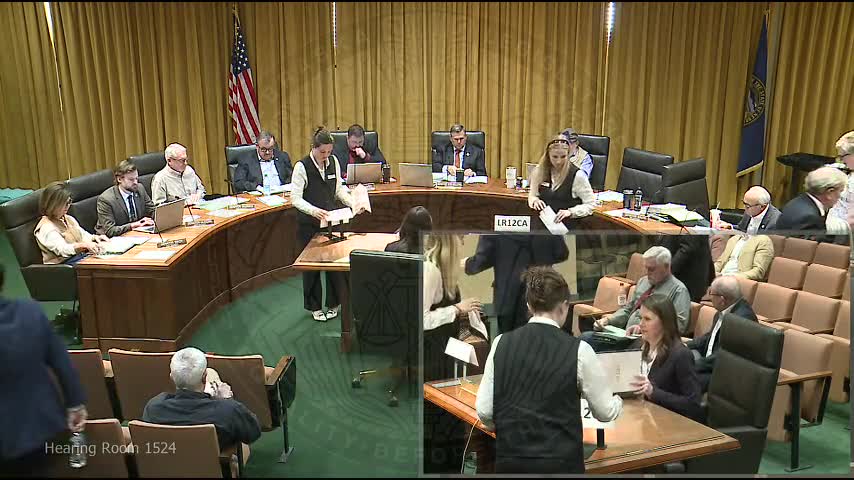
Senator Kathleen Kauth told the Revenue Committee she filed LR 12 CA to begin discussion of a property‑tax constitutional amendment modeled on California’s Proposition 13 that would change how residential and agricultural property is assessed and taxed. She said the measure would provide predictability for homeowners by capping reassessment growth and tying taxable value to the sale price (her initial proposal referenced a 1.5% base for residential property).
Kauth said the proposal is intended to protect homeowners — particularly seniors and people on fixed incomes — from sudden, steep increases in property tax bills tied to rapid market appreciation. “The goal of the CA is to not hurt schools, it's to not hurt the counties, it's to not take money away from anyone but it is to put a pin in what people are experiencing with their property tax,” she said.
Opponents from municipal and county associations, chambers of commerce and policy groups told the committee the amendment would undermine the uniformity clause in Nebraska’s constitution, create fiscal instability for local governments and likely shift costs to other taxpayers or state general revenues. John Cannon, executive director of the Nebraska Association of County Officials (NACO), and Lynn Rex of the League of Nebraska Municipalities said the proposal would remove uniformity and introduce wide valuation disparities between neighboring properties that have changed hands at different times.
Key points from testimony - Sponsor’s intent: Kauth said LR 12 CA is meant to provide predictable, stable property tax liabilities by fixing taxable value at a base sale price with a modest annual escalator (she noted 1.5% as an example for residential property and suggested 1.125% for agricultural land in early drafts). She said the proposal aims to spare people from being priced out of their homes by rapid valuation increases. - Opponents’ fiscal and legal concerns: Witnesses warned a constitutional assessment limit would force the state or other taxpayers to backfill substantial revenue declines for schools, cities and counties, citing California’s long experience after Prop 13. NACO and municipal witnesses emphasized the constitution’s uniformity clause and assessment‑to‑market requirements used by county assessors. - Technical proposals and alternatives: Several neutral and proponent testifiers recommended more targeted or technical reforms, such as county reassessment schedules, different treatment for non‑owner occupied or commercial property, or circuit‑breaker style tax credits. Witnesses urged careful design to avoid shifting burdens to renters, businesses or other taxpayers.
Committee discussion Committee members pressed the sponsor and witnesses on how the amendment would affect agricultural land, how to avoid a long‑term revenue cliff for local governments, and whether alternatives such as valuation caps, circuit breakers or targeted relief would better meet policy goals. The hearing record includes multiple proponent and opponent letters and a range of technical suggestions from property‑tax experts.
No committee vote occurred; the hearing closed after sponsor and stakeholder testimony. Because LR 12 CA is a proposed constitutional amendment, proponents and opponents emphasized constitutional and budgetary consequences rather than a near‑term statutory change.