Get Full Government Meeting Transcripts, Videos, & Alerts Forever!
Get email alerts on the School Budget And Facilities topic
No spam. Unsubscribe anytime.
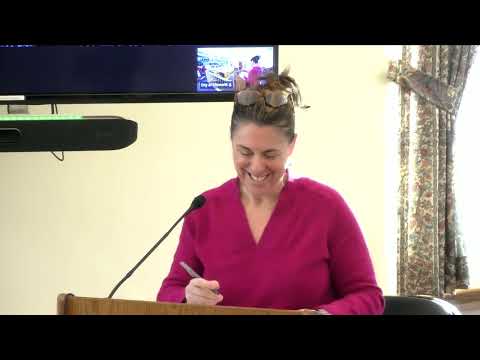
Ellsworth school official outlines grant reliance and urgent track repairs, proposes TELP phase 2 to fund lights
Summary
Amy, a school department official, told the Finance Committee that the district relies on a mix of federal and state grant programs that “help offset our local budget,” and warned that potential changes to federal funding could force “drastic reconfiguration” of staff and services.
Amy, a school department official, told the Finance Committee that the district relies on a mix of federal and state grant programs that “help offset our local budget,” and warned that potential changes to federal funding could force “drastic reconfiguration” of staff and services.
Amy said the district’s federal grant receipts include ESEA funds (Title I, II, IV and V), local entitlement for special education, Perkins/CTE grants for Hancock County Technical Center, and COVID-era funds to prevent student homelessness. She said state grants and smaller federal awards also support adult education, family literacy and technology (Teach with Tech). “This kind of gives you a picture. It's a lot of money that helps offset our local budget,” she said.
Nut graf: The presentation framed two budget risks for FY26: (1) a heavy reliance on grants that could change with state or federal decisions, and (2) an immediate facilities need at the high-school track that Amy said is unsafe for championship competition and has both lighting and resurfacing components she estimates could exceed $1 million.
On grants and staffing, Amy said some grant lines pay for positions and program-specific supplies and professional development; she noted that local entitlement for special education covers staffing and specialized instructional materials that are not in the local budget. She said the district has been advised by the superintendents association not to assume continuation of all federal funds when preparing the local budget and that the district will present a fuller accounting at the formal budget presentation.
Amy listed current grant efforts: applications for a comprehensive after‑school program and a Rural Utilities Service (RUS) grant to support instructional technology upgrades and classroom standardization, both described as competitive.
On the athletic facility, Amy said the track is “dangerous” and that the district likely will need to close parts of the track this spring; she said the lights are “now gonna be really unsafe” and that resurfacing plus lights “is probably gonna be over a million dollars.” She described a school reserve earmarked for lights of about $100,000 and said an estimated cost for lighting alone ranges from about $230,000 to $300,000 depending on scope and whether existing poles can be reused. Amy added that resurfacing work carries long lead times and currently has roughly a one‑year scheduling delay.
Amy proposed including the lighting portion in a TELP phase 2 package being prepared by EMC (the contractor who managed a recent phase 1 TELP project). She said phase 1 produced significant energy and facilities improvements and that rolling lights into a broader efficiency project could reduce net annual budget hits via TELP payments and energy savings. “We would look to do a TELP again like we did with phase 1,” she said, and added that a phase 2 TELP proposal and budget details would be presented to the council after the Facilities Committee meeting where EMC will present specifics.
Committee members asked technical questions about life expectancy of a track, bonding as a financing option, whether lights could be installed without interfering with later track resurfacing, and whether poles need replacing. Amy said contractors had told staff that poles could generally be reused and that poles sit outside the fenced track area, so lights could be installed without preventing later resurfacing work. She said some proposals suggested adequate lighting could be achieved with four rather than six poles, and that EMC project management would firm up scope and excavator/electrical sequencing prior to work.
Amy asked for guidance on whether the city and school would split cost shares (one suggested split was one‑third school, one‑third city, one‑third private fundraising) and whether the city would commit to pursuing the lighting portion now. Several committee members expressed support for pursuing lights through the TELP phase 2 approach and for including the project in the FY26 budget process while recognizing final approval must come through the formal budget and council process.
Ending: Amy said the schools will bring detailed TELP numbers, estimated TELP match and payment schedules, and grant application status back to the council and Finance Committee at upcoming meetings; she said she will return in two weeks with further budget materials and that the phase 2 TELP presentation will be discussed at the Facilities Committee prior to coming to the council.